It’s hard to look ahead by looking back, but since there’s no alternative it’s everyone’s favorite sport.
So it goes in economic forecasting. We’re all reliant on yesterday’s numbers. Beggars can’t be choosy, but they’re always busy, which brings us to this morning’s update on retail sales for February. The news isn’t good, but it’s not necessarily getting worse, or so it appears. For the moment, that constitutes progress and perhaps even reason for hope.
As our chart below shows, retail sales contracted in February by a slight 0.1% on a seasonally adjusted basis. That’s no reason to cheer, but it’s a heck of a lot better than the steep 1%-3% monthly drops in the last four months of last year.

January’s 1.8% advance for retail sales suggested that maybe the bleeding had stopped, although that idea is again on the defensive in light of last month’s modest setback.
Monthly Archives: March 2009
THE TROUBLE WITH JAPAN
Japan has been a thorn in portfolio strategy’s side for over a decade, and more of the same is on tap for the foreseeable future.
As the world’s second-largest economy after the U.S., with a stock market capitalization to match, Japan looms large as an influence in the global economy and the capital and commodity markets. Unfortunately, the influence has been largely negative since the early 1990s on matters of asset allocation.
WHEN WILL IT END?
Another monthly employment update, another dismal report. So it goes in a vicious recession. The only question: When will it end?
We take a stab at some perspective below, but first let’s recap this morning’s ugly numbers. Last month suffered another sharp fall in nonfarm payrolls, the U.S. Bureau of Labor Statistics reports. The economy lost 651,000 jobs in February—the 14th consecutive month of payroll declines and the third month of losses above the 600,000 mark. In this year’s first two months alone the economy has already shed nearly 1% of total nonfarm payrolls. Unfortunately, the outlook for March doesn’t look good either.
That brings us to the burning question: When will this nightmare end? We don’t have the answer, nor does anyone else. That said, a fair reading of the economic data, including a review of past recessions through history, suggests that the bleeding will go on for some time. That’s just a guess, of course. Can we do better than simply guessing?
TALKING ABOUT ASSET ALLOCATION ON THE INSIDE VIEW PODCAST
The bear market is roaring, investors are running for cover and the economic fallout is everywhere. Casual observation suggests that asset allocation is among the victims, or so it appears.
Dismissing the concept of multi-asset class investing is easy these days, not to mention tempting. Many corners of the capital and commodity markets are licking wounds, leaving virtually no place to hide. But this is no time to abandon asset allocation, as our two guests on today’s edition of The Inside View explain.
Strategic perspective, in short, is essential for recognizing the power of asset allocation through time, including tough times. But perspective tends to take a holiday in bear markets, which compels most investors to consider only the recent past. That risks ignoring the opportunities that arise in periods of high stress and lofty price volatility. So says our first guest, Gary Brinson, a veteran money manager and strategist whose name is most familiar as a co-author of a famous 1986 research study that helped put the concept of asset allocation on the investment map, so to speak. These days, Brinson is president of GP Brinson, a Chicago investment firm in Chicago. He’s also a board member at The Brinson Foundation.
Our other guest is Adrian Cronje, director of asset allocation at Wilmington Trust. Cronje is an expert in asset allocation and he shares his thoughts, as does Brinson, on how to think about strategic portfolio design in the current environment.
As a preview, this is no time to abandon asset allocation. To understand why, tune in…
Please visit CapitalSpectator.podbean.com for additional options with episodes of The Inside View.
THE VALUE PROPOSITION…
In your editor’s “other” life as an independent financial journalist, the resulting stories appear near and far. The latest comes by way of Financial Advisor. In the February issue, I take a look at how we’re all value investors now, or at least should be. Take a look at the story here…
AND FEBRUARY MAKES THREE…
Since all hell broke loose last fall, February marks the third month that everything went down. September and October 2008 were across-the-board losers, and so was last month. The only thing that gained, by a thread, was cash, based on 3-month T-bills, as our chart below shows.
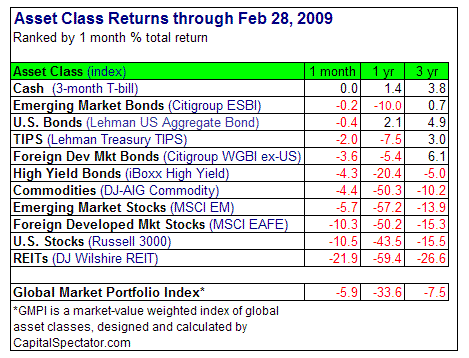
The deep pain now coursing through the capital and commodity markets needs no explanation at this point. The global recession strangling the planet inspires only selling, hoarding cash and otherwise retreating from debt in any way, shape or form possible. This is a toxic combination and one that explains the various economic ills that are likely to roll on. The unwinding is also necessary to cure the problems that afflict the global economy, but no one expects the process to be pretty or speedy.