What should we expect from Mr. Market? The answer’s always in doubt, but strategic-minded investors should run through the numbers anyway.
It’s hard to overrate the value of taking a hard look at investing assumptions. By continually putting an expected price on risk, we become better investors. There are no crystal balls, but the next best thing is improving our skills in the art and science of discounting the future as a tool for enhancing return…maybe.
As an example, in the next issue of The Beta Investment Report we forecast an expected equilibrium risk premium for the market portfolio of 2.5%. We arrive at that forecast from summing up the individual forecasts for each of the major asset classes based on their market-cap-informed share of the total portfolio. Overall, it’s a long-term prediction based on an equilibrium assumption and, we believe, a reasonable benchmark forecast, for reasons we discuss in some detail in the newsletter. But we can’t be sure that our forecast is accurate and so we need to stress test our assumptions a bit. Here’s a very brief illustration of the basic concept, including some of the give and take that keeps us forever wondering about what’s coming.
Monthly Archives: May 2009
READY OR NOT, INTEREST RATES ARE RISING
Is it an ominous sign, or just another step on the journey back to normalcy?
For the moment, the jury’s out, but there’s no question that the benchmark 10-year Treasury Note’s yield is upwardly mobile these days. Yesterday’s jump to 3.71% elevated the yield to its highest since last November. What does it mean?
One interpretation is that the yield is simply returning to something approaching normalcy. As the threat of economic and financial disaster recedes, the price of money is expected to return to levels that prevailed before the world seemed to be coming apart in the last four months of 2008. That implies a return to the 3.5%-4.0% range for the 10-year, a range that was prevalent for much of last summer.

But in the current economic climate, nothing is quite as benign as it appears. Recall that it was only in March that the Federal Reserve announced that it would buy long government bonds to keep long rates low as part of its efforts to stimulate economic recovery. Immediately following the news, the yield on the 10-year dropped by an extraordinary 50 basis points in a single trading session, closing at around 2.5% on March 18. As of last night, the 10-year yield was 120 basis points higher. What does that say about the Fed’s plans to keep rates low?
IS THE SMALL-CAP VALUE BETA STILL RELEVANT?
It’s been 17 years since the professors Eugene Fama and Ken French penned the first of several papers that identified small-cap value as a separate equity beta worthy of special consideration. The basic idea is that stocks that are generally shunned by the crowd, as indicated by a low price-to-book ratio, are riskier than the market overall. Investors who are willing and able to hold this risk are rewarded with above-average returns in the long run.
There are a number of theories for why small-cap value stocks generate returns that are higher than implied by the standard interpretation of modern portfolio theory. One idea is that small-cap value is a proxy for the risk tied to the economic cycle. During recessions, small-cap value shares are especially vulnerable and so investors are especially keen to shun this group. In turn, the fear generates an above-average expected return for small-cap value.
IS THE BOND MARKET TRYING TO TELL US SOMETHING?
In absolute numbers it’s easy to shrug off, but the trend appears to have gained new momentum over the past week or so.
We’re talking here of the spread between the nominal 10-year Treasury Note and its inflation-indexed counterpart, a.k.a., the 10-year TIPS. The yield difference between these two securities is one of the more widely watched market-based forecasts of inflation. It’s not infallible, but neither is it irrelevant. It does, however, offer a real-time measure of the crowd’s outlook for inflation and as our chart below suggests, the market seems to be growing increasingly anxious.

In absolute terms, of course, it still looks trivial. The current 10-year inflation forecast of 1.73% is, by historical standards, quite low. And as the chart above reminds, we’re still quite a ways from the 2.5% forecast that prevailed before all hell broke loose last September.
ANOTHER CYCLICAL CLUE
The jury’s still out on when the recession will end, but the case for arguing that the pace of economic contraction is slowing got another boost this morning with the weekly update on initial jobless claims.
For the week through May 16, new filings for unemployment benefits dropped by 12,000 to 631,000, the Labor Department reports. That’s a clear signal that the recessionary winds are still blowing hard. But as we’ve been arguing for several months, including here, a topping out in new reported claims may signal the negative economic momentum is ebbing. Today’s update continues to suggest that we’re at or near the trough of the recession. Or, if you’re an optimist, you might think that the trough came a month or two back.

The reasoning for considering jobless claims as an early clue of the general economic trend is suggested by the historical record, as we explained here. By that standard, today’s numbers lend a bit more confidence that the downturn’s low point has arrived, or perhaps just passed. But keep in mind that even if that’s true, that leaves plenty of recessionary months ahead before growth returns.
ALAN BLINDER’S HALF RIGHT
Former Fed vice chairman Alan Blinder warns of the dangers of slowing the central bank’s printing presses too early and thereby repeating the mistakes of the mid-1930s. As he explains,
From its bottom in 1933 to 1936, the G.D.P. climbed spectacularly (albeit from a very low base), averaging gains of almost 11 percent a year. But then, both the Fed and the administration of Franklin D. Roosevelt reversed course.
In the summer of 1936, the Fed looked at the large volume of excess reserves piled up in the banking system, concluded that this mountain of liquidity could be fodder for future inflation, and began to withdraw it. This tightening of monetary policy continued into 1937, in a weak economy that was ill-prepared for it.
Blinder is right to warn against ending the liquidity injections too early. But that doesn’t mean the party should go on forever. In a sign of the times, however, Blinder’s mum on identifying that magic day in the future when the ambitious expansion of the money supply and the Fed’s balance sheet should end and the monetary tightening should begin. He’s quiet on this point for a very good reason: He doesn’t know the date. Nor does anyone else, and therein lies the great challenge confronting the U.S. economy, and one that Blinder avoids discussing in his otherwise salient article on Sunday in the New York Times.
A BRIEF HISTORY OF THE GLOBAL MARKET PORTFOLIO
It all looks obvious in hindsight. It always does. But the future has its own brand of consistency: It’s always unclear.
The good news is that the future’s not as unclear as we once thought it was. Revelations in financial economics over the last 20 years or so gives us reason to think that returns are partly predictable when looking out over the medium-to-long-term horizons. In the short term, momentum seems to play a role, perhaps a dominant role.
The trick is figuring out how to blend these insights into one strategic vision. One piece of the puzzle is keeping an eye on the evolving relationship of asset classes through time. On that note, the chart below offers a preview of what we’ll be studying in more depth in the next issue of The Beta Investment Report. The graph shows how the major asset classes performed relative to one another from the end of 1997 through April 30, 2009. It’s a busy graph and so as a favor to your eyes click on the larger version.
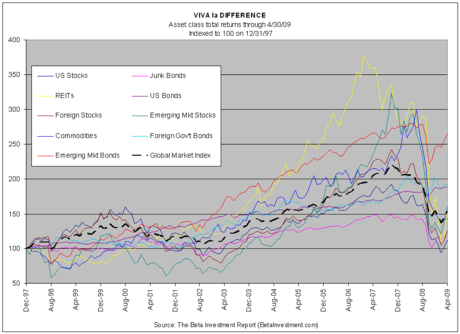
The primary message is that there’s been plenty of volatility in the various components that make up the total market index. Speaking of which, our proprietary Global Market Index, a passive weighting of the major asset classes, has performed more or less as you might expect relative to the world’s capital and commodity markets. In other words, GMI’s delivered average performance, give or take. (The heavy broken black line in the chart above is GMI.)
That’s another way of saying that GMI has beaten some asset classes since 1997 and trailed others. The question, as always: Which asset classes will beat GMI in the future? It may be tempting to simply pick the ones that have outperformed in the past as repeat winners, but that’s misguided. Diversification works over time, but a lot depends on what you pay for the individual pieces. That’s especially true if you’re planning on besting GMI. The price of risk, in other words, is critical.
Unsurprisingly, generating alpha relative to what’ available to everyone as beta is tougher than it looks, as the mediocrity in much of the active management industry suggests. That’s not to say that we should simply lie down and accept GMI as the best we can hope to achieve. But neither should we assume that besting Mr. Market’s asset allocation will be easy. Finding the sweet spot is primary mission. After that, the details get messy.
SLOW AND SLUGGISH, AND THAT’S THE OPTIMISTIC FORECAST
Today’s update on wholesale prices and new filings for unemployment benefits strengthens the case for thinking that the worst of the economic crisis is behind us. Or perhaps it’s better to say that the numbers du jour don’t derail the case for optimism. But as we opined yesterday, and repeat today, there’s likely to be a longer-than-usual gap between the recession’s trough and a return of what the crowd recognizes as a sustained rebound in growth of some magnitude.
Meantime, there are two more data points that support a somewhat brighter outlook of our still-speculative forecast that the cyclical low point, if not imminent, is near.
Let’s begin with the producer price index (PPI) report for April. Wholesale prices rose 0.3% last month, the government reports. That’s in contrast to the 1.3% drop in March. Yes, PPI remains volatile, and on a year-over-year basis there’s outright deflation. But as the monthly readings suggest, maybe, just maybe, we’ve found some stability in prices.
Still, as the chart below reminds, there’s still quite a bit of play in the month-to-month numbers. It wouldn’t be surprising to see a sharp decline next month or the month after. We’ll just have to wait to confirm, or deny, our suspicion that wholesale prices are in the process of stabilizing after the earth-shattering blowback from the financial and economic crisis of late.

That said, news that monthly prices aren’t in free fall is encouraging for thinking that the deflationary threat is passing. As we’ve discussed repeatedly since this crisis began, including here and here, preventing deflation from taking root is the essential first step for returning the economy to something approximating a normal state. If prices are allowed to decline, the headwinds for growth become far stronger. But there’s reason for mild optimism.
BETWIXT AND BETWEEN
Today’s update on retail sales for April wasn’t bad, but it wasn’t good either. We suspect that more of the same is coming, in retail sales and other economic numbers. The worst of the recession appears to be passing, but the best of the rebound is still nowhere in sight.
Retail sales slipped a mere 0.4% last month on a seasonally adjusted basis, the Census Bureau reports. As declines in this series go, that’s the mildest downturn yet since the recession began in December 2007. That’s all well and good, but let’s not forget that the outright monthly gains in retail sales of January and February have faded. Are we now settling into to a period of treading water? Perhaps.

To be sure, there were some bright spots in today’s report, including gains in retail sales in the auto and building materials sectors. But overall, the message in today’s update is that momentum in retail sales appears is conspicuously absent. Changing the dynamic will take a sharp turnaround in the labor market. That glorious day, however, is nowhere in sight.
STILL HOPING…
The momentum in the front line of the recession still favors the dark forces of contraction, today’s update on employment for April suggests. One can argue that there’s a bright side to the job destruction, but that’s still wishful thinking. Indeed, it’s hard to put a positive spin on a retreat of 539,000 for nonfarm payrolls last month.

Yes, that’s better than the 699,000 drop in March, but then that’s not saying much. The hope is that the slowing pace of job loss is a sign of better times. Perhaps, although we shouldn’t expect too much too soon. The vanishing act in jobs continues to be widespread and deep, affecting both the goods-producing sectors as well the services side of the economy.
Still, the worst of the labor market’s contraction may be behind us, which is a reasonable forecast, as the apparent topping out in new filings for jobless benefits suggests. Yesterday’s update on weekly claims for unemployment benefits implies no less. But a slowing rate of job loss isn’t the same thing as job growth. Even if the labor market contracts at a much slower rate of, say, 200,000 jobs a month for the rest of the year, that’s still another 1.6 million fewer workers earning a paycheck by New Year’s Eve.