The Federal Reserve may be downplaying inflation risk, but financial markets are less confident. The central bank left interest rates unchanged on Wednesday, implying that it could remain patient in deciding whether there’s a threat to price stability — a commitment Chair Kevin Warsh has vowed to deliver multiple times since taking the helm in May. Market sentiment, by contrast, is somewhat less convinced that monetary policy is fine as is.
The ongoing Middle East conflict isn’t helping. As the war drags on, it remains a threat by lifting inflation and slowing growth. Flat‑out risk‑off signals, however, have yet to arrive, based on a review of several indicators using comparisons of ETFs.
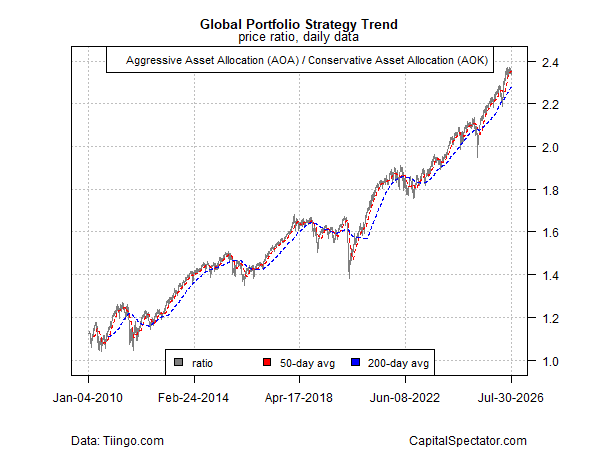
We may be at an inflection point for the risk appetite, but the jury is still out, according to a big‑picture profile of global asset allocation strategies based on the ratio of two ETF proxies: an aggressive strategy (AOA) versus its conservative counterpart (AOK). Despite all the macro turmoil in recent months, this ratio is churning in a range, holding on to the rebound from the sell‑off in the early days of the Iran war. The implication: investors are still processing the risk outlook.
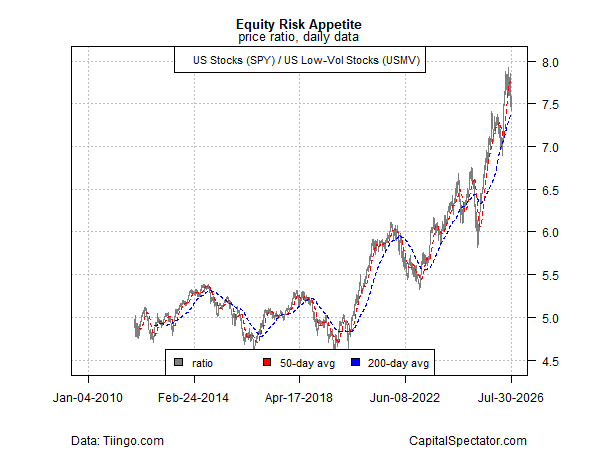
Within some asset classes, by contrast, changes in sentiment are starker. Notably, investors have sharply dialed down the collective risk appetite, as shown by the steep decline in the ratio of the U.S. stock market (SPY) vs. a low‑volatility counterpart (USMV), a proxy for a relatively conservative equities strategy. Although a clear risk‑off signal has yet to emerge on this front, the stock market’s tolerance for shock and awe has been severely depleted, and a tipping point may be near if additional negative surprises arise.
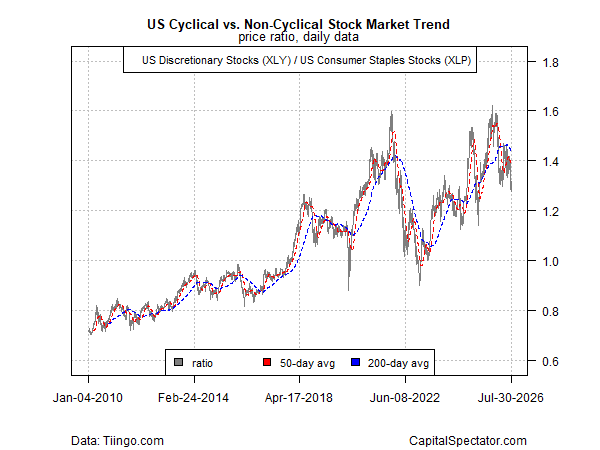
A more sensitive proxy for equity‑market risk tolerance reveals a greater degree of weakness, which could be an early warning sign and deserves close attention in the weeks ahead, based on the ratio of U.S. cyclical stocks (XLY) to defensive shares (XLP).
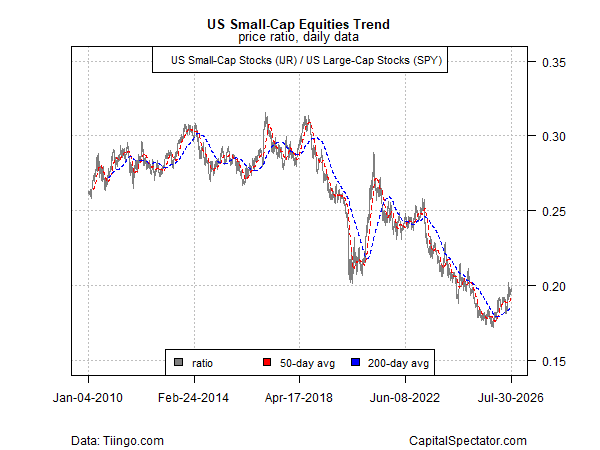
By contrast, the recent recovery in relative strength for small‑cap stocks (IJR) vs. large caps (SPY) remains resilient.
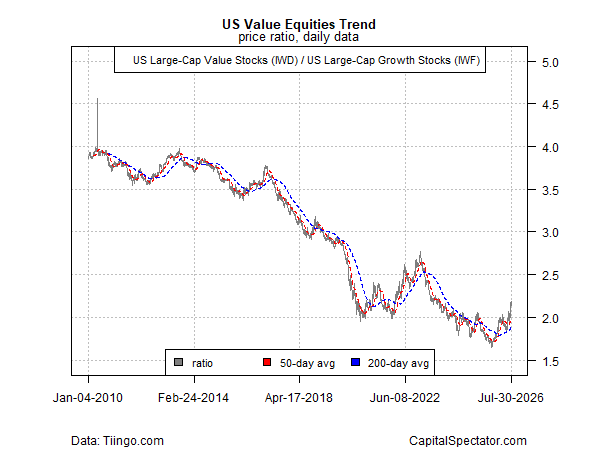
Similarly, the rebound in value stocks (IWD) over growth (IWF) still looks robust.
The bond market, by contrast, is is leaning into a risk‑off signal, based on the ratio of medium‑term Treasuries (IEF) vs. their short‑term counterparts (SHY).
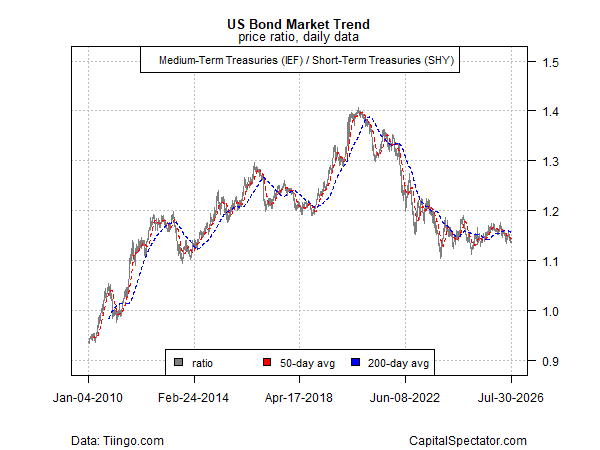
If the IEF–SHY ratio sinks further and triggers a clear risk‑off signal, the shift could spill over into the stock market and spark a new leg down for equities.
Across asset classes, investors are increasingly uneasy even as the Federal Reserve maintains a patient stance on inflation risk. Taken together, the indicators suggest that markets may be approaching a critical juncture.
Learn To Use R For Portfolio Analysis
Quantitative Investment Portfolio Analytics In R:
An Introduction To R For Modeling Portfolio Risk and Return
By James Picerno
