The bond market continues to demand a higher risk premium, based on fair-value estimates for the US 10-year Treasury yield. Driven by concerns about sticky inflation and mounting government debt, the benchmark rate’s spread over fair value in August rose to its highest level since January 2025.
The Capital Spectator estimates fair value for the 10-year yield using three models. The average of these models ticked up to 4.1% last month. The actual 10-year yield rose even more, increasing to an average of 4.68% in August, roughly 58 basis points above the average fair-value estimate.
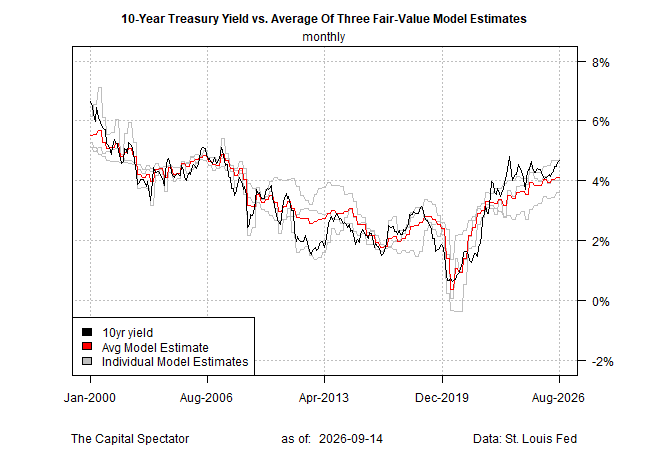
The higher market premium extends a rise that began after the spread bottomed in October 2025 at roughly equilibrium, when the market yield and fair-value estimate were more or less aligned. Since then, the market premium has moved higher, fueled by several factors, including the Iran conflict, which has boosted headline inflation measures through higher energy costs.
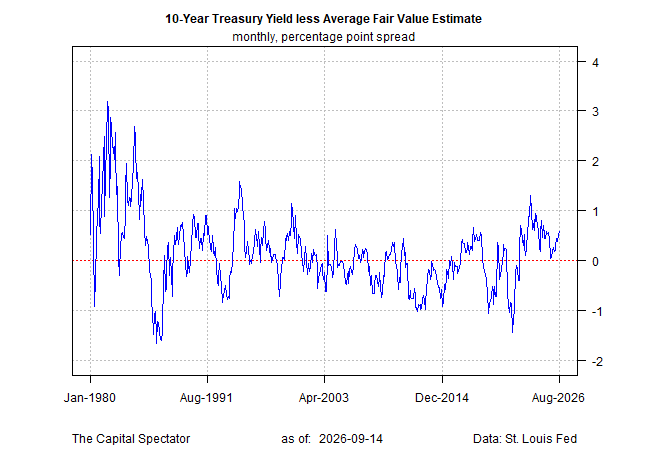
The fair-value estimate has also been rising, but not as quickly as the market yield. One reason is that several of the inputs used to estimate fair value are economic indicators that arrive with a lag and are published monthly or quarterly. The bond market, by contrast, reprices Treasury yields in real time throughout each trading day and reacts quickly to current events.
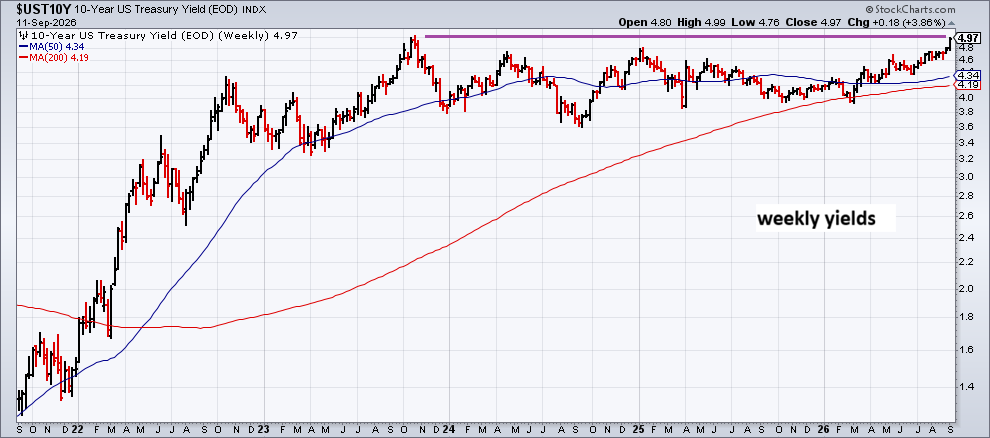
If the recent trend continues, the market premium for the 10-year yield will soon exceed the previous peak set in early 2024. Recent market action suggests that a new peak could arrive as early as this month. Last week, the 10-year yield surged to just below 5.0%, the highest level since late 2023. A decisive move into the 5%-plus range would signal expectations for an even larger market premium in the months ahead.
The key variables are the Iran war and the political winds in Washington regarding the ballooning federal debt. Progress on either front appears unlikely in the near term. On that basis, both the market yield and the fair-value estimate are expected to move higher.
Additional factors supporting higher yields and fair-value estimates include a relatively robust US economy. Several nowcasts suggest that the upcoming third-quarter GDP report will show a solid pickup in growth. The Atlanta Fed’s GDPNow model, for example, currently estimates Q3 growth at 4.4%, marking a strong acceleration from Q2’s modest 1.5% advance.
Taken together, the evidence suggests that the bond market is pricing in a combination of fiscal strain, persistent inflation pressures, and resilient economic growth. Unless one or more of those forces begin to ease, Treasury investors are likely to continue demanding a sizable premium over fair value. For now, the path of least resistance appears to be higher for both yields and fair-value estimates, with the possibility that the 10-year rate will test levels not seen since before the pandemic-era bond rally reshaped the fixed-income landscape.
