The Federal Reserve usually looks through headline measures of inflation and focuses on core readings when adjusting monetary policy and setting its target rate. The reasoning is that core inflation generally does a better job of capturing the underlying trend of price changes and ignores short-term noise. The challenge is deciding whether this time is different.
There are no easy answers because the future is uncertain, and so the Fed runs the risk of making a non-trivial policy error at tomorrow’s FOMC meeting. The main dilemma: a variety of core inflation measures continue to show a disinflationary bias unfolding, while headline readings of prices highlight sticky inflation that’s still running well above the central bank’s 2% target.
In normal times, the Fed would likely focus on core metrics and decide that monetary policy was sufficiently tight. But for several reasons, one is hard-pressed to describe the current climate as normal.
Several factors are supporting headline inflation, including the ongoing Iran conflict, which is keeping energy costs elevated. The Trump administration’s revived tariff war is another source of upside pressure on prices. Growing concern about federal debt is another reason Wall Street remains concerned about inflation.
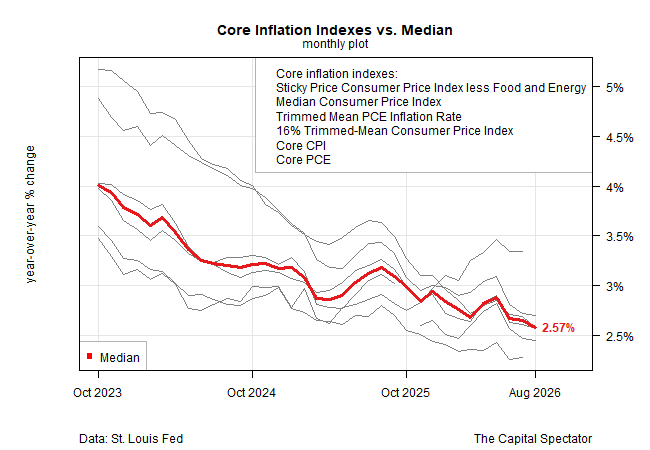
The good news, at least for now, is that headline inflation isn’t accelerating, although it’s not fading either. The consumer price index (CPI) was steady at a 3.4% year-over-year pace through August. Meanwhile, core CPI, which excludes volatile food and energy prices, ticked down to a 2.4% annual increase, the lowest in more than five years and close to the Fed’s 2% target.
On its face, the core measure of inflation is encouraging. What’s more, a variety of alternative core indexes confirm that a disinflationary bias is still in progress, as shown in the chart below.
Why, then, are Treasury yields rising? The benchmark 10-year rate crossed above 5% on Monday for the first time since Oct. 2023 before pulling back and closing at 4.99%. But in a sign that the bond market remains anxious about inflation and monetary policy, the 10-year yield in early trading on Tuesday rebounded to just above 5.04%, marking its highest point in nearly two decades.
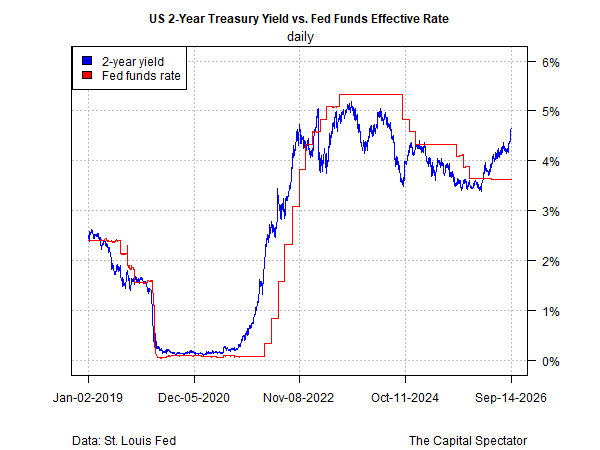
Meanwhile, the policy-sensitive 2-year yield also pushed higher, jumping to 4.68% on Monday, the highest in more than two years and far above the Fed’s current 3.50%-3.75% target range. This maturity is pricing in high odds of a rate hike, which aligns with Fed funds futures, which are currently estimating a 90%-plus probability that the central bank will announce a hike tomorrow.
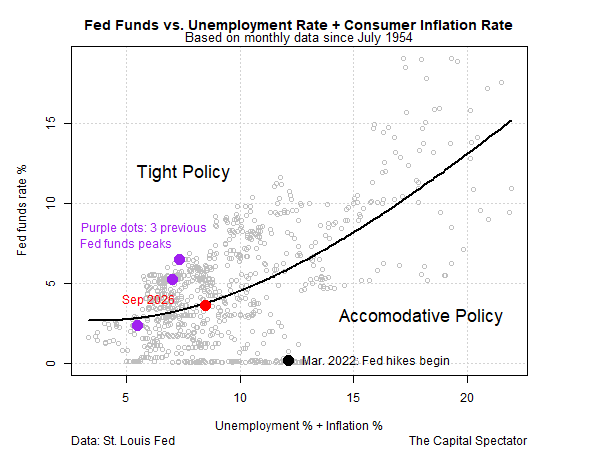
The challenge for the Fed is that it’s not obvious that the current policy rate, roughly 3.63% via the Effective Fed Funds rate, is dramatically inappropriate, based on a simple model that uses the unemployment rate and headline CPI as inputs. But the recent escalation in the Iran conflict, which is keeping energy prices elevated, is running interference in what might otherwise be a clearer picture for policy.
As the war escalates and reduces Middle East energy export capacity through developments such as the Houthis’ bombing of Saudi oil pipelines, the upside pressure on headline inflation may increase. The energy-related pressure would quickly fade if the war ended, but the conflict still looks set to persist in the near term. The US crude oil benchmark has shot higher recently and is trading above $100 a barrel for the first time since May.
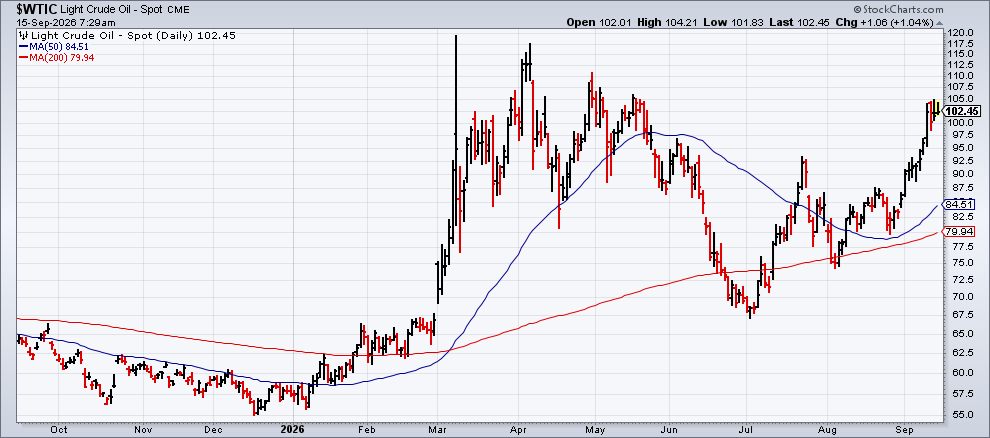
Strong geopolitical drivers have tightened the normally modest correlation between oil and inflation. As a result, rising oil prices are actively driving up inflation expectations and putting upward pressure on interest rates, a relationship that could persist and perhaps strengthen as long as the war continues.
All of which puts the Fed in an especially tough spot. With market expectations confident that a rate hike is coming tomorrow, leaving the target rate unchanged could trigger a new phase of disappointment in the bond market and drive yields sharply higher. Alternatively, a hike could enrage President Trump, who has demanded lower rates, a scenario that could further imperil the Fed’s independence, depending on how the White House responds.
Perhaps the biggest risk is that the Fed embarks on a new tightening cycle that ends up being premature if the Iran conflict winds down and energy exports resume. But some analysts are worried that the Middle East crisis could last for many more months, in which case headline inflation could move significantly higher.
Deciding how to respond in real time without a clear understanding of how risks will evolve is a perennial challenge. The current situation is especially fraught on that front, leaving the Fed with an especially difficult choice tomorrow, a choice that can be summed up as: damned if it does, damned if it doesn’t.
