In this issue:
- Mostly meandering markets
- US assets take a back seat to global asset allocation this week
In this issue:
Long ago and far away, economists thought they understood the relationship between unemployment and inflation. The prevailing wisdom back in the day: higher (lower) inflation aligned with lower (higher) unemployment. Believing in this relationship appeared to be reasonable for the 1960s. But then something happened to shatter this conviction: the 1970s.
* Cease-fire between Israel and Hamas puts 11-day war on hold
* US proposes minimum 15% global tax on multinational firms
* US Treasury wants crypto transfers over $10k reported to IRS
* Eurozone Composite PMI (a GDP proxy) rises to 39-month high in May
* UK private-sector growth in May jumps to fastest pace in two decades-plus
* Japan slips back into economic contraction in May via PMI survey data
* US Leading Economic Index rose in April, surpassing pre-pandemic high
* Philly Fed Mfg Index: growth cooled in May but remains strong
* US jobless claims continue falling, dropping to new pandemic low:

First-quarter growth posted a strong improvement over the previous quarter and a repeat performance is expected for the second-quarter report on gross domestic product (GDP) that’s scheduled for release in late-July.
* Ceasefire expected soon for Israeli-Palestinian conflict
* Israel unleashes another wave of airstrikes in Gaza on Thursday
* US and Russian diplomats meet ahead of Biden-Putin summit
* Biden waives US sanctions on Russian-German gas pipeline company
* GOP defections help House pass inquiry into Jan. 6 siege on the Capitol
* Most GOP states plan to cut unemployment benefits as jobless claims fall
* Fed officials discussed conditions for easing stimulus in April policy meeting
* German producer prices accelerated sharply to 5.2% annual rate in April
* Gold rises to highest level since January:

Inflation anxiety is rising, commodities prices have popped and the consumer price index increased at a pace far above expectations in April. What isn’t increasing is the benchmark 10-year Treasury yield. Let’s restate that: it’s no longer rising.
Identifying which way the macro wind is blowing isn’t getting easier. So far this month the government has published five key economic reports and each one has delivered sharply divergent results relative to the consensus forecasts. It’s unclear how long the surprise factor will remain in overdrive, but for the near term the incoming numbers may be unusually misleading.
* Israel-Gaza conflict continues with no sign of ceasefire
* China accuses US of threatening peace as warship transits Strait of Taiwan
* World currently facing multiple crises, UN Secretary warns
* Ex-Treasury secretary Summers says Fed will be forced into sudden rate rise
* President, Treasury secretary promote $2.3 trillion infrastructure package
* Is 4% inflation the tipping point for triggering lower stock prices?
* Chinese regulators tighten rules on using cryptocurrencies for payments
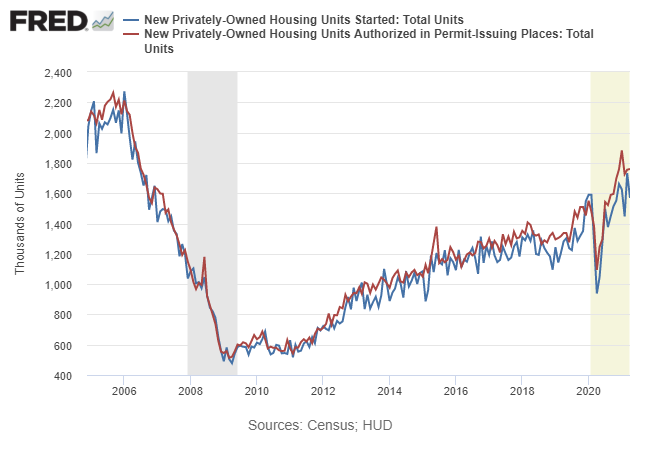
* US housing starts fell sharply in April but building permits rose moderately:
So-called high beta shares have rallied sharply in recent weeks and are now the top performer for US equity factor returns year to date, based on a set of ETF proxies through yesterday’s close (May 17).
* Israel-Palestinian conflict continues to rage on Tuesday
* Japan’s economy contracted more than expected in first quarter
* Supreme Court will hear case that challenges Roe v. Wade abortion case
* Amazon pursuing deal to acquire MGM in bid to expand entertainment footprint
* Investors rushing into bank stocks for an economic recovery play
* Brent crude oil rebounds to $70 a barrel
* NY Fed Mfg Index ticks lower in May, but still signals strong growth
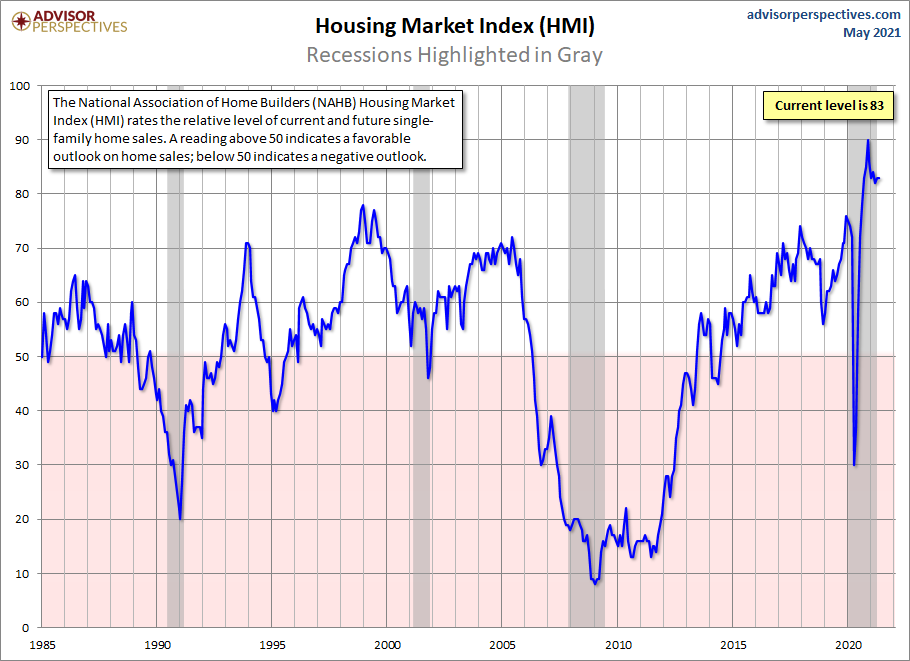
* US homebuilder sentiment is unchanged in May, holding at high level: