Second round of coronavirus is ‘inevitable,’ Fauci warns: CNN
Race for developing coronavirus vaccine expands with Pfizer tests: WSJ
What’s on the Fed’s agenda for today’s policy meeting and press conference? BBG
Investors expect big tech will dominate after crisis: NY Times
Eurozone economic sentiment in April posts biggest decline on record: Reuters
Richmond Fed Mfg Index declines sharply in April: RF
US Consumer Confidence Index plunges to 6-year low in April: CNBC
US home prices were rising steadily before coronavirus crisis in Feb: CNBC
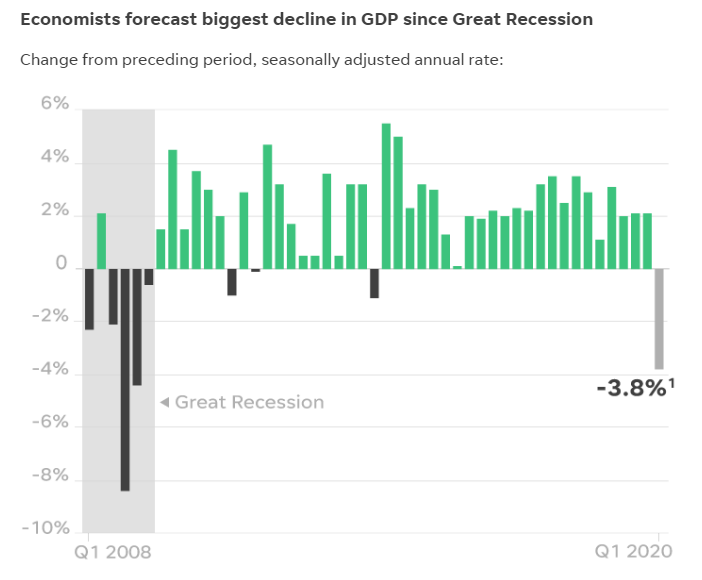
Today’s US Q1 GDP report is expected to show a 3.8% fall in output: USAToday
When Will The US Stock Market Regain Its Previous High?
If you didn’t know anything about the coronavirus and remained clueless about the economic devastation, you might look at a chart of the S&P 500 and think that a severe market correction was rebounding and equities would soon reclaim the previous high-water mark. Reality, however, isn’t quite that simple.
Macro Briefing | 28 April 2020
Oxford Group’s coronavirus vaccine may be available as early as Sep: NY Times:
China has near-total control over anti-biotic supply. Is America at risk? STAT
US oil prices continue to slide as lack of storage weighs on market: MW
What’s left in the Fed’s playbook after massive stimulus? CNBC
The Federal Reserve is reinventing itself during coronavirus crisis: WSJ
Surge in internet use due to coronavirus is good news for chipmakers: WSJ
Will US stock market look through dismal earnings season… or two: BBG
VIX Index (US stock market’s ‘fear gauge’) falls to 8-week low:
TIPS And Foreign Corporates Rose Last Week As Stocks Fell
Despite a late-week rally in equity markets, risk-off sentiment dominated last week, leaving most of the major asset classes lower by the close of trading on Friday, Apr. 24. Bucking the trend: inflation-indexed Treasuries, which posted the best gain for the trading week, based on a set of exchange-traded funds.
Continue reading
Macro Briefing | 27 April 2020
Some US states begin to reopen their economies: WSJ
Treasury Sec. Mnuchin expects Q3 rebound for US economy: MW
Stock market’s rise is a bet on on testing, treatments to restart economy: Reuters
Bond market considers deflation risk ahead of this week’s Fed meeting: BBG
Surge in gov’t spending will lead to higher taxes… eventually: CIO
Consumer sentiment tumbles for 3rd month in April: CNBC
US Composite PMI: economic output collapses in April: IHS Markit
US durable-goods orders plunged 14% in March: MW
Daily rise in US Covid-19 deaths falls to 3-week low for Apr. 26: Johns Hopkins
Book Bits | 25 April 2020
● The Technologized Investor: Innovation through Reorientation
Ashby Monk and Dane Rook
Summary via publisher (Stanford U. Press)
Institutional Investors underpin our capitalist world, and could play a major role in addressing some of the greatest challenges to society such as climate change, the ballooning wealth gap, declining infrastructure, aging populations, and the need for stable funding for the sciences and arts. Advanced technology can help institutional Investors deliver the funds needed to tackle these grave challenges. The Technologized Investor is a practical guide showing how institutional Investors can gain the capabilities for deep innovation by reorienting their strategies and organizations around advanced technology. It dissects why technology has historically failed institutional Investors and recommends realistic changes that they can make to unlock technological superpowers. Grounded in the actual experiences of institutional Investors from around the globe, it’s a unique reference manual for practitioners on how to reboot their organizations for long-term performance.
Research Review | 24 April 2020 | Covid-19 Blowback
Pandemics and Systemic Financial Risk
Howell E. Jackson (Harvard Law School) and Steven L. Schwarcz (Duke U.)
April 19, 2020
The coronavirus has produced a public health debacle of the first-order. But the virus is also propagating the kind of exogenous shock that can precipitate – and to a considerable degree is already precipitating – a systemic event for our financial system. This currently unfolding systemic shock comes a little more than a decade after the last financial crisis. In the intervening years, much as been written about the global financial crisis of 2008 and its systemic dimensions. Additional scholarly attention has focused on first devising and then critiquing the macroprudential reforms that ensued, both in the Dodd-Frank Act and the many regulations and policy guidelines that implemented its provisions. In this essay, we consider the coronavirus pandemic and its implications for the financial system through the lens of the frameworks we had developed for the analysis of systemic financial risks in the aftermath of the last financial crisis. We compare and contrast the two crises in terms of systemic financial risks and then explore two dimensions on which financial regulatory authorities might profitably engage with public health officials. As we are writing this essay, the pandemic’s ultimate scope and consequences, financial and otherwise, are unknown and unknowable; our analysis, therefore, is necessarily provisional and tentative. We hope, however, it may be of interest and potential use to the academic community and policymakers.
Continue reading
Macro Briefing | 24 April 2020
House approves $484 billion for small business coronavirus relief: USA Today
Millions of US workers continued to file for jobless benefits last week: WSJ
Trump may extend social distancing rules through early summer: CNBC
US economic sentiment falls dramatically in April: IHS Markit
US banks pulling back from lending to European firms: FT
China is a crucial source of coronavirus gear for US: NY Times
Which companies should get bailed out from coronavirus blowback? New Yorker
Why are stocks up when millions are losing their jobs? MW
US coronavirus deaths had been trending down but reversed course on Thursday:
Standard Asset Allocation Faces New Scrutiny And Suspicion
Recent history has been humbling for nearly every corner of portfolio management. There are exceptions, of course. Several managed futures ETFs, for example, have been relatively stable in the recent market correction. But extreme stress has afflicted most corners of the financial markets, which in turn has unleashed unexpected challenges for many portfolio strategies.
Macro Briefing | 23 April 2020
The grim calculus for deciding when to reopen the economy: NY Times
US jobless claims expected to rise 4.5 million in today’s report: USA Today
Trump signs order to suspend immigration: Bloomberg
Eurozone PMI: “unprecedented collapse of Eurozone economy” in April: IHS Markit
Record decline in UK economic output in April amid public health crisis: IHS Markit
Japan’s economic decline intensified in April via PMI survey data: IHS Markit
Bankruptcy threatens US energy industry after supply/demand shock: Reuters
A closer look at IMHE’s widely cited Covid-19 forecasting model: Quartz
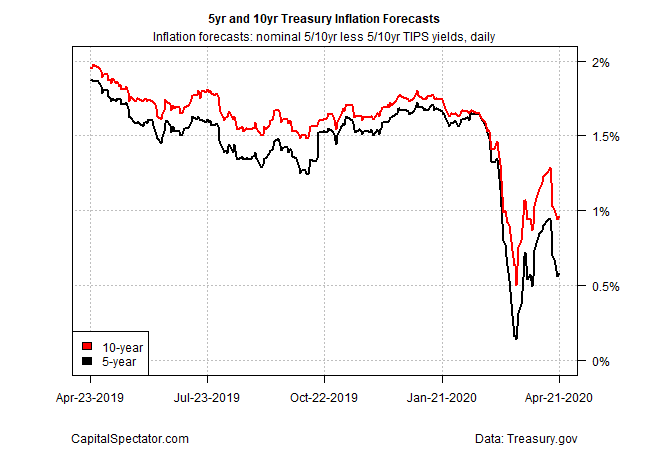
Treasury market’s implied inflation outlook is below 1% for 5- and 10-yr maturities: