Macro Briefing | 26 December 2019

US holiday spending rises, thanks to e-commerce at record high: Reuters
China sails new aircraft carrier through Taiwan Strait: Reuters
GOP senator ‘disturbed’ by McConnell’s ‘coordination’ with White House: Politico
Births in Japan fall to lowest level since 1874: NY Times
Long-run secular inflation trend looks set to decline: Vanguard
Richmond Fed Mfg Index: sector activity fell for 2nd month in Nov: RF
Gold is trading above $1500, a seven-week high: Bloomberg

Buon Natale!

Christmas has come early to the world headquarters of The Capital Spectator, which can only mean one thing: Your editor is slipping out the door to beat the rush and commence the holiday festivities ahead of the crowd. We’ll be back at the grindstone on Thursday, Dec. 26 with a fresh spin on the post-holiday outlook. Meanwhile… Merry Christmas!

Macro Briefing | 23 December 2019

Is N. Korea planning a new hard-line anti-US policy? CNN
India’s Modi defends citizenship bill amid protests: BBC
China announces plans to cut import tariffs on wide range of goods: BBG
Russia vows to retaliate for US sanctions on new Russia-Germany pipeline: AP
Atlanta Fed’s GDPNow model estimates Q4 growth at +2.1%, matching Q3: AF
NY Fed’s Q4 GDP nowcast revised up to still-weak +1.3%: NYF
US GDP growth remains at +2.1% for revised Q3 data: CNBC
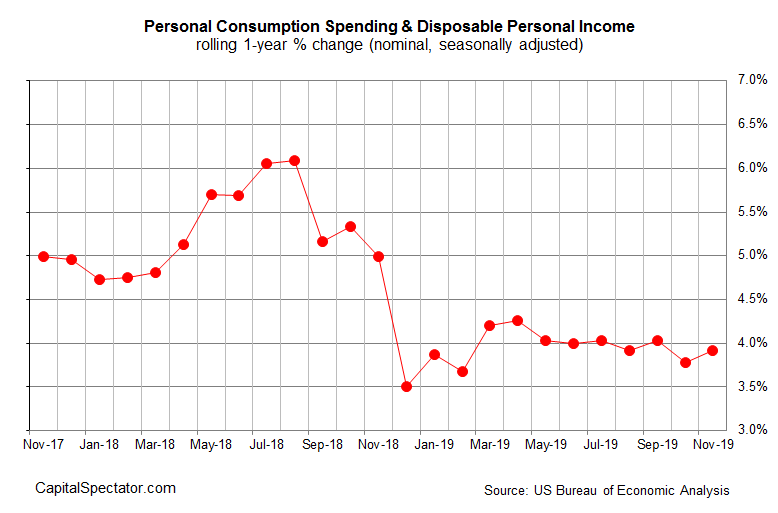
US consumer spending’s 1-year trend ticked up to moderate +3.9% in Nov:

Best of Book Bits 2019 (Part I)

Another year over, which means it’s time for the annual look-back for The Capital Spectator’s weekly Book Bits column. In keeping with tradition, we’ll highlight ten titles that found their way to these pages over the course of 2019. The criteria that delivered the results below? Your editor found the books intriguing, entertaining and/or revealing for one reason or another. As usual, the short list will be carved into two equally digestible servings, starting with five today, followed with the balance next week. Happy reading!

Continue reading

Research Review | 20 December 2019 | Value Investing

Value Bubbles
Messaoud Chibane and Samuel Ouzan (Neoma Business School)
February 27, 2019
According to several extended behavioral theories, value profits should mirror momentum profits, and vary over time. We test these theories in the cross section of returns. Value returns depend on market states. From 1926 to 2018, following negative market return, the average so-called value premium is about three time its unconditional counterpart, whereas it appears to vanish following positive market return. Moreover, several short episodes of extreme losses in momentum strategy (momentum crashes) are contemporaneous with extreme value profits (value bubbles). Our results are robust to various time varying risk- based explanations.
Continue reading

Macro Briefing | 20 December 2019

House approves revised North American trade pact: WSJ
UK prime minister’s Brexit bill expected to pass in Parliament: CNBC
Diplomacy runs up against N. Korea’s Dec. 31 deadline for US talks: Reuters
US Leading Economic Index stabilized in Nov after falling for 3 months: CB
Existing home sales in US fell 1.7% in November: BH
Philly Fed Mfg Index: activity slowed in Dec to weakest growth in 6 months: PF
US jobless claims fell last week after spiking to 2-year high: MW

Macro Briefing | 19 December 2019

House impeaches Trump: Reuters
Pelosi may delay sending impeachment articles to Senate: Politico
Impeachment doesn’t worry investors: MW
Is North Korea preparing to test a long-range missile? CNBC
India detains thousands for defying ban on protests over citizenship act: BBC
Sweden’s Riksbank is first central bank to exit negative rates: RTE
Economists expect US expansion to continue in 2020 via new survey: WSJ
UK retail sales fell in Nov, 4th monthly decline–weakest run since 1996: BBG
10yr/2yr Treasury yld curve spread (via daily data) rises to 29bps, a 6mo high:

US Business Cycle Risk Report | 18 December 2019

The US economy continues to reflect signs of stabilizing after a months-long period of downshifting. The possibility of a firmer expansion can’t be ruled out, but there are few convincing signs at this point. What is clear: recession risk remains low, as it has been all along (unless you cherry picked an indicator or two). As outlined below, reviewing a broad-minded data set still  shows that output is increasing at a moderate pace and near-term projections for the US macro trend point to more of the same.
Continue reading