We interrupt our regularly scheduled review of markets and economics to consider President Trump’s latest comments on US libel laws. His remarks on Wednesday suggest that the White House will lead a new effort to revise long-standing legal standards that are directly related to the Constitution’s First Amendment rights and freedom of the press – the bedrock of US democracy. The administration doesn’t have the power to rewrite libel laws and it’s doubtful that the Supreme Court will be swayed to revisit the subject. That leaves the possibility of a constitutional amendment to effect any revision, but that’s even more unlikely, if only because introducing legislation through this channel is a long and winding road.
Continue reading
Macro Briefing: 11 January 2018
Trump may be preparing to withdraw from Nafta trade pact: Bloomberg
New York City sues big oil over climate change: AP
IRS under pressure to reduce withholding taxes ahead of election: Politico
Trump says US libel laws are a “sham” and vows to “take a strong look”: CNBC
US import prices barely budged in Dec: Dow Jones
Businesses trim year-ahead inflation expectations to 2.0%: Atlanta Fed
Policy change for bond buying by central banks worries investors: NY Times
South Korea plans to ban cryptocurrency trading: Reuters
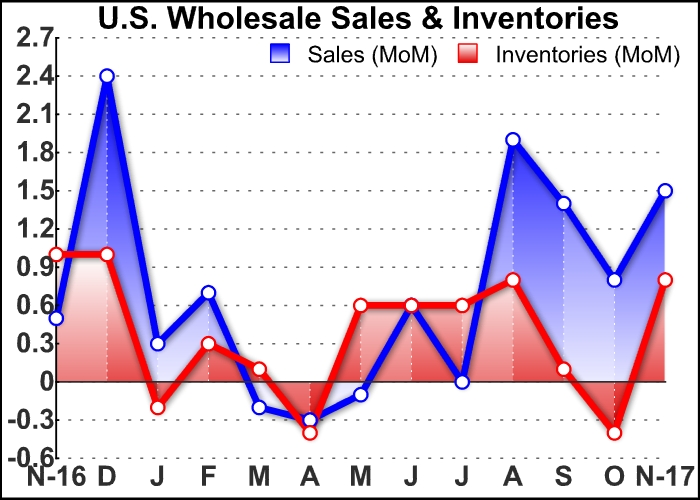
US wholesale inventories rebounded sharply in December: RTT
5 Questions For Professor Steve Keen On Debt And Financial Crises
What might trigger the next financial crisis and recession? Private debt tops the list, explains Steve Keen, an economics professor who heads the School of Economics, Politics and History at Kingston University. It’s a potent threat, in part because debt has increased since the 2008 financial crisis and interest rates appear poised to trend higher in the years ahead. Yet the risk bound up with private debt is widely underappreciated in the economics profession, Keen explains in his recent book: Can We Avoid Another Financial Crisis? 
Continue reading
Macro Briefing: 10 January 2018
Federal judge rules in favor of DACA immigration program: The Hill
Trump voices willingness to deal on immigration legislation: Bloomberg
Federal court rules against GOP re: gerrymandering districts: The Atlantic
Iran’s supreme leader calls for revenge against US for recent protests: NY Times
S. Korea’s president cites Trump as factor for new talks with N. Korea: NY Times
World Bank predicts global growth will peak this year: The Telegraph
Job openings in US fall to six-month low in Nov: Reuters
US Small Business Optimism Index remains close to record high in Dec: NFIB
The path to approval of a bitcoin ETF still faces high regulatory hurdles: Reuters
US 10-year Treasury yield rises to 2.55%, a 10-month high: Reuters

How Long Will The Stock Market’s Low-Volatility Regime Last?
US stocks ticked up to another record close yesterday (Jan. 8) – the fifth consecutive trading day with a new high, based on the S&P 500 Index. For much of the last two years, in fact, equities been rising steadily and forging new peaks with remarkably low levels of volatility. How long can the calm endure? No one knows, but it’s a safe bet that at some point the market’s tranquility will end. Low-vol regimes aren’t unusual for the stock market, but they come with a limited shelf life. What are the warning signs that will signal regime shift? Let’s consider some possibilities, including a pair of metrics to monitor the trend that may help us decide when the jig is up.
Continue reading
Macro Briefing: 9 January 2018
North Korea and South Korea hold first meeting in two years: CNN
A US government shutdown is a rising risk: Fiscal Times
Trump administration orders nearly 200,000 Salvadorans to leave US: Fox
Special counsel Mueller expected to request interview with Trump: CNN
Regulators nix Energy Secretary’s plan to prop up coal and nuclear plants: The Hill
Outstanding credit card debt in US reached a record in Nov: USA Today
Is Wall Street’s euphoria a contrarian indicator? Bloomberg
China reportedly orders reduction of cryptocurrency mining: TechCrunch
Annual growth for US commercial & industrial lending ticks below 1%: St Louis Fed

Emerging Markets Stocks Lead Markets Higher In 2018’s First Week
Equities in emerging markets posted the strongest return for the major asset classes in 2018’s first week of trading, based on a set of exchange-traded products. The losers for the year-to-date performance so far are limited to US bonds and US real estate investment trusts (REITs).
Continue reading
Macro Briefing: 8 January 2018
Trump administration set to roll out aggressive trade crackdown: Politco
French president calls for EU-China partnership on trade, climate: WaPo
Cleveland Fed president: rate hikes are last resort for financial risks: Reuters
US job growth was surprisingly slow in December: CNBC
Factory orders in US rose for fourth straight month in November: MarketWatch
ISM: US services sector growth slowed for second month in Dec: RTT
White House chief economist: no need for faster rate hikes: Bloomberg
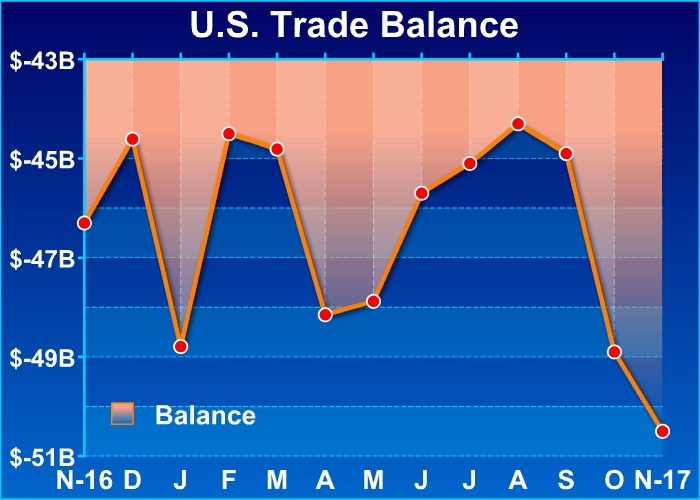
US trade deficit widens to biggest gap in 6 years in November: RTT
Book Bits | 6 January 2018

By Valeriy Zakamulin
Review via Alpha Architect
There are many popular academics (Moskowitz, Ooi, and Pedersen) and bloggers (i.e., Gary Antonacci) with a solid grasp of trend-following rules. However, Valeriy is the expert’s expert when it comes to the details on trend-following rules. In fact, we were so impressed by the depth and scale of Valeriy’s knowledge on moving average rules, a few years ago, we labeled Valeriy the, “Moving Average Research King.” Valeriy’s new book only emphasizes that we were probably correct in our assessment.
Continue reading

US Payrolls Growth Unexpectedly Cooled In December
Corporate payrolls in the US increased by less than expected in December, rising 146,000 in 2017’s final month — well below November’s strong 239,000 rise, according to this morning’s monthly employment report from the Labor Department. Economists were looking for a stronger rise: 185,000 via Econoday.com’s consensus forecast. The softer gain kept the year-over-year trend unchanged at a modest pace, which suggests that the labor market in 2018 may face stronger headwinds than previously assumed.
Continue reading