The Capital Spectator is taking a holiday recess to recharge, recline and relax. But there’s no permanent rest for the financially obsessed, and so we’ll return on January 2 with another round of observation and analysis.
Meantime, here’s wishing our readers a healthy, profitable and productive 2008.
Happy New Year!
Monthly Archives: December 2007
MERRY CHRISTMAS…
by Lord Tennyson
Ring out, wild bells, to the wild sky,
The flying cloud, the frosty light;
The year is dying in the night;
Ring out, wild bells, and let him die.
Ring out the old, ring in the new,
Ring, happy bells, across the snow:
The year is going, let him go;
Ring out the false, ring in the true.
Ring out the grief that saps the mind,
For those that here we see no more,
Ring out the feud of rich and poor,
Ring in redress to all mankind.
Ring out a slowly dying cause,
And ancient forms of party strife;
Ring in the nobler modes of life,
With sweeter manners, purer laws.
Ring out the want, the care the sin,
The faithless coldness of the times;
Ring out, ring out my mournful rhymes,
But ring the fuller minstrel in.
Ring out false pride in place and blood,
The civic slander and the spite;
Ring in the love of truth and right,
Ring in the common love of good.
Ring out old shapes of foul disease,
Ring out the narrowing lust of gold;
Ring out the thousand wars of old,
Ring in the thousand years of peace.
Ring in the valiant man and free,
The larger heart, the kindlier hand;
Ring out the darkness of the land,
Ring in the Christ that is to be.
JOE DOES IT AGAIN
They say that you should never underestimate the consumer, and this morning’s update on personal income and spending reminds just how practical that proverb can be. Yes, recession may be coming, but if the gloomy analysis is having an impact on Joe Sixpack, it’s not obvious in the latest data from Bureau of Economic Analysis.
Admittedly, disposable personal income isn’t exactly soaring, although it rose at a higher pace last month vs. October (0.4% compared to 0.2%). At least the trend is encouraging given that we’re told an economic slowdown is upon us.
But the real news is in the spending column. In particular, personal consumption expenditures soared by 1.1% last month. As our chart below shows, that’s impressive by recent standards. In fact, the last time PCE jumped so high was more than two years ago.

Granted, November always enjoys a seasonal burst of holiday shopping, although even by that standard holiday cheer of late is running considerably hotter in 2007.
ANOTHER SIGN OF SLOWDOWN
If there’s any one still wondering if the economy’s slowing, this morning’s update on weekly jobless claims may help blow some of the clouds of doubt away.
For the week through December 14, initial jobless claims rose to 346,000, up 12,000 from the previous week, the Labor Department reported. That’s not the high point in recent history, which was November 14’s 353,000. Nonetheless, the trend is telling. And as our chart below illustrates, the trend definitely isn’t our friend lately when it comes to jobless claims. The 10-week moving average of new weekly filings for unemployment insurance rose to 334,500. That’s the highest in two years.
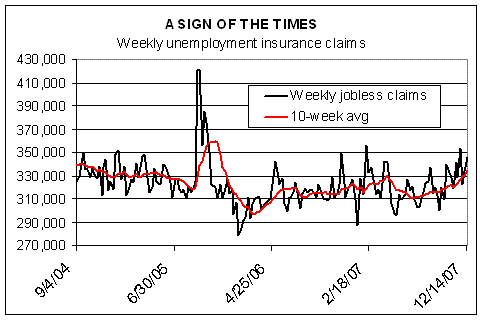
Of course, one might say that jobless claims are still within the range that’s prevailed for several years, and on that basis the trend signifies only statistical noise. Perhaps. In fact, economic slowdowns are only obvious in hindsight. Then again, given the broader economic context of late, which is less than encouraging, the warning sign emanating from the jobless numbers today suggests that the risk of trouble for 2008 is still rising.
The bond market seems inclined to agree. A new rally appears to be brewing in the 10-year Treasury, pushing the yield down again to 4.07% at yesterday’s close. In fact, one could argue that fixed-income traders now have the “all clear” sign to run bond prices up (and yields down) amid the mounting evidence that a slowdown is upon us. But there’s a complicating factor: inflation.
A number of pundits have invoked the “S” word (stagflation) recently, and so the prospect of a slowing economy and higher inflation will haunt the bond market even as it rallies on the outlook that more interest rates are coming as an economic stimulative. No wonder, then, the iShares Lehman TIPS ETF (a proxy for inflation-indexed Treasuries) is up more than 4% in the last three months, more than double the gain for bonds generally, as per the iShares Lehman Aggregate ETF.
No doubt we’ll all be keeping a close eye on the incoming economic numbers to figure out what comes next. We’re all still data dependent, and the forecast calls for more of the same well into the new year.
OFFSHORE BONDING
What’s true for stocks also applies for bonds: Most of the planet’s debt is issued outside of America. As of this past spring, roughly 53% of the outstanding value of the world’s bonds with maturities of one or more years was issued in a currency other than the dollar, according to the Bank for International Settlements.
The implication: diversified portfolios for U.S. investors should have bond allocations that are more or less evenly split between domestic and foreign debt. In practice, it’s very few U.S. investors take such a global approach to strategic bond allocations. But shunning foreign bonds is a bet, and a pretty big one, relative to Mr. Market’s recommendation.
Yes, putting 50% of your bond allocation into foreign debt may seem extreme, although doing so would merely match the market’s mix. Then again, a zero percent allocation to foreign bonds looks severe as well. Diversification, after all, is the only antidote to living in a world where the future’s forever uncertain.
Whatever seems reasonable as a bond allocation, there’s a strong case for having some exposure to non-dollar debt. That, in essence, is the theme in an article your editor penned for the December issue of Wealth Manager. As a preview, we argue that holding foreign bonds (and their ETF and mutual fund equivalents) denominated in local currencies improves the expected risk-adjusted performance for the long run. For the reasons, read on….
STABLE PRICES WON’T COME CHEAP
Last week’s troubling news on inflation (as detailed in the November reports for consumer and wholesale prices) should come as no shock to readers of these digital pages (assuming, of course, you’ve agreed with our thesis). For some time now, we’ve been expecting that pricing pressures were set to rise. The only question: when? We can answer that question with a confident “now,” allowing us to move on to the next batch of questions: how long will it last, and how high will it go?
The answers are yet to be determined. While we wait to see how the central bank reacts, we can review the lessons that the past imparts. That begins with the recognition that inflation never dies, although it does go into long stretches of hibernation. Even then, it’s always waiting to pounce, looking to exploit any temporary lapse in central banking judgment or the occasional exogenous event, such as oil running higher.
For much of the 1990s, and deep into the 21st century, prices have been relatively contained. But your editor has a deep and abiding respect for cycles, and so one might wonder if the great disinflationary cycle has finally turned, or at least ended? Twenty years or so, after all, is a long time, and nothing lasts forever in economics.
Certainly it’s getting easier to make a persuasive case that risk outlook for inflation has notched higher. Indeed, with producer prices rising in November at the highest annual rate since the 1970s, and consumer prices also bubbling strongly last month, the numbers speak for themselves.
We don’t know what’s coming, of course, but this much is clear: inflation remains a monetary phenomenon, as Milton Friedman long ago preached. To the extent that prices rise or fall far out of line with what shifting demand and supply trends imply, the effect is almost certainly due to decisions by central bankers. So it goes in a world of fiat currencies, where printing presses eventually determine the value of dollars, euros, yen and so forth.
With that in mind, we turn to those printing presses overlooked by the Federal Reserve. As our chart below reveals, the annual pace of M2 money supply (the broadest measure of printing press activity published by the Fed) has been steadily climbing in recent years. For the 52 weeks through this past December 3, M2 is up 6.2% in nominal terms. That’s almost certainly higher (perhaps much higher) than the pace of growth for GDP this quarter.

Why is the Fed creating what some might say is excess liquidity? The usual suspects come to mind, starting with efforts to juice the economy to circumvent sluggish growth or recession. There are also some liquidity problems in the credit markets, spawned by housing correction and the ills associated with subprime mortgages. In fact, it’s never hard to rationalize a little extra liquidity to tide the economy over until the outlook is brighter. The challenge is keep a little nip every now and then from turning into a drunken binge.
A BULL MARKET FOR SURPRISES?
The crowd expects an economic slowdown. Even former Fed chairman Alan Greenspan has hopped on the bandwagon, warning yesterday that the risk of recession is “clearly rising.”
And so it is by a number of statistical measures. But even if we all think we know what’s coming, there’s still plenty of risk to waylay strategic-oriented investment portfolios. This, in short, is no time for complacency or immoderate confidence.
The primary challenge for the next several months is less about a slowing economy. Rather, the potential for surprises–positive or negative–are considerable, which could bring dramatic spikes in volatility. Ultimately, higher vol presents opportunity, as well as risks, although the price of entry will be making decisions that are in conflict with the crowd.
Our thinking about the possibilities arising from a new round of drama in the capital markets was inspired at yesterday’s press briefing at the New York office of Barclays Capital, where your editor heard presentations from several analysts on a broad array of economic and investment topics. On the matter of the U.S. market, the Barclays team, led by Larry Kantor, head of economics and market strategy, was in agreement: economic growth in America is turning sluggish. Barclays predicts that growth will slow to 1% in this year’s Q4 and 2008’s Q1. If so, that would be a sharp slowdown from Q3’s 4.9% rise.
IMPORTING TROUBLE
The Fed dropped interest rates yesterday, as expected. The 25-basis-point cut looked overly cautious in the eyes of some. But after reading this morning’s report on import prices, the question is whether a 1/4-point cut is a 1/4-point too much?
Yes, there’s the problem of credit crunching and a slowing economy. By that standard, the central bank is doing its job of easing the pain. But then there’s the issue of the Fed’s other mandate: price stability.
The subject promises to be topical today and in the days ahead after investors digest the fact that import prices last month rose 2.7%–the largest monthly increase since 1990, the Bureau of Labor Statistics reported. That elevates the 12-month gain in the import index to an extraordinary 11.4% through the end of November. Such levels haven’t been seen since the 1980s, as our chart below reveals.

Of course, we can almost hear the optimists countering that the rise was due largely to the surge in energy prices in November. Quite true, and if you exclude petroleum from the figures, import prices rose by a substantially lesser pace of 0.7% last month. Yet the fact remains that prices paid for imports are on the rise generally, and in more than a few cases the pace is in the upper range for recent if not distant history. Indeed, a review of the various categories of imports shows that the annual pace of price increases through November is generally advancing at or above the 3.5% annual inflation rate for the U.S. consumer price index.
The U.S., in short, runs the risk of importing inflation at a higher dosage than we’ve seen in quite a few years. It’s not a huge problem today, next week or next month. But over time, left untended, the disease will take its toll. The U.S., after all, is the world’s biggest economy with a taste for imports to the tune of nearly $200 billion a month, and growing at more than 6% a year, according to the latest numbers from the Commerce Department.
ANOTHER LESSON IN RISK
The housing crisis, like all crises, imparts lessons. The most important one is also the oldest: risk never takes a holiday, even though it may appear excessively sleepy for long stretches.
It’s a simple yet powerful message, although that doesn’t stop any one from ignoring it, as many do. But the warning signs are almost always evident, as they were all along in the housing boom that’s now turned into some degree of bust.
Indeed, any time you hear that a financial strategy or investment product is predicated on the notion that the underlying market is largely immune to the bears, one should assume the appropriate response by running for the hills.
Alas, such caution was arguably in short supply as Wall Street securitized $2 trillion worth of home mortgages over the past 10 years, built partly on the idea that the average home sweet home would never suffer a material decline in price. But as the Wall Street Journal reports today,
much of the promise of the new financial architecture — together with its underlying assumptions — has proven to be a mirage. As house prices fall and homeowners default on mortgages at troubling rates, the pain has spread far and wide. An examination of the resulting crisis shows that it is comparable to some of the biggest financial disasters of the past half-century.
Turning assets into securities is nothing new, of course. From credit card debt to commodities, the boom in securitization has been percolating in the financial industry for 20 years. Arguably the difference this time around is that the underlying asset was thought to be impervious to the bears.
It’s understandable how someone might think so. Looking at year-over-year prices for housing on a national basis, for instance, shows no losses for decades. Indeed, you have to go back to the 1960s to find red ink by this standard, and even then the dip was slight and brief. If we stop there, housing as an asset class exhibits the stuff of legend: enduring and virtually uninterrupted gain.
There’s just one problem with that conviction: it’s wrong. True, housing prices rarely go down, or at least much of the second half of the 20th century tells us. But rarely isn’t never. In fact, there were periods of steep price declines, albeit one has to look back to the 1930s and 1940s for the evidence, which readers can do by glancing at a long-term chart of housing prices courtesy of Professor Robert Shiller via Grant’s Interest Rate Observer.
A TROUBLING TREND
This morning’s update on payrolls for November confirms what was already obvious: employment growth is slowing.
The economy created 94,000 net new jobs last month, the Labor Department reported. Yes, there have been months with lesser gains, such as September’s sluggish 44,000 rise, although compared with the last few years it’s hard to get excited about 94,000 new jobs in a labor force of nearly 154 million.
But rather than focusing on any one month, consider the larger trend. As our chart below illustrates, there’s no mistaking the slowdown in the jobs creation machine.

The only question is the magnitude and duration of the deceleration and whether it deteriorates into outright job losses. In the previous downturn in 2000-2003, the economy at one point was shedding in excess of 300,000 jobs a month. We’re a long way from such levels of pain. In fact, the steep monthly losses the last time was in large part related to the bursting of the tech bubble. This time, the labor market’s leaner and meaner and so the prospect of a sudden collapse in employment creation looks unlikely. Then again, it’s not fully clear how the headwinds from the real estate correction and other problems will unfold next year.
The good news is that the unemployment rate continues to hold steady at 4.7%. In fact, the jobless rate hasn’t been over 5.0% since late 2005.
Nonetheless, we expect that the slowdown in jobs creation will progress through at least Q1 2008. The cycle is turning and, given the size of the U.S. labor market, cyclical turns are generated for broad and deep economic reasons. Momentum, in short, usually has the upper hand with macro trends that affect the labor market. The Fed seems inclined to agree, or so another rate cut at next Tuesday’s FOMC meeting would suggest.