For the naive alien only just arrived on planet Earth, yesterday’s GDP report might be considered a great triumph. Indeed, taking the numbers at face value, there’s reason to celebrate. Real annualized GDP for the U.S. surged by 4.9% in the third quarter, according to the revision dispatched yesterday by the Bureau of Economic Analysis. That’s the fastest pace in four years by the standard of the past 20 years it looks sizzling. In short, the economy appears to be growing at a strong pace.
With that out of the way, we can now begin to address why the last statement may be irrelevant, or at least sufficiently misleading so as to require additional explanation. Let’s begin with the usual caveat that the GDP number is now and always a lagging figure. The third quarter might as well be the Jurassic Period for anxious investors in the here and now. Yes, GDP reports are always out of date, but that’s not a problem if the trend is fairly smooth and last month looks pretty much like this month and provides some fairly sturdy clues about next month.
Alas, the economy’s outlook these days is changing faster than a politician’s core beliefs. Suffice to say, there’s an excess of conflicting news out there. To take one example, consider the hot GDP number relative to the trend for initial jobless claims. While Q3 witnessed impressive growth, one has to wonder what Q4 will bring if the labor market is weakening, as the jobless claims data now suggest.
As our chart below shows, new filings for unemployment benefits have taken wing. Granted, it’s still within the range of recent history, but the trend doesn’t look encouraging. From mid-September through last week, jobless claims are up 40% and now reside at a nine-month high.

No wonder, then, that the Fed is now widely expected to cut interest rates again. Although Fed funds are currently at 4.50%, down from 5.25% a few months back, the dismal scientists tell us that it’ll take more cuts to head off the mounting economic weakness that appears to be taking root.
Monthly Archives: November 2007
THE FED TO THE RESCUE? AGAIN?
The economy may or may not be slowing, but it’s clear that the stock market still loves the idea of lower interest rates.
Exhibit A is yesterday’s commentary from one Fed vice chairman. “Uncertainties about the economic outlook are unusually high right now,” Don Kohn advised the Council on Foreign Relations yesterday, according to Reuters. “These uncertainties require flexible and pragmatic policy-making — nimble is the adjective I used a few weeks ago.”
For the uninitiated, this may sound like casual chit chat on the rubber-chicken circuit. But for the savvy trader, this was insider code for: the Fed will CUT rates at the December 11 FOMC meeting. Fed funds futures have no reason to argue: as we write, the January contract is leaning closer to the idea that a 25-basis-point reduction is in the offing.
Perhaps at some point in the coming days another Fed head will take to the podium and give the stock market another reason to run equities up another 300 or so points on the Dow. This, dear readers, is the age of speculative opportunity in the stock market, albeit a wobbly one that’s increasing dependent on obscure commentary by central bankers.
Fortunately, ours is a multi-asset class world that’s accessible by ETFs and other publicly traded securities. For strategic-minded investors, there’s always a varied mix of relative risk and return opportunities. U.S. stocks, for our money, don’t look all that attractive, although they don’t appear overly expensive either. This is not early 2000, when valuations were in the stratosphere. But neither is it 1982, when equity shares were about as popular as yellow fever.
THE RETURN OF THE BOND GHOULS
Some may doubt that a recession’s coming, but the bond market has already made up its mind.
The yield on the benchmark 10-year Treasury sunk to 3.85% yesterday, the lowest in three years. The rush to buy bonds, and thereby lower yields, reflects the growing sentiment that more trouble awaits the American economy. In short, fixed-income investors couldn’t be happier.
The sharp drop in yield brings up the subject of whether the previous low might be revisited. Back in June 2003, the 10-year yield briefly dipped to 3.07%. The dramatic fall in the price of money at the time inspired forecasts that the 3.07% would stand as the low mark for a generation or more. It sounded like a plausible argument at the time. Indeed, a month later, in July 2003, the 10-year yield reversed course and closed the month at 4.47%.
As for today, it’s any one’s guess if a similar rebound is coming any time soon. Meanwhile, the bull market in bonds has boosted fixed-income weights this year. Investors who shunned bonds earlier have paid the price. With U.S. equities suffering, debt has lived up to its traditional reputation as a potent diversification tool.
A RECESSION FORECAST IS STILL A FORECAST
We’re told that a recession is coming, or something that looks and feels like a recession. In fact, we’re told a lot of things. Some of the predictions actually pan out; most just fade into oblivion. Alas, distinguishing one from the other is always a problem, and at times like this it threatens to be a bigger problem than usual.
The economy, after all, faces a number of risks, starting with ongoing pain inflicted from the housing correction. The collective toll promises to be substantial in the quarters ahead, or so we’re told by a fair number of dismal scientists and former government officials.
In the latter category is one Larry Summers, who’s receiving a fresh bout of media attention with his prediction that a recession awaits the U.S. economy. As the former Treasury Secretary wrote in yesterday’s Financial Times, “the odds now favour a US recession that slows growth significantly on a global basis.” He cited a number of reasons, starting with the housing sector, which he feared may be in “free fall.” The proper response, he counseled, may be one of cutting interest rates again, along with some other prescriptions. But even if his recommendations are carried out, he admits that there’s no guarantee that a recession will be averted.
Or, we might add, that a recession is coming. Yes, we agree that the warning flags are waving and that only a fool would ignore the economic risks at this moment. We’re of a mind to think that the risks are higher than usual and so a strategic-oriented portfolio should, within reason, be positioned to take advantage of any future volatility. But don’t confuse danger signs with absolute clarity about what comes next.
A GLIMMER OF LIGHT
It’s been a while since there’s been good news for housing, which makes this morning’s update on October’s housing starts especially welcome.
Privately owned housing starts in October rose 3% percent above the revised September estimate, the Census Bureau reported today. The increase, which is the first after three straight months of declines, was the biggest gain since February. As an added treat, the advance in housing starts were comfortably above the consensus forecast, according to TheStreet.com. In addition, the government revised September’s starts up a notch.
Alas, the housing correction (or should we say recession?) isn’t over. It’ll take more than one month in one data series to reverse the battered state of affairs that continues to roil the sector. Indeed, if we look at year-over-year trends, last month’s housing starts are more than 16% below the levels from October 2006.
DEBATING THE ROLE (AND TAX RATES) OF THE RICH…AGAIN
The wealthy are in the crosshairs again. From suspicious columnists to populist politicians, debating the proper tax rate for individuals with more than a little extra disposable spending power has again become fashionable.
So it goes after a long bull market that’s only suffered brief interruptions over the past generation. No wonder, then, that lots of people have made lots of money, a trend that starts to skew wealth generation in favor of those who more than an average share of it. Add to the mix the drop in tax rates over the past few decades and it all adds up to what could be thought of as a golden age for minting money.
That, at least, is how it looks in the rearview mirror. And who can argue that some elites have enjoyed a tax loophole here or there that looks suspect to fair-minded citizens of modest means? But before we go off the deep end and push the pendulum too far in the opposite direction, perhaps it’s time to step back and consider the big picture in an effort to optimize government levies so that they maximize economic growth while delivering the requisite services that we, as a society, deem appropriate. And while we’re at it, the United States needs tax reform if only to simplify the mess that otherwise passes as the current tax code.
But we digress. The body politic sees the tax code as something more than a source of revenue. For some, there’s a moral issue here, namely: How best to serve the wants and aims of the society without killing the golden economic goose in the process? No, we won’t even begin to tackle such a question on these digital pages. At least not today.
But in the interest of sparking a wider debate, we turn to a conversation your editor had with one Hunter Lewis, a co-founder of Cambridge Associates, a global investment consultancy, published in the November issue of Wealth Manager. In his recently published book (Are the Rich Necessary) he makes a case for tweaking the tax code to promote more–much more–charitable giving by those who generally suffer the upper levels of tax rates. You may or may not find the author’s arguments compelling, but they’re as good a place as any to start a (hopefully) constructive debate for what promises to be a topical issue in 2008. To jump on the debating bandwagon, click here.
SECTOR SCORECARD
Mr. Market isn’t always right, but quite often he imparts valuable information. No, he won’t whisper the secret to easy money in your ear. But he’s always willing to provide some perspective, which comes in handy every now and again if only to remind investors that capital flows are forever evolving.
With that in mind, we crunched the numbers on the 10 major sectors that comprise the S&P 500 in search of a closer look at the internal dynamics of the U.S. stock market. All data is courtesy of Standard and Poors as of the close of trading on Tuesday, November 13.
First up is everyone favorite’s metric: performance. For the year through this past Tuesday, the energy sector remained firmly in the lead among the S&P sectors, as our chart below shows. Following in close pursuit was the second-place materials sector with information technology in a respectable third-place showing. Financials, by contrast, were dead last, posting a loss for the year of nearly 14%. Consumer discretionary stocks are the only other sector with red ink this year as of this past Tuesday.

WHAT’S UP WITH INFLATION?
It should come as no surprise to learn that headline inflation continues to creep higher. The Federal Reserve has been aiding and abetting this trend for some time now, as these pages have long suggested.
This morning’s update on consumer prices advises that inflation is now running at a 3.5% annual pace through last month–the highest in over a year. As our chart below suggests, the trend of higher inflation looks like more than a temporary blip. After bottoming out at a 1.3% annual rate in October 2006, pricing pressures have been on the march upward ever since.
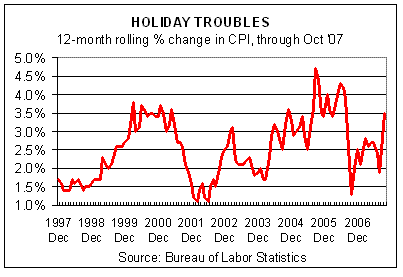
Yes, the core rate of inflation (which the Fed favors as a gauge for monetary policy) looks better, although questions on this front abound too. Stripping out energy and food reveals an annual rate of inflation through last month at 2.1%, unchanged from September. It’s unclear if core CPI’s sideways behavior of late is a prelude to a fall or a rise. Much depends on what the Fed does in the coming months.
That said, the Fed seems inclined to err on the side of more liquidity these days, and that may be the deciding factor for 2008. Indeed, as we noted on Monday, nominal M2 money supply is rising at a rate well above GDP’s nominal pace, a trend supported by the drop in Fed funds since September.
REITs & JUNK: TAKING A CLOSER LOOK
Volatility has returned to the capital markets and that’s good news for strategic-minded investors. Higher volatility is usually associated with lower prices, which in turn can generate more favorable valuations. Deciding when the valuations look sufficiently tempting, however, is never easy.
Consider two asset classes that have been under pressure of late: REITs and high-yield bonds. Of the two, REITs have been hit harder. For the year through the end of last month, REITs suffered a 2.5% loss, based on the Vanguard REIT ETF (VNQ). High yield bonds fared better by posting a 3.6% rise YTD through October, as per Vanguard High Yield Corporate (VWEHX). Even so, junk took a heavy blow in the July/August correction and since then has only recovered a portion of its former glory.
Both asset classes are distinctive for their yields. By that standard, the price declines in each have brought higher yields. (As always, price and yield move inversely for bonds and equities.) Are the yields tempting?
DEVILISH DETAILS
The pace of growth in money supply is a number that’s meaningless in a vacuum. To quote a rate of expansion offers no more insight than looking a stock or bond and having no knowledge of valuations beyond. With that in mind, what can we say of the 6.6% advance (in nominal terms) over the past year in M2 money supply, based on the latest data for the week through October 29?
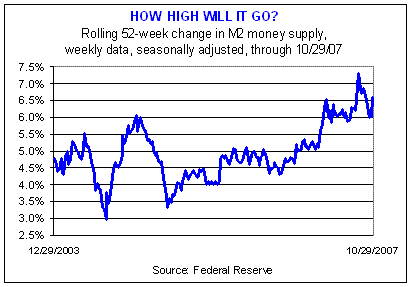
We can begin to search for an answer by considering the speed of the economy. For the third quarter, the government’s current estimate tells us that nominal GDP grew by an annualized 4.7%. Using those figures in combination, it’s clear that the Fed’s printing money at a significantly higher rate than economic growth.
So, what have we learned? On its face, the data suggest that money supply is rising faster than prudence suggests. But again, additional context is necessary lest we make a hasty judgment.
Let’s also add to the record that the 4.7% nominal GDP pace fell from 6.6% in Q2. For additional perspective, take note that the benchmark 10-year Treasury yield now stands at 4.23% and the Fed funds rate is 4.50%. In sum, interest rates are generally lower than the economy’s rate of growth while money supply is rising at a pace that’s substantially higher than GDP’s growth.
All of which might be considered perfectly reasonably if the goal is to juice the economy and head off a slowdown. To be fair, a slowdown for Q4 and beyond is now on everyone’s lips; only the degree seems to be in question. But once again, additional context casts a cloud of uncertainty over an otherwise obvious decision to err on the side of monetary stimulus.