There’s more than one way to run a central bank, which inevitably leads to the possibilities of success or failure. The trick is figuring out if one or the other’s likely and if the expectation is already priced into bonds and other assets.
With that setup, we turn to the yesterday’s announcement by the European Central Bank to hold rates steady and keep its benchmark borrowing rate at 4.0%. In the related press conference, ECB president Jean-Claude Trichet made it clear that rising inflation played a role in the decision.
For the casual observer, taking a tough stand on inflation may seem like an easy choice for a central bank, but investors shouldn’t assume that the ECB’s hawkish disposition is the default position.
Witness the Federal Reserve of late, which finds it far easier to cut than stand firm. In fact, Fed chief Bernanke yesterday signaled that even more rate cuts are coming. “In light of changes in the outlook for and the risks to growth, additional policy easing may well be necessary,” he said in a speech in Washington. “We stand ready to take substantive additional action as needed to support growth and to provide adequate insurance against downside risks.”
Monthly Archives: January 2008
MR. MARKET’S GLOBAL EQUITY ALLOCATIONS
The U.S. stock market capitalization, as a share of the global equity market, has fallen to its lowest level since 1995, according to numbers from S&P/Citigroup Global Equity Indices.
As this year dawned, U.S. stocks claimed a 40.6% slice of the global equity pie, down from 43.9% the year before. As recently January 1, 2002, the U.S. share was as high as 57% of global equity cap. Since then, the U.S. slice has slipped each and every year, bringing us to the current 40.6%, which is more or less tied as the lowest with 1995, based on looking at January 1 numbers over the years.
On a relative basis, if the U.S. is down, other markets must be up. The most conspicuous rise comes in the emerging markets, which posted a 10.5% share of the global equity capitalization as this year opened, up sharply from 7.5% a year ago and triple the level in 2002.

Looking more closely on a regional basis around the world, Europe actually eked out a marginal gain while Japan slipped. Asia Pacific ex-Japan moved higher, rising to 6.4% of global equity cap, up from 5.3% a year ago. Latin America continues to rise as well, starting this year at 2.4% vs. 1.6% on January 1, 2007.
What insights should strategic-minded investors draw from these numbers? For starters, it provides a rough estimate of how to allocate a global equity portfolio if you had no particular view on which regions looked more, or less attractive than others.
Alternatively, for those who think they know better than Mr. Market, the numbers provide a rough benchmark for deciding what constitutes over- and underweighting on global equity basis. For those who are so inclined, the numbers may suggest that overweighting the U.S. is starting to make sense while underweighting emerging markets has some merit.
Perhaps, perhaps not. Mr. Market never reveals his plans ahead of time. The past, at least, is as clear as ever.
HERE IT COMES
There’s no mistaking the trend now. The economy’s slowing dramatically and the risk of recession is quite real, as this morning’s dreary employment report for December strongly suggests.
Nonfarm payrolls rose a thin 18,000 last month, the Labor Department reported today. As our chart below shows, that’s the slowest pace for job creation in over four years. Adding to the labor market’s woes is the news that the unemployment rate for December jumped to 5.0%, up from 4.7% previous. The jobless rate is now at its highest since November 2005.
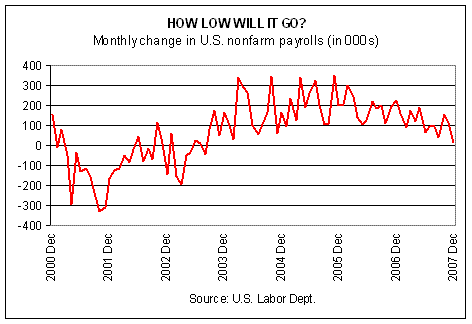
One jobs report may or may not reflect the future, but it’s tougher to overlook the broader trend over time. The economy’s been creating fewer and fewer jobs for two years now and we expect it to go negative. Yes, there are various reasons for that, and in any given month the trend changes. But there’s no mistaking the slowdown now. When the largest economy on the planet has had a tougher time creating jobs for two years or so, one should take notice.
Even the services sector, the great source of strength for the economy over the past generation, is now showing signs of strain in minting new jobs. Consider that last month, the economy generated 93,000 new services jobs, down sharply from November’s 160,000 gain. Meanwhile, the losses in construction and manufacturing jobs are accelerating and last month the tumbles there nearly overwhelmed the frugal gains in services sector.
It’s any one’s guess what comes next, but today’s numbers are likely to cast a long shadow over investor sentiment until something dramatic arrives to persuade the crowd to think otherwise. In short, volatility is likely to remain in a bull market.
For strategic-minded investors who’ve been increasingly wary, and raised portfolio allocations to cash, all of this provides the potential for continued opportunity to pick up asset classes on the cheap in the coming weeks and months (and years?). No, it won’t be easy, but successful investing never is as a long-term proposition. Nonetheless, those with a long-term view must stay vigilant and ignore the noise.
Just keep repeating the mantra that when it comes to asset classes, lower prices equate with higher expected returns. Realizing those higher returns won’t necessarily come quickly or be an easy decision. But the combination of opportunity and patience will pay off eventually.
None of which is news to students of history. As Nathan Rothschild long ago counseled, buy when blood is running in the streets. Easy to say, tough to do. In fact, it’s just the flip side of selling in roaring bull markets. If you believe in one, you should embrace the other.
DON’T STOP THINKING ABOUT TOMORROW
Homo economicus likes to imagine himself as a clever being. And in some respects, he’s right. But when it comes to investing, even the most intelligent minds in the universe can be hornswoggled. Mr. Market, someone once told us, is a tricky nemesis.
With a new year standing before us, and an old one behind, this is the traditional moment to reassess, review and make a guess at what’s coming next. That includes deciding how to tweak the portfolio, if at all. The challenge, for our money, is now and forever at the center of success, or failure. Strategy, in other words, trumps all, even though the outcome may not be obvious for years or even decades. Nonetheless, the choices we make today, tomorrow, next year and beyond for building a portfolio–overweighting this, underweighting that–ultimately dictate results, for good or ill.
On that subject we’re routinely impressed by how difficult it is to reengineer betas to suit our investment needs and claim victory. Indeed, a popular if not universal goal is reducing risk while maintaining return. No easy trick, although it’s tempting to think that any one can do it. The proliferation of ETFs, to take an obvious example, provides a broad and ever-expanding palette of betas to play with. Surely an intelligent strategist can choose a mix of betas, from stocks to bonds to commodities and beyond, and craft a winning portfolio that delivers superior risk-adjusted returns.
While such a goal isn’t impossible, it’s devilishly difficult to achieve for the long run. Ironically, most investors probably have no clue just how difficult the task. Why? Because one can only recognize the depth of the challenge by routinely analyzing a living, breathing portfolio over the course of time. Daily analysis is ideal, although weekly or even monthly data will suffice over long periods. In any case, unless you’re crunching the numbers regularly, and comparing your results to a benchmark, it’s easy to overlook just how elusive successful investment strategy can be.
A YEAR OF LIVING DANGEROUSLY
Last year will be remembered for many things, but calm investment waters won’t be one of them.
One reason is that 2007 witnessed the widest range of performances among the major asset classes since 2000. On top was emerging market stocks, which soared by 36.5% in 2007. At the opposite extreme were REITs, posting a loss of 17.6%–the first down year for the asset class since 1999.

The spread from best to worst last year was a hefty 54 percentage points–the widest since 2000, proving once again that there’s always plenty of opportunity (and risk) inhabiting the investment landscape in terms of the broad asset classes.
The fact that REITs finally succumbed to the laws of gravity after seven straight calendar years of gains may or may not signal what’s coming in 2008. But if you compare the steep slide in REITs last year against the five-year bull market in emerging market equities that’s still ongoing, one can see the outline of a rebalancing opportunity.
Then again, it’s probably too early to make hasty, dramatic decisions for portfolio strategy. REITs, after all, defied gravity for seven years. The hope that they’re now poised to rally after just one down year may be asking too much. Nonetheless, as a long-term proposition, taking a bit away from emerging markets and redeploying it to REITs looks eminently reasonably, at least at the strategic margins.
Still, your editor expects that additional bargains among the asset classes will surface as 2008 unfolds and volatility continues to rise. The crowd isn’t sure if deeper economic troubles are coming, and so the odds for surprises look pretty good.