The major asset classes had their best performance month in April since last October. Only TIPS and foreign developed market bonds suffered red ink last month, as our table below shows. On balance, April was the strongest monthly tally since the perfection of October 2007, when everything was in the black.
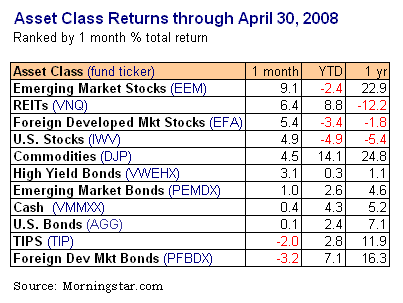
April fell short of the October standard, but not by much. Meanwhile, the leading performers were anything but subtle last month. Indeed, April’s big winner was emerging market equities, which soared more than 9%. That’s about as high a monthly rise as this corner of equities has ever posted.
In a strong second-place showing: REITs, up 6.4%, which is another performance that’s rarely topped in any one month, based on the historical record.
Meanwhile, stocks across the board were up, and so were junk bonds and commodities. Let’s just say that April was a success for investors with diversified portfolios. Unless you were loaded to the gills in inflation-indexed Treasuries and/or sovereign bonds issued by the major foreign governments, you almost certainly saw your portfolio’s value rise last month.
Daily Archives: April 30, 2008
JOE TURNS DEFENSIVE
The economy managed to grow slightly in this year’s first quarter, the government reported today. GDP rose by an annualized 0.6% in this year’s first three months, matching the growth rate in Q4 2007. Given all the recession anxiety of late, that’s a victory of sorts. But this is no time for celebrating. As a closer reading of today’s GDP report shows, consumers are turning defensive in their spending habits in a big way.
Personal consumption expenditures (PCE)–which represent about 72% of total GDP– rose by a meager 1.0% (seasonally adjusted annual rate) in the first quarter–down from 2.3% in Q4 2007. That’s the lowest pace since Q2 2001, which also witnessed a 1.0% expansion. The reason for the current slowdown: two of PCE’s three major components posted declines in the first quarter. Spending on durable goods was particularly hard hit, dropping by a hefty 6.1%–the first case of red ink here since 2005. Nondurable goods also slipped in Q1, falling 1.3%. This marks only the fourth instance in the past 15 years that nondurable goods spending contracted in a quarterly reading.
The lone source of consumer spending salvation came via services expenditures; the only member of the three broad gauges that define consumer spending that posted a gain in Q1. Fortunately, services spending posted a healthy 3.4% jump. But that only reminds that consumer spending overall would be shrinking if it wasn’t for the resilience in services.
Nonetheless, no one should misunderstand what’s unfolding: Joe Sixpack’s sentiment to buy, buy, buy has taken a hefty blow, at least for the moment. And no wonder: prices are soaring for basic staples, i.e., energy and food. Meanwhile, the family home is worth quite a bit less and Joe’s investment portfolio probably suffers a similar discounting. Logic suggests that saving more and spending less is eminently reasonable at this juncture. The only question now: How long will the newly defensive sentiment last?
Clearly, it’s premature to say that the worst of the economy’s downshifting is past. Anecdotal evidence for the second quarter, which is barely a month old, suggests that the correcting process is still underway. Perhaps May and June will deliver better news, perhaps not. But based on the numbers presented in today’s GDP update, combined with an objective survey of finance and economic conditions in the month of April, there’s still a case for staying cautious and defensive in one’s investment strategy. The proverbial “other shoe,” it seems, is in the process of dropping as we write.
THE MEANING OF “REFOCUS”
Perhaps it signifies nothing, but the timing is suspicious.
Last December, the Treasury Department announced that it was sharply reducing the annual limit on investments in the inflation-indexed series of U.S. Savings Bonds, a.k.a., I-Bonds, to $5,000 a year as of January 1, 2008–down from $30,000 a year previously. (The $5,000/yr limit also applies to conventional Savings Bonds as of January 1.)
No big deal in the grand scheme of finance, although we can’t help but notice that the new lower limit comes at a time when inflation-linked portion of payouts for I-Bonds look set to rise, as per the methodology that ties a portion of the bonds’ interest rate to the consumer price index.
The official reason for the reduced investment maximum, as per the Treasury’s press release, was rationalized this way: “The reduction from the $30,000 annual limit in effect for both series since 2003 was made to refocus the savings bond program on its original purpose of making these non-marketable Treasury securities available to individuals with relatively small sums to invest.”