At long last a bit of good news: retail sales rose last month by 0.2%, reversing February’s stumble and bringing hope to the dwindling number of optimists who think economic growth will remain intact. But while Wall Street may be inclined to jump on the news as a reason to buy, the bigger trend in retail sales can’t be denied.
Indeed, as our chart below reminds, the cycle in consumer spending is still clear, which is to say: down. Over the past year through March 2008, advance estimates of U.S. retail and food services sales rose 2.3%, or near the lowest annual pace since the previous down cycle of 2001-2003.

What’s more, other than the positive sign that precedes the number, last month’s rise in retail sales isn’t all that impressive as increases in this data series go. In fact, March’s gain of 0.2% (0.15% if you carry it out to two decimal points) could hardly be more frugal relative to past monthly reports of recent vintage, as our second chart below shows.
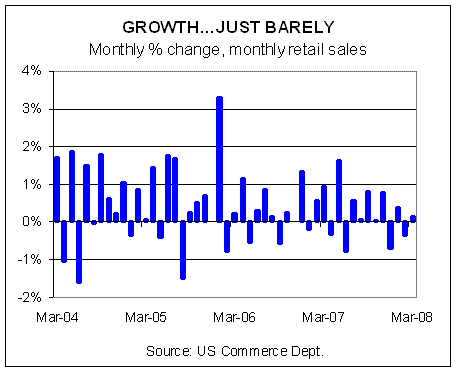
So, yes, monthly data is filled with statistical noise, tempting false impressions for those looking for broader trends. As such, no one should be surprised to see a month or two of relatively large gains in the near future. But that by itself doesn’t change the fact that the economy’s slowing and probably is set to contract for at least a time this year. No, it’s not the end of the world, nor is the contraction doomed to run on for anything longer than what passes for a normal stretch. Of course, no one really knows and so the guessing game rolls on.
Monthly Archives: April 2008
IMPORT PRICES STILL SOARING
Today’s update on import prices once again paints a troubling picture on pricing pressures.
Import prices jumped 2.8% last month, the U.S. Labor Department reports. That’s the highest since last December’s unnerving 3.2% spike. More troubling is the fact that the 2.8% rise in March is in the upper range for monthly changes going back to the 1980s. Adding insult to injury, import prices soared 14.8% measured over the 12 months through last month, as our chart below shows. That’s the highest 12-month rate in the Labor Department’s archives, which goes back to 1982 as per the web site.
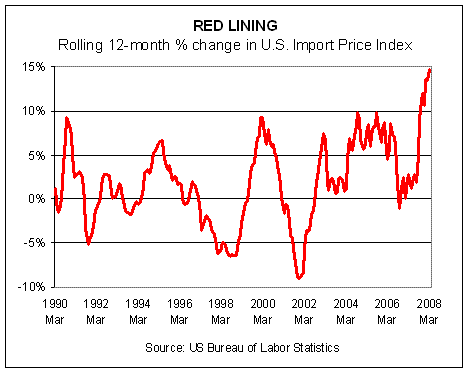
The “good news,” if we can call it that, is that much of the rise in import prices was due to higher energy costs. And energy prices can’t rise forever–we hope. In any case, the 14.8% surge in import prices over the past year falls to 5.4% after stripping out energy. But the lesser rise in non-petroleum import prices is hollow comfort once you recognize that the 5.4% annual pace is the highest since the 1980s. The basic trend, in short, is not in doubt, no matter how you slice the import-price pie.
How troubling is a 5.4% rise in non-petroleum imports? In search of an answer, consider that inflation generally in the U.S. is climbing by 4.0%, based on the annual rise in consumer prices through February. And the nominal (pre-inflation adjusted) annualized pace of economic expansion in 2007’s fourth quarter was 3.0%. In other words:
* non-petroleum import prices are advancing at a roughly 33% faster rate than general inflation
* non-petroleum import prices are rising 80% faster than the nominal growth of GDP
And if we add energy back to the mix, import prices are, well, let’s just say they’re skyrocketing.
THE IMF’S BIG-PICTURE ANALYSIS
Global economic growth is slowing, the International Monetary Fund announced yesterday in its new World Economic Outlook (WEO).
“The global expansion is losing speed in the face of a major financial crisis,” WEO advises. The leading offender is the U.S., the report says, thanks to the correction in the housing market. “The emerging and developing economies have so far been less affected by financial market turbulence and have continued to grow at a rapid pace, led by China and India, although activity is beginning to moderate in some countries.”
INDEXING THE GLOBAL MARKET PORTFOLIO
Buying Mr. Market in all his various asset class flavors is easy these days, thanks to the proliferation of ETFs and mutual funds that mine all the major (and increasingly minor) niches in the capital and commodity markets. But what is Mr. Market offering exactly? And what does his track record look like?
That’s a crucial question for strategic-minded investors, if only to catch a glimpse of the true global market benchmark, which by definition is diversification in full. Alas, there’s no off-the-shelf index for the global portfolio, at least none that we’ve come across. The vacuum inspired your editor to put one together, and so today we unveil the Capital Spectator Global Market Portfolio Index (GMP), which is an approximation of the global capital and commodity markets and weighted as per Mr. Market’s valuation. We’ll be using the index in future posts to compare and contrast various trends in the financial markets.
The methodology behind the benchmark in discussed in some detail below, but first let’s address the obvious question: how has GMP performed? The quick answer is in the chart below, which shows the relative total return performance of GMP against the S&P 500. As you can see, GMP handily beat the S&P 500, from the end of 2001 through March 31, 2008.
click to enlarge

Looking at the trailing performance numbers, the GMP index generated a 13.4% annualized total return for the five years through the end of last month vs. 11.3% for the S&P 500. In addition to outrunning the S&P, the GMP index did so at about three-quarters of the S&P’s volatility over those five years (measured by annualized standard deviation of monthly total returns). The practical evidence of this smoother ride is evident in recent history. From the S&P’s peak back in October 2007, the stock market suffered a -13.8% tumble through the end of last month, vs. a mild -3.2% loss for GMP.
THE PUSH-ME PULL-ME INFLUENCE OF ALTERNATIVE INVESTING
Alternative investing is hot. But you already knew that. Assets under management in hedge funds, private equity, venture capital and other formerly obscure realms have been exploding for the better part of a decade now. Slightly less obvious in the financial universe is the trend’s influence on the conventional money management business. For several years now, more and more investment shops are offering something a bit different, which generally means indulging in portfolio engineering of one kind or another. One quick measure of the trend can be found in the growing list of mutual funds and ETFs for which the underlying strategy can’t be described in 10 seconds or less.
THREE MONTHS RUNNING FOR JOB DESTRUCTION
Another day, another symptom of recession to digest.
Today’s statistical confirmation is brought to you by the monthly change in nonfarm payrolls, which lost ground in March, reports the U.S. Labor Department. Meanwhile, unemployment popped up to 5.1% last month from 4.8% previous, pushing the jobless rate to its highest since May 2005.
The loss of 80,000 jobs last month was only slightly worse than the 76,000 slippage the month before. More troubling is the fact that the economy has suffered job destruction for three months running, a stretch of red ink that hasn’t occurred in this data series since 2003. As economic signals go, the triple-month slip is quite robust. Any one month is subject to revisions, of course, but the general trend can’t be denied for such a crucial economic indicator as payroll changes.
“Strong relationships exist between the employment data and virtually every other economic indicator,” advises Richard Yamarone, director of economic research at Argus Research, in his book The Trader’s Guide to Key Economic Indicators. “The growth rate of nonfarm payrolls, for instance, is strongly correlated with the growth rate of GDP, industrial production and capacity utilization, consumer confidence, spending, income–even with Federal Reserve activity. If it’s relevant to economic activity, it will have links with the payrolls data.”
Alas, as you can see from our chart below, the trend in nonfarm employment has turned decisively down. Meanwhile, today’s news only corroborates the negative signal in yesterday’s update on weekly jobless claims,
click to enlarge

It’s easy to jump to conclusions and assume that the Fed will now cut interest rates again in the wake of the employment picture. Perhaps, but it’s not yet obvious in Fed funds futures prices. The Fed funds rate currently stands at 2.25%, down from 3.0% previously after a hefty cut at the March 18 FOMC meeting. The next scheduled confab is April 29 and 30. Judging by the futures market, however, the jury’s still out on whether another cut is imminent, suggesting that the central bank has already dispensed its monetary medicine for this cycle.
Indeed, if the current downturn proves to be short and shallow, one could argue that the Fed’s pre-emptive liquidity injections will suffice. All the more so if one is worried (as is your editor) about the inflation outlook. Of course, all bets are off if upcoming economic reports show a worse-than-expected economic contraction is unfolding. Unfortunately, it’ll be a month or two at least before the downturn’s true nature will begin to emerge. The future is as cloudy as ever no matter where we are in the cycle. Worrying and nail-biting, of course, roll on with full transparency in real time.
A SPIKE ENDS THE DEBATE
No one should be surprised by this morning’s discouraging news on weekly jobless claims, which surged to 407,000 last week–the highest since the anomalous but temporary spike in September 2005 directly after Hurricane Katrina. The warning signs have been bubbling for months, as CS and others have pointed out. And so, this time, the rise in new filings for unemployment insurance is a reflection of a weak economy rather than a one-time weather event. In short, there will be no sudden and sharp drop in new claims this time, as there was in 2005.
As our chart below reminds, the rise in jobless claims has been unfolding since late last year. The message in the graph is clearly that the tide has shifted in no uncertain terms. No one can say that jobless claims are still in a range that reflects a healthy economy. Those days are over. The front line of optimism now turns to looking for light at the end of the tunnel. As we discussed last Friday, the recession is here and the debate necessarily moves to the questions: how long, how deep?
click to enlarge

Fed Chairman Bernanke set the official tone yesterday, when he said “recession is possible” in testimony on Capitol Hill. By this editor’s reckoning, Bernanke was being charitable. As the above chart suggests, the odds of sidestepping economic contraction look virtually nil. Yes, anything’s possible. But if we look at a broad range of economic indicators in addition to today’s jobless claims report, it’s hard to miss the obvious trend.
It’ll take time to get a handle on how short and shallow (or long and deep) the recession will be. Given the lag in economic data, the coming weeks and months are likely to provide ongoing confirmation of what’s already obvious. As a result, the focus turns to the various leading economic indicators for clues about where the cyclical trough lies and what will spark an eventual upturn. But let’s not strain our eyes at this point; it’s too early for that. For the moment, patience and prudence, along with a modest dose of opportunistic buying sprees here and there are still a strategic-minded investor’s best friends.
VOLATILITY SURVEILLANCE
It comes as no surprise to learn that volatility in the capital and commodity markets has been rising of late. Confusion and uncertainty (both of which have been in surplus in recent months with regards to economics and finance) typically sow the seeds of wider trading ranges. Monitoring volatility is no short cut to easy profits, of course, but as we’ve discussed from time to time, the ebb and flow of volatility sometimes offers strategic-minded investors some valuable clues about investment cycles.
With that in mind, below we present a freshly updated chart of rolling 36-month volatility over time for several major asset classes, with data through March 31, 2008. Consider that volatility looked unusually low in ’06 and ’07, which we now know was a prelude to a reversal. Note too that trailing returns back in ’06 and the first half of ’07 looked exceptionally strong across the major asset classes. The two trends looked long in the tooth, suggesting that the cycle was poised to turn. And turn it did. But now that it’s turned, what’s next?
click for larger image

That’s always a relevant question and it’s forever unclear in real time. To the extent that strategic-minded investors can generate informed guesses about the future, tracking volatility cycles is one among many factors to survey on a regular basis. For the moment, there are no obvious signals springing from volatility, at least nothing comparable to the signs of ’06 and ’07. As such, volatility remains one more metric we watch and will continue watching, always in context with other factors, starting with valuation.
Meantime, volatility has been rising and returns have been falling. But that too will end…at some point. Cycles, in short, remain very much alive and kicking.
SEAT BELTS ARE RECOMMENDED (corrected version)
Whipsawed is the best way to describe recent action in the major asset classes. What was down is up; what was up is down.
Consider the horse race for March, as per our table below. Commodities were the bottom performer, posting a total return loss of -6.5%. A month earlier, commodities were the leading asset class, posting a 12.2% gain in February. Meanwhile, REITs were the big winner in March, completely reversing their last-place status the month before.

In fact, what little postive-return consistency there was in February and March among the major asset classes was concentrated in cash and foreign bonds.
The back and forth is hardly surprising. The unfolding drama in finance and the wider economy leaves investors jumpy as they ponder where the next shoe will drop. We’re already up to our necks in fallen footwear and few pundits (including this one) are prepared to say it’s over.
Yesterday was a perfect example. It’s not every day that the U.S. Treasury Secretary gives press conferences outlining ambitious proposals for overhauling financial regulation in the U.S. and dramatically expanding the powers of the Federal Reserve. Yes, the plan may be dead on arrival in Congress, as has been widely reported. But it’s clear that the turmoil on Wall Street continues to reverberate throughout the wider economy and the government.
Meantime, large financial institutions keep announcing the price tag of previously believing that bull markets last forever. The Swiss banking giant UBS announced yesterday that its first-quarter loss would top $12 billion, thanks largely to mounting troubles from the subprime mess.
If investors are skittish in such an atmosphere of uncertainty, no one should be shocked. Strategic-minded investors, however, should be looking to take advantage of the volatility when opportunity arises. For equities in particular, there’s a recession premium associated with buying when the crowd wants cash. The catch: the recession premium probably won’t pay off for years and the only way to boost the odds of success are buying at lower prices and extending one’s investment horizon.
These are extraordinary times and markets are likely to be whipsawed for the foreseeable future, interrupted by periods of calm that give way to a fresh round of drama. Once the economic outlook stabilizes will something approaching a more normal state return to the risk/reward profile of the major asset classes. But for the moment, ours is a fluid period. As Wall Street and Main Street grapple with the prospect of recession, prices will be volatile. So it goes when uncertainty comes in larger-than-usual doses.