It’s been all about prices lately, and it’ll continue to be about prices for some time.
The update du jour on that front is import prices, which have surged higher by nearly 18% for the year through May, the Bureau of Labor Statistics reports. On a monthly basis, the trend looks a bit less threatening. Import prices rose by 2.3% last month, down a bit from April’s 2.4%. The trend looks even better if we exclude prices of petroleum imports, which continue to climb into uncharted territory. Even so, non-petroleum import prices are up 6.6% for the year through May, reminding that the U.S. continues to import inflation.
For comparison, domestic inflation is up by a relatively mild 3.9% for the 12 months through April, with an update for May scheduled for release tomorrow. It doesn’t take a lot of math to figure out that the more this country imports, the stronger the pressure is for higher prices in everything from onions to oil.
Any way you slice it, prices generally are rising. The Federal Reserve’s position to date has been more or less to hope that the slowing economy would take the edge off the pricing pressure. As we’ve long argued, that’s an especially risky policy for this economic cycle. Much has changed in 2008 compared to recessions past, and so waiting for aid in the form of slowing or slumping demand may not do the trick this time around.
Monthly Archives: June 2008
DIVING DEEP FOR VALUE
The idea that smaller companies can potentially generate bigger rewards is an old one, although it’s forever new in creating hope.
In 1981, Rolf Banz formally introduced the concept of a small-cap risk premium into the academic literature. For the 43 years through 1974, small cap performance left large cap stocks in the dust, his study found.
The news probably wasn’t surprising to financial economists. Modern portfolio theory, forged in the 1950s and 1960s, teaches that higher returns are a function of higher risk, and by that simplified reasoning the higher performance identified by Banz looks like compensation for higher risk.
In the years after Banz’s paper, small cap research has became increasingly sophisticated, as well as controversial. As evidence, one need only review the debates that are still raging in the wake of the Fama and French research that identifies small-cap and value risk factors as fundamental drivers of equity returns generally.
Certainly there’s plenty of risk in small cap stocks. On that, we can all agree. There’s even more risk in the micro-cap equity realm, which includes the smallest of the small. Does the higher risk translate into even higher returns? Perhaps, although this world isn’t for the financially squeamish. But if you can stand the heat, and you have an eye for value, there may be opportunity at the low end of the capitalization scale.
Exactly how much opportunity is debatable. In search of more context, Jon Heller recently created an index that tracks a basket of the “deep value” spectrum of micro-cap value stocks: the Cheap Stocks 21 Net/Net Index. It’s far too early to make definitive judgments on such a short track record, but that doesn’t stop us from looking.
If you’re curious, pay a visit to Heller’s blog, Cheap Stocks,where he comments on value investing far and wide. Yet for all his enthusiasm for poring over thinly traded microcaps in search of value, he’s also mindful of the dangers. As he wrote last week, there’s no shortage of hazards lurking in the murky waters of deep value microcap investing. That may be why the rewards can be so extraordinary. Nonetheless, the traps “are especially prevalent in the land of net/nets (companies trading below net current asset value) where we expend a great deal of research effort,” Heller warns.
Heller, by the way, is an analyst by training. Holding both a CFA and an MBA, he’s president of Newtown, Pa.-based KEJ Financial Advisors, LLC, his recently launched fee-only financial planning firm. Previously, he spent 17 years looking at the numbers for Bloomberg, L.P., in various positions, including overseeing the firm’s equity research department for several years. He’s also worked at SEI Investments. This reporter had the good fortune to witness Heller’s impressive analytical skills up close, when our paths crossed at Bloomberg. For all his abilities at reading balance sheets, deciphering income statements, and otherwise looking for financial pearls among swine, he has also has a healthy respect for portfolio diversification and the power of multi-asset class portfolios. In short, Heller is that rare breed who knows how to navigate the micro and macro waters when it comes to investing strategies and financial analysis.
As such, we were intrigued when we learned that our old pal has been dabbling in an indexing project targeting micro caps that look undervalued. Relatively little is known about how this group acts as an asset class, if we can call it that. That makes Heller’s forays, tentative and experimental though they are at this point, worthy of closer inspection. Inspired to learn more, we recently conducted an email interview with Heller on his new index. Here’s an excerpt:
NOW WHAT?
Perhaps it was just bad timing, or dumb luck. Or maybe the forex market really is testing the Fed chairman. Whatever the explanation, Ben Bernanke’s decision last week to break with precedent and talk up the dollar looks ill-timed.
But what’s done is done. As we discussed last week, the Fed chief last Tuesday and Wednesday decided to speak in relatively clear and transparent terms on the dollar and inflation. By the standards of former central bank heads, Bernanke’s chatter was surprisingly transparent, especially as it relates to the dollar. Typically, talking about a strong dollar is left to the Treasury Secretary for public discussion. But last week was different, and Bernanke said in no uncertain terms that the Fed’s “commitment to both price stability and maximum sustainable employment…will be key factors ensuring that the dollar remains a strong and stable currency.”
Extraordinary as such comments are for a Fed chairman, the effort backfired, judging by last week’s fall in the dollar. The U.S. Dollar Index fell by nearly 1% last week, with all of the decline coming on Thursday and Friday, i.e., the two days immediately following Bernanke’s remarks on the dollar. Of course, it’d be naive to think that the greenback’s stumble last week was purely a market referendum on Bernanke. There are many other global economic forces in play that conspired to trigger fresh selling in the dollar–higher oil prices and inflation worries, for example.
But let’s be clear: if the dollar is allowed to decline for any length of time from here on out, the trend will take a toll on the Fed’s influence. Yes, the central bank’s primary weapon is the power to control the money supply, and by extension the price of money. But moral suasion is also a critical lever for the Fed. Simply put, what the Fed says is no less important than what the Fed does. In the cause of central banking, actions don’t speak louder than words; rather, the two are on equal footing. A central bank that loses the respect of markets is a central bank that must wage its fight for sound money with one hand tied behind its back.
ANOTHER ROUGH JOBS REPORT
This week has witnessed some encouraging news on the economic front, but this morning’s update on payrolls will mute any temptation for celebrating.
Indeed, the unemployment rate surged upward to 5.5% last month from 5.0% in April, the Bureau of Labor Statistics reports. The jobless rate is now at its highest since October 2004. And let’s not forget that unemployment reports are the most politically sensitive economic number and that this is a political year. As a result, we expect the echo chamber to ring loud and clear over this report. Prepare yourself for a hefty dose of discouraging chatter about jobs and the economy this weekend and into next week.
Perhaps that’s appropriate, considering that the economy continued to shed jobs in May, as our chart below shows. In every month of 2008 so far, nonfarm payrolls have shrunk.

There’s simply no way to spin the reality that the economy is on the defensive. The pain isn’t necessarily deep or wide, at least not yet. But there’s no denying the trend.
Still, it’s been tempting at times this week to think otherwise. Yesterday’s news that retail sales for May exceeded analysts’ expectations was taken by some as a sign that the worst is behind us. Another potential bright spot was the drop in jobless claims for last week, which surprised economists and inspired some to declare that the economy was finally on the mend.
TALK IS CHEAP, BUT IT’S NOT WORTHLESS
The Federal Reserve Chairman is chatting up the dollar these days. On two separate occasions this week, Ben Bernanke made some extraordinary comments about inflation and the greenback. Extraordinary, that is, for a sitting Fed chairman.
Typically, the tired remarks about a strong dollar being in the best interests of the U.S. are dispatched by the Treasury Secretary—a view that’s summarily dismissed by forex traders largely because it’s been made so often over the years that it’s lost any real meaning. But when the Fed chairman speaks of the buck with a bullish view, well, that’s something else entirely. Unsurprisingly, the foreign exchange market is paying attention.
PORTFOLIO THEORY: THE UNNATURAL ALTERNATIVE
The genius of Markowitz’s portfolio theory, unveiled to the world in a 1952 research paper, shines as bright in the 21st century as it did 50 years previous. But it’s debatable if the associated logic and allure of the basic concept is widely understood or practiced in 2008.
Granted, Markowitz himself has partially renounced some of the technical aspects of the original paper. Namely, the idea that one should “optimize” a portfolio solely by analyzing expected returns vis a vis expected volatility (standard deviation) is considered by many to be overly simplistic and in need of revision. In fact, there’s been much progress in bringing more nuance and sophistication to portfolio theory over the past 50 years. There are as many ways to implement a Markowitz-inspired view of portfolio theory as there are stars in the heavens. Yet there’s still value left in the conventional proposition of Markowitz’s portfolio theory, aided and abetted by the capital asset pricing model and the efficient market hypothesis.
THE ALLURE (AND RISK) OF EMERGING MARKETS
There’s a whole lot of stress-testing going on these days in the capital markets. And one of the striking lessons is that emerging markets have proven to be far more durable than many investors, including yours truly, thought possible. Yes, the durability could evaporate tomorrow for all we know. But for the moment, it’s hard not to be impressed by the resiliency of equities in the developing world.
Consider the table below, which compares the major asset classes and ranks performance by May 2008 total returns. Once again, emerging markets were the clear winner, rising by more than 3% last month. Other than commodities, emerging markets equities are comfortably in the lead for the past year through May 31, 2008 as well.
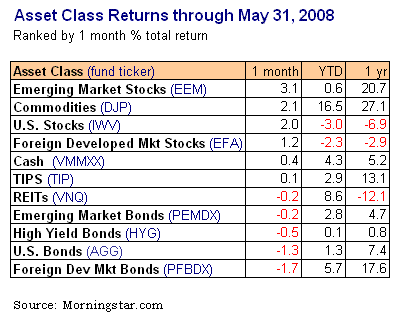
Yes, there have been some tough spots along the way, as there inevitably are for all the major asset classes. This year’s January and March were especially hard on equities in emerging markets, which suffered dramatic declines in those months. Nonetheless, it’s hard to overlook the fact that despite all the turmoil in the global economy–from wars to price shocks in energy and food to various political and weather-related disturbance–this slice of the world’s stocks has held up remarkably well.