With the last of the June economic data in hand, it’s time to update the CS Economic Index, which is calculated monthly. As our chart below shows, and anecdotal evidence suggests, the U.S. economy is weak and getting weaker.

The black line in the chart above, which runs through June 2008, is our broad measure of U.S. economic activity, comprised of 17 variables, ranging from nonfarm payrolls to retail sales to business loans. The index’s biggest weighting (a bit more than 40%) is comprised of leading indicators, which are those measures (such as new building permits and disposable personal income) of economic activity that are considered as windows into the future. Another 30% of our broad economic index is made up of coincident indicators with the remaining 30% in lagging indicators. In short, the CS Economic Index is designed to measure broad economic activity, giving a modest bias to leading indicators.
With that in mind, we take no comfort from the relatively sharp decline in the leading component of our index (the red line in the chart above). As you can see from the graph, the leading indicators are signaling that there are more challenges ahead. In fact, the leading indicators have been flashing warning signs for some time now, although the downside momentum has only been bubbling since late last year.
Monthly Archives: August 2008
HOLDING ON…FOR NOW
This morning’s update on personal income and consumer spending is a complicated beast. On first glance, it looks like the great American income machine has stumbled, and stumbled badly. But looks can be deceiving. Maybe.
The first order of business in digesting today’s report on personal income and outlays is looking at the big negative: disposable personal income dropped by a hefty 1.9% (seasonally adjusted) in June. This is income that’s left over after Joe Sixpack has paid his bills and so it’s a key number about his capacity for running to the mall and picking up an extra TV. In short, this is the front line measure of the American economy’s growth potential. GDP, after all, is overwhelmingly dependent on consumer spending. As such, the 1.9% drop in DPI–the first slump since April 2007 and the biggest decline since August 2005–looks ominous, as our chart below suggests.

But the DPI drop isn’t quite as painful as it appears. Note in the chart above the large bump in May that precedes June’s drop. The rise in DPI is courtesy of the government’s stimulus checks. The stimulus is temporary, of course, and so its effects are beginning to fade. No great surprise. If we take out the anomalous jump in May’s DPI, June’s level of DPI is at an all-time high.
The key issue is deciding how much additional DPI fading awaits. Logic suggests we’ll return to trend, short of another round of stimulus. By that reckoning, DPI will fall in the coming months, perhaps to the $10.6 trillion level for August or September. That not-unreasonable assumption means that the market has to brace itself for more red ink on the DPI ledger. Such declines will look troubling, but they won’t signal much more than the aging effects of stimulus checks. Up to a point, that is. Indeed, one might reasonably think that DPI is due for some additional retrenching due to the various economic ills of late. In that case, DPI declines may run on for longer than the optimists expect.
REITS POP, COMMODITIES FLOP
July 2008 was one of the more challenging months for strategic-minded investors in recent memory. There was plenty of red ink on last month’s tally, as our table below shows, although the headwinds were even stronger than losses alone suggest.
Let’s begin by noting that the big stumble last month came in commodities. The DJ-AIG Commodity Index, for instance, dropped by an astonishing 11.9% in July. That’s the biggest month setback for the benchmark, as far as we can tell, based on records we can dig up going back to 1991. (Our ETF proxy in our table fared even worse, slipping more than 12% last month.)
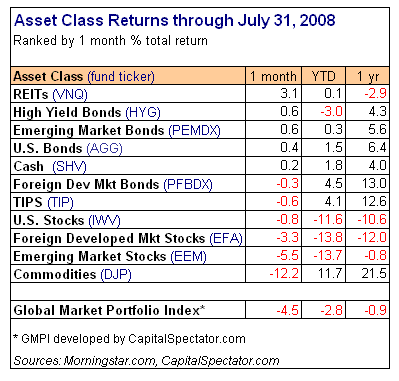
Foreign stocks took it on the chin last month, too, although the pain was modest by comparison with commodities.
In the winner’s column: REITs, which rebounded in July with a robust gain. Overall, we can say that REITs popped and commodities flopped.
The steep tumble in commodities was due mostly to oil’s sharp drop last month. Since most commodities indices are heavily weighted in oil and energy, it’s no surprise to learn that commodity benchmarks overall suffered in July. Unexpected? Hardly. Commodities generally have been rallying for years and the corrections along the way, at least on a monthly basis, have been relatively rare and quite mild for the most part. Taking some of the froth out of prices, particularly in oil, is long overdue and it wouldn’t surprise us to see more of the same in the months ahead. Commodities generally are a volatile asset class, and if you factor that in with the record prices for many raw materials of late, it’s no surprise to see downside volatility has finally come a-courtin’.