Yesterday’s huge tumble in the stock market has spread fear far and wide among investors, your editor included. But focusing on the here and now isn’t the answer. This too shall pass, but not anytime soon.
What’s a strategic-minded investor to do? Nothing at the moment. If you haven’t been trimming back on risk in your portfolio, now’s not the time to start. Easy to say, tough to do. But investing isn’t easy and panic selling is never the answer. Yes, those are just words and it’s slim comfort when you look at your investments and see only red. But keep in mind that people like Warren Buffett, and institutions like Citigroup and J.P. Morgan have been buying while everyone else is selling. Why? Because they’re looking forward, several years down the road.
We’ll go out on a limb here and predict that the global economy will survive, and in a year or two it’ll be thriving once more. One reason is that there are multiple mechanisms in place to prevent collapse. No, the risk of a deep, systemic failure isn’t zero. And, yes, an asteroid could hit the Earth next week. But for those with a medium/long time horizons, the key question you want to ask yourself: What will you think three years from now looking back?
For the 20 or so years your editor has been writing and investing for his personal account there’s a recurring theme that gnaws: we didn’t take advantage of the calamity. The mind tells us to run when there’s danger, and ride with the crowd when skies are sunny. There’s some logic to that, but left unchecked it leads to mediocrity or worse over time.
Monthly Archives: September 2008
I DON’T LIKE MONDAYS
There’s never a good time to release bad news about consumer spending and income, but it’s even worse on the day that’s likely to witness Congress vote in favor of the $700 billion bailout for the U.S. financial system.
Spending that mountain of cash to salve so much self-inflicted pain will inspire no one, least of all investors. Yes, it may provide a short-term bump in prices, maybe. And it may keep the apocalypse at bay, maybe. And the government may get the money back when it resells the assets down the road, maybe. But in the long run, it’s not a productive use of capital. Mopping up spillage never is.
For every argument in its favor, it’s easy to worry about the potential for negative blowback. Did we forget to mention that we’re in uncharted territory here?
Adding to the woes about the limits of Washington’s debt-financed restoration of financial order is news this morning that disposable personal income dropped 0.9% last month, the third in a row. No wonder, then, that personal consumption expenditures were unchanged in August from the previous month.
“With the labor market remaining very weak, slow to negative growth in disposable income will most likely plague the consumer for at least the next six months,” Adam York, an economist at Wachovia Economics Group, told CNNMoney.com.
It’s hard to see the outcome as anything other than recession. “It looks like we are poised to see a real-term decline in personal consumption and that will likely result in a negative GDP number in the third quarter,” James O’Sullivan, economist at UBS Securities opined to Reuters.
As we write, the S&P 500 is off by nearly 4%. Meanwhile, the flight-to-safety instinct is very much humming today. Demand for the 10-year Treasury pushed its yield down sharply to around 3.65% in early afternoon trading, New York time, down from 3.83% at Friday’s close.
The problem at the moment is the unknown. The haziness on the future—future earnings, future real estate prices, future this, future that—is weighing on just about everyone. It’s going to take time—several weeks, at least—to get a halfway decent guesstimate of what the government’s getting for its $700 billion. Add to that the question of how much patience the global markets have for yet another big borrowing binge by the U.S. And what will all this do to Joe Sixpack, and to corporate profitability, and real estate prices, and on and on.
No one really knows, and the depth of the ignorance and the magnitude of its implications have rarely been greater.
Yup, it’s a Monday alright.
IT TAKES TWO TO TANGO…
As we prepare to enact the mother of all bailout packages, there are lots of questions about how it all happened. As The Big Picture’s ever-perspicacious Barry Ritholtz reminds in Barron’s, even Wall Street needed some help in blowing itself up. Alas, it’s too late for salvation in 2008, but Ritholtz’s brilliant analysis of what happened, and why, well, there’s always the next time. Too bad that enlightenment in the money game is still cyclical. But we can still dream, can’t we?
ANOTHER BAILOUT IS COMING, BUT THE ECONOMY’S STILL HURTING
Surveying the financial and economic landscape looks increasingly like an exercise in watching the perfect storm unfold. Today’s sour updates on durable goods orders, new home sales weekly jobless claims only strengthen the sentiment.
Durable goods first: they’re down. Big time. The government reports that seasonally adjusted new orders for durable goods slumped 4.5% in August, the biggest percentage drop since January. As the chart below reminds, the trend looks equally troubling in actual dollar value as well.

It doesn’t help that on a rolling 12-month basis, new orders for durable goods have fallen for six months running. Ditto for the fact that the back-to-back losses of nearly 5% in July and August for the 12-month change in new orders is the deepest loss for two consecutive months in six years. Let’s not mince words: the trend is definitely not our friend here.
THE ALLURE (AND RISK) OF SILVER LININGS
Financial crises, bank implosions and chaos generally don’t often inspire. But every debacle has a silver lining. One of those linings shows up these days in higher interest rate spreads. Investors willing to wade into the riskier realms of debt are being paid for their troubles, or so one could argue.
As our chart below shows, you get more for your money these days when buying high-yield bonds and Baa-rated corporates, the lowest tier of investment grade debt.
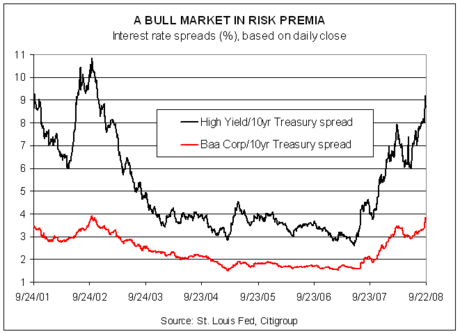
High-yield bonds (as per Citigroup High Yield Index) offered an 875-basis-point yield premium over a 10-year Treasury Note as of Monday’s close. Meanwhile, the yield on Baa bonds (represented by Moody’s Seasoned Baa Corporate Bond Index) closed at 378 basis points over the 10-year the same day. As the graph above relates, those are the highest risk premia in roughly six years.
But are they high enough? Do they fully compensate for the turbulence ahead? Since we don’t really know what degree or type of hazards await, we must remain agnostic when it comes to proclaiming definitive answers. Common sense, however, suggests that there’s still trouble afoot, and so one can’t be fully confident that the elevated risk premia noted above will suffice. But they might.
The potential for capital losses that exceed the received yield is an ever-present risk, and perhaps more so than usual in the early days of autumn in these United States. At the same time, it’s getting harder to ignore the rising spreads. It may be too early to make hefty bets about the future, but it’s not too early to begin dipping one’s investment toes into the riskier ranks of bonds. That’s especially true for those with an existing multi-asset class portfolio, a long-term perspective and an underweight position in lower-grade fixed-income allocations.
There are no guarantees with investing, but you can count on variations in risk premia. Ignoring the variations is imprudent, but so is diving in head first at the first uptick in yields. Finding a middle ground is the goal, and arguably that middle terrain begins with a toe in the water now.
Yes, spreads may be higher down the road. Or not. We don’t know, and neither does any one else. You can bet the farm one way or the other. Alternatively, you could make modest buys on occasion, when the odds seem at least moderately favorable. Might these be one of those times?
WHAT YOU DON’T KNOW CAN HURT YOU
The dollar was crushed yesterday. The U.S. Dollar Index dropped more than 2%, reversing whatever gains were left from the now-evaporated summer rally.
The verdict, it would seem, is in. The forex market isn’t amused by the prospect of adding $700 billion-plus to the already bloated U.S. budget deficit. Jay Bryson, global economist at Wachovia Securities, summed it up neatly in a note to clients yesterday, explaining that “this weekend’s announcement that the U.S. government will buy up to $700 billion worth of bad debt from financial institutions is a short-term negative for the dollar. In order for investors to absorb the increased issuance of U.S. Treasury securities the returns on those securities will need to rise.”
Bryson adds that there are two ways for bond returns to rise from a foreign investor’s perspective. Yields can rise, which is to say that prices will drop. That seems plausible, given that $700 billion in new debt equates to roughly 15% of existing Treasury debt outstanding. The second way is a depreciation of the dollar.
Yesterday, we got both. The buck was slammed and the benchmark 10-year Treasury Note rose to 3.83%, the highest close in more than a month.
Why does this matter? Because foreigners will be ponying up a fair chunk of the $700 billion loan to fund the new bailout plan. As such, monitoring what foreigners think is more than a passing news story these days. One might wonder what might compel foreign central banks and offshore investors to further expand their already large holdings of Treasuries.
WALL STREET, R.I.P. NOW WHAT?
The financial industry has been transformed to a degree that few thought possible only a few weeks before. But this is all a sideshow to the real story of change as it relates to the economy and deciding how Main Street will fare in the months and years ahead.
Still, it’s hard not to gawk at the spectacle that is Wall Street. First observation: Wall Street as it existed just a few weeks ago is gone. The news that Morgan Stanley and Goldman Sachs–the last two large, independent investment banks standing–will transform their businesses into bank holding companies, a decision that completes the decimation of the old investment banking model. The boys had a good run. Unfortunately, they blew up the industry and now all that’s left is a bunch of humbled Citigroup wannabes.
That’s not so bad, if only because Citigroup, sprawling and unwieldy as it is, didn’t self-destruct. Neither did J.P. Morgan or Bank of America. One reason: those three, as bank holding companies, operate under a tighter, more constricting regulatory framework, and so by law they were forced to operate more conservatively compared to the likes of Bear Stearns and Lehman Brothers. No problem: some of our favorite institutions are plain old banks and the world will probably survive just fine now that they’ve inherited the throne.
But let’s not get too giddy. Keep in mind that there are still a lot of little Lehmans and Bear Stearns in the world, otherwise known as hedge funds. Collectively, this gang runs a lot of money, much of it leveraged, and some of it–perhaps most of it–is managed unintelligently. We don’t really know, of course, but given what’s transpired in recent weeks we’re inclined to wonder.
A BULL MARKET IN GOVERNMENT INTERVENTION
First it was Bear Stearns. Then the government bailed out Fannie Mae and Freddie Mac. Before the ink was dry on that deal, Uncle Sam loaned $85 billion to insurance giant AIG in exchange for an 80% stake in the company. Along the way, the Fed has been throwing money every which way, depending on the day.
But wait: there’s more. In the last 24 hours, a new round of government bailout efforts are underway. Yesterday, Congressional, Federal Reserve and Treasury officials were talking of launching a massive government fund to buy up the toxic securities from investment banks and other institutions. Meanwhile, the SEC announced a ban on short selling on nearly 800 financial stocks. And the Treasury is now insuring money market funds to shore up sentiment in the wake of news that the Reserve Fund—a money market portfolio—broke the buck this week, i.e., its net asset value fell below $1. The drop stoked fears that even cash equivalents might not be safe.
The government, in other words, is throwing everything but the kitchen sink at the bear market. There’s some logic to this, of course. Preventing bank runs and the like is just common sense. But how much is too much? Or too little? Alas, intervention is an art, not a science. Financial turmoil of the degree we’ve seen this week is rare, and so there’s not a lot of precedent. The early 1930s are an obvious era for study, but the relevance is limited, since two or three things have changed the days of FDR and “brother can you spare a dime.”
Meanwhile, asset prices want to fall, and interest rates want to rise (i.e., those rates that involve private parties that can’t print their own money). But the government is doing everything in its power to keep Mr. Market from having his way. This is reasonable, up to a point, although it’s a safe bet that it’ll take time before we know where reason ended and moral hazard began.
A DESPERATE STRUGGLE FOR PERSPECTIVE…AGAIN
Perspective may be the only true value left when fear runs amuck.
There’s a blizzard of reports swirling about and it’s easy to get confused. One need only review the headlines for a few minutes to feel dizzy. But while the red ink flows like rivers in a hurricane, the first step in assessing what’s happening is stepping back and looking at the big picture. With that in mind, here’s a whirlwind tour of where we stand as of last night:
First, demand for safety has surged–to extraordinary levels. One need only look at the collapsed yield on 3-month Treasury bills for evidence. It’s a rare event when money managers willingly accept a guarantee of no return, perhaps even a slight loss in exchange for assurance that principal will be returned. Welcome to the new age.
The annualized yield on the popular benchmark of a “risk-free” asset closed at 0.03% last night, a sea change from just three days earlier, when the security closed at a 1.49% yield. Reportedly, some investors yesterday at one point were gladly buying 3-month T-bills at negative nominal yields! The rush to safety was so strong that the hope of turning a profit could wait for another day (or year?). The same motivation drove up the price of gold by one of the biggest single-day gains ever for the precious metal. The rise had nothing to do with inflation worries, which are effectively dead for the moment. Rather, it’s all about finding a port that’s sure to weather the financial storm blowing through global markets. A few thousand years of encouraging history in the metal’s ability to preserve wealth aren’t easily ignored these days.

Where does that leave the major asset classes? Battered and bruised, to be sure. With the exception of commodities and bonds–short-term investment grade bonds–there was red ink everywhere yesterday. There’s no shortage of minus signs so far this month either. All the major asset classes are down in September through last night, with the exception of U.S. investment grade bonds as per the Lehman Aggregate Bond Index. As a result, our CS Global Market Portfolio Index (GMP) has slumped 8.5% so far this month, based on our preliminary estimates. That’s better than the S&P 500’s 9.9% drop this month through yesterday, although it’s cold comfort given what’s going on in the world. (We’ll analyze GMP and the implications for portfolio strategy in more detail in the coming days and weeks. As a preview, this isn’t entirely unexpected although it’s clearly painful.)
The biggest fear is now fear itself. Perhaps that’s rational, perhaps not. Lending has dried up, cash is king and everyone’s wondering where the next shoe will drop. That’s hardly a surprise, but strategic-minded investors must keep the big picture in perspective.
THE HOUSING SLUMP ROLLS ON
A bit of good news on the real estate front would be ideal right about now. Alas, today’s update on the housing market is disappointing once again.
Housing starts for August posted another hefty decline, the Census Bureau reports. The 6.2% drop in annualized starts last month vs. July isn’t the biggest decline on record, but it’s still hefty. More troubling is the fact that the declines just keep coming, as our chart below shows. Starts are now at a 17-1/2-year low.
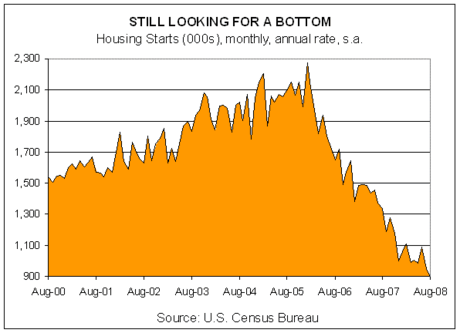
Investors have been looking for a bottom in starts, and the bounce in June gave hope to some, including this editor, who thought maybe, just maybe, the carnage was behind us. But the optimism was premature–again. Today’s numbers reconfirm the bearish tone in housing.