The great sucking sound on Wall Street has few redeeming features with the possible exception that it’ll cleanse the economy of long-running financial excess and dampen, if not kill the former inflation for a time.
Today’s update on consumer prices for August offers a preview of things to come. The CPI dropped a seasonally adjusted 0.1% last month, the Bureau of Labor Statistics reported today. That’s a sea change from the surges of 1.1% in June and 0.8% in July. The last monthly decline was -0.4% in September 2006.
That still leaves CPI higher by 5.4% in August from 12 months previous, but the annual pace of CPI is likely to fall further in the months ahead. The reason, of course, is that demand generally is retreating. From commodities to large-screen TVs to the three-bedroom ranch in the suburbs, the marginal growth in buying overall has evaporated.
One need only read the newspapers in the past 24 hours to understand why. Deflation, in short, is the big risk at the moment. It may or may not pass quickly, but that’s the primary hazard hanging over the economy as we write. Rest assured that the Federal Reserve will continue to inject liquidity into the system as insurance to keep the blowback from Wall Street from infecting Main Street. In fact, the Fed yesterday “added $70 billion in reserves to the banking system yesterday, the most since the September 2001 terrorist attacks,” according to Bloomberg News. The helicopters are in the air and Captain Ben is releasing the proverbial bags of money.
We have no problem with the central bank going to extraordinary lengths to keep the system from seizing. That’s the only challenge today. The question is whether, and when the bank will commence a mopping up effort at the appropriate time down the road. Keep in mind that the government is accumulating lots of new debt as a result of the financial troubles. The recent bailout of Fannie Mae and Freddie Mac, for instance, will increase government’s red ink by a tidy $300 billion, estimates economist Nouriel Roubini in an interview via Advisor Perspectives. And it’s not clear how much more the government will have to spend before the crisis is over. Meanwhile, the ongoing expenses of modern government continue to roll on, i.e., the expanding price tags for Medicare, Social Security, the Iraq War, and on and on.
The path of least resistance is still printing more money. For now, however, no one really cares, given the turmoil of the moment. And rightly so. Focusing on whether AIG will be liquidated, for instance, is the priority, as today’s FOMC meeting will surely reflect. The long-term isn’t dead, but it’s taken a back seat to the events of the moment.
Nonetheless, for those who can still look out a year or more, inflation is still an issue, although the future of pricing pressure depends on what unfolds in the coming weeks and months. How bad will the economy be hurt? How steep will job losses be? How will foreign economies be affected? And on and on.
Monetary policy is fated to attack the virus du jour, which is a function of falling demand and the associated illness of deflation, either real or perceived. No wonder, then, that the stampede into Treasuries went up a few notches yesterday. And for good reason, since there are real and present deflation dangers afoot. The D risk may soon pass, and it may evade us entirely, but for the time being no one really knows and so the Fed will and must act on the side of assuming a rising D risk.
The Faustian bargain of central banking is on full display. Trading long-term price stability for short-term comfort is always lurking, although it’s rarely on such a stark display as it is now. The good news is that enlightened policy can navigate the two quite well by satisfying the immediate needs of liquidity without throwing away price stability over time. The bad news: human error hasn’t been banished.
Monthly Archives: September 2008
NIRVANA FOR NIBBLING
If it keep on raining, the levee’s gonna break.
Some of these people gonna strip you of all they can take.
–Bob Dylan, “The Levee’s Gonna Break”
There’s a rumor going around that Wall Street’s troubles, which have become every investor’s troubles, reach back only a year or so. In fact, the genesis of the mess goes back much further. It’s true, of course, that most investors have only been paying attention for the last year or so, thus the rumor.
The unwinding of the great bull market is now unwinding faster, and with devastating consequences. But for those who claim that they didn’t see it coming, it’s obvious that they weren’t paying attention in the 21st century. Excess has been building for some time, and the trend must reverse, as all trends eventually do.
There are many lessons one can draw from the downfall that is now in full swing, but the most important one is the same one that every crisis imparts and that too many investors ignore until it’s too late: risk management is the only salvation over a full business cycle.
The bankruptcy of Lehman Brothers, the sale of Merrill Lynch and the precarious and perhaps fatal finances of AIG are nothing new in the grand scheme of economics and finance. Businesses have been collapsing and investors have been losing money since the ancients invented the money game. What’s changed in relatively recent history is our understanding of how we should play the game, as we’ve discussed many times, such as here.
Risk management, in short, is the first and last rule in money management. Easy to say, tough to do, but always and forever essential. Unfortunately, learning this lesson is very, very difficult, if not impossible at times–especially for those at the highest levels of the financial industry.
Risk management has been ignored, or at least manipulated and distorted by too many finance heads, and the price tag is now in full view. Identifying the motivation and rationalization for going off the deep end with inane behavior in managing assets is ultimately an exercise in reviewing the flaws of the human mind as it relates to greed and fear.
CYCLICAL WISDOM
How many times must this lesson be learned? Apparently there’s no limit when it comes to naïve and overconfident investors, which is to say that the need for tutoring is vast and unending. Sad and frustrating, but still true.
Two examples from today’s papers remind once more that diversification is too often ignored, assuming it’s recognized at all. Chalk it up to greed and fear, and perhaps ignorance of sound investment strategy. Good financial planning advice is widely available, but that doesn’t stop self-destructive behavior in finance, even in the center of the financial universe.
In today’s New York Times, for instance, a story about the fallout from the collapsing Lehman Brothers—a 157-year-old Wall Street investment bank—quotes a “rank and file employee” of the stressed company as it relates to the person’s investments. This former Lehman worker, who left the firm earlier this year, “lamented that he had put enough faith in the firm to retain shares — a decision he is paying for. ‘My children’s education fund is wiped out,’ said this person.”
One might imagine that working on Wall Street would provide some exposure to the lessons of sound portfolio strategy that have been honed over the last 50 years, but one can never assume when it comes to money.
Another sad item comes today via The Wall Street Journal, which relates the tale of a man who apparently invested all or at least most of his sons’ college money in Freddie Mac shares last week. The government has since taken over the battered mortgage institution and the shares have dropped sharply, leaving the investor’s college fund virtually wiped out.
SECTOR SURVEY
The U.S. stock market has been battered, twisted and otherwise assaulted over the past year or so. From the outside, the point requires no elaboration for those with equity positions of one type or another. But what has the havoc wrought on the internal sector allocations?
In search of some perspective, we crunched the numbers to see what’s changed over the past two years in large- and small-cap sectors for domestic stocks. Let’s start with the large-cap realm, as defined by the S&P 500 (all data comes from StandardandPoors.com).
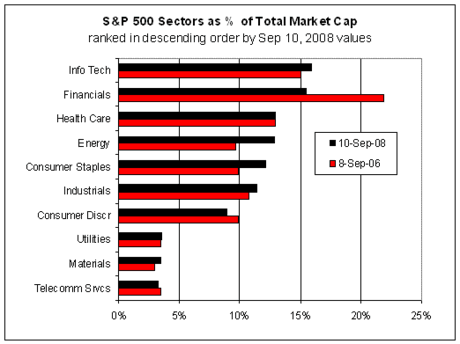
As the above chart shows, information technology now occupies the top position in the S&P 500 as of yesterday, posting at 16% share of total market cap. Although that’s up only slightly from its share of two years previous, the rise was enough to dispatch the former leader—financials—to the number two slot.
CONTRARIAN UPDATE
There’s a bear market in prices, but the bull is alive and kicking when measured in risk premia, albeit in varying degrees, depending on the asset class.
Consider two examples in our chart below, which illustrates the history of yield premia for high yield bonds and equity REITs relative to the 10-year Treasury yield. Clearly, Mr. Market is offering a bigger cushion of safety in these asset classes relative to recent history. The question is whether the cushions will suffice for what’s coming? To be sure, higher yield premia are no short cut to easy profits, but neither are they chopped liver.

For junk bonds, the premium over the 10-year is the highest in five years. At the end of August, the Citigroup High Yield Index posted a trailing yield of 779 basis points over the constant 10-year Treasury yield, as per numbers from the St. Louis Fed. That’s the richest spread for the index since early 2003.
The spread premium on equity REIT yields, although higher relative to recent history, is less compelling. At 115 basis points over the 10-year yield, the NAREIT trailing yield has risen from negative territory, but it still pales in comparison to the 300-basis-points plus of 2003.
What does it all mean? The case for buying junk and REITs looks more enticing today than it did in 2006 or 2007. That doesn’t mean you can’t lose money in either asset class going forward, but it does suggest that the prospective returns vary and that’s largely driven by shifting valuations.
For investors with broadly diversified portfolios across the major asset classes and a long-term focus of five years or more, the above charts suggest that it’s time to start nibbling at high yields bonds via broadly diversified portfolios targeting the asset class. The same could be said for REITs, although the case is less compelling.
Putting cash to work these days is unnerving, of course, as yesterday’s steep decline in the stock market reminds. But blood is running and that suggests that prospective returns are higher. No guarantees, of course. Even prudent-minded investment strategies can look ugly in the short run, and perhaps for even longer stretches than logic suggests. That said, opportunity abounds, at least for those who have risk capital at the ready and the stomach for the roller coaster that almost certainly awaits in the near term.
STILL SEARCHING FOR VALUE
It’s one of the most fundamental and enduring relationships in finance. As fear and risk rise, the valuations become more enticing. When all hope is gone, and the last bull throws in the towel, the prospective returns are probably at their highest.
Simple enough, right? The lesson: buy at maximum pessimism or when blood runs in the street, to quote the infamous Rothschild axiom. Sound advice, and perhaps the only true piece of wisdom for dealing with the capital markets. Alas, it’s devilishly difficult to pull off. One reason: no one knows where the bottom is except with the benefit of hindsight.
Another reason: investors tend to be human, and humans tend to trip over that emotion thing every now and again.
So it goes. Pessimism rises, and the more it rises the more likely higher expected returns will be ignored. Of course, there’s always a reason to ignore the seemingly higher odds of richer prospective performance, and much of that has to do with negative signs on recent trailing returns. It’s tempting to think that because recent history has thrown us a pair of concrete shoes, it’ll continue to do so for the foreseeable future. The effect works in reverse, of course: positive returns are expected to continue after a long string of gains in the recent past.
An antidote to giving recent performance too much weight in your strategic decision making comes by way of relative valuation. That includes trailing dividend yields among the major regions of the world. As per our chart below, dividend yields are up in the developed world’s capital markets, as per data from S&P/Citigroup Global Equity Indices through the end of last month. Europe in particular offers comparatively rich yields.

The U.S., by contrast, looks a lot less compelling on a dividend-yield basis. That doesn’t mean that domestic stocks won’t outperform European equities. But if we limit ourselves to what we know, the numbers speak for themselves.
LABOR PAINS, PART DEUX
The labor market continues bleeding, as today’s update on the nation’s payrolls for August reminds.
Compared with past recessions–and, yes, we’re in one–the current ills look mild, as our chart below suggests. What worries us is that the pain, however modest, may roll on for longer than usual.

Is a “mild” recession that lasts longer than usual better, or less painful, than a deeper contraction that ends quickly? Only time will tell, although our suspicion is that in the grand scheme of economics, deeper and quicker is probably the better choice, although that depends heavily on how deep deep is.
In any case, no one has a choice and we’re all fated to play the recession cards we’re dealt. What’s more, there’s plenty of pain in the employment numbers these days, comparisons to the past notwithstanding. For the eighth month running, nonfarm payrolls contracted. Adding to the pain is the rise in the unemployment rate last month to 6.1%, the highest since 2003.
True, August’s loss of 84,000 jobs in the economy was fairly middling, although that’s cold comfort for those who are out of work. But in the search for a silver lining in today’s employment news on a macro level, that’s as good as it gets for the moment.
The question, then, is how long does the job destruction roll on? To repeat our standard mantra, no one knows. But there are clues, and currently they’re not encouraging. As we pointed out yesterday, initial claims for new unemployment benefits look inclined to rise. The implication: future employment reports will stay negative for the foreseeable future.
One result is that the Fed is likely to shy away from an interest rate hike any time soon. But even that traditionally bullish news has lost its power to inspire. Meanwhile, there’s still the question of whether inflation is set to fade. If not, we’re in for even greater challenges.
In short, there are still many risks bubbling in the economic and financial spheres. Defense is still the only game in town.
LABOR PAINS
If there’s reason for optimism about the state of the U.S. economy, you won’t find it in today’s update on jobless claims.
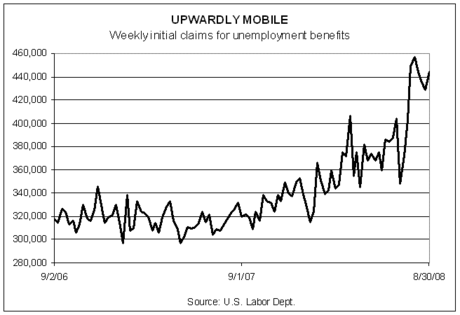
As our first chart shows, the bias toward the upside continues with new filings for unemployment benefits. Certainly the modest dip in new claims last month appears to be fading. Last week, new filings rose to 444,000, up from 429,000. That’s still below the recent high of 457,000 set on August 2, but the upward momentum doesn’t look like it’s about to fade any time soon.
Another clue about the state of the job market comes by way of continuing claims for unemployment benefits. This pool of the previously unemployed is much larger than the new arrivals, and the ranks of those who’ve been collecting checks from the government for some time continues to swell, as our second chart below illustrates. Today’s update on continuing claims reveals that 3.435 million were drawing unemployment benefits for more than a week in the week ending August 23.

Keep in mind that the stress in the labor market didn’t drop out of the blue. Looking at the initial claims chart above suggests that the early signs of trouble go back a year or more. At first, the gentle rise of new claims was subtle, and therefore widely dismissed. In recent months, the trend became too obvious to ignore, and by this editor’s reckoning the rise will roll on in the coming weeks and perhaps months.
“The labor market will continue to worsen,” Dana Saporta, an economist at Dresdner Kleinwort in New York, told Bloomberg News ahead of this morning’s jobless claims report. “I look at claims and see much higher readings than just a few months ago, and I see that as consistent with the rising unemployment rate.”
Today’s numbers don’t offer reason to think otherwise. In turn, the soft labor market will likely keep the Fed from raising interest rates. That raises the question of whether, or if, inflation will cool. But we’re getting ahead of ourselves. The update on consumer prices doesn’t come until September 16.
THE INVESTMENT BENCHMARK FOR THE MASSES
Every investor needs a benchmark. Picking a relevant one is a challenge, in part because the menu is crowded. The good news is that there’s a great starting place for everyone: the yield on the 10-year inflation-indexed Treasury Note, a.k.a., the 10-year TIPS.
As guaranteed payouts on Mother Earth go, this one’s about as solid as they come. Not only can you sleep easy knowing that your principal will be returned, the payout in the years ahead will be immune from inflation. Yes, one can argue that the underlying inflation yardstick–the consumer price index–is flawed, but we’ll leave that glitch aside for the moment.
Accepting the 10-year TIPS at face value gives us a robust benchmark for comparing and contrasting our investment strategies. It is, in short, the true risk-free benchmark for investors considering the rainbow of risks in the world to embrace or avoid. Yes, we could quibble and cite the 5-year or 20-year TIPS. But we’ll split the difference and use the 10-year span, in part because much of bond investing revolves around decade-long maturities as benchmarks.
As of last night, a 10-year TIPS yields 1.69%. The question before the house: can you beat it? That is, will your investment strategy generate more than a 1.69% return–after inflation–when you crunch the numbers on September 3, 2018?

No doubt some, and quite probably many investors will answer in the affirmative. But the task ahead is tougher than it appears. Why? Several reasons, starting with the fact that buying and holding a 10-year TIPS is a strategy with no moving parts. As such, there’s no chance for error in executing the strategy and grabbing the yield as stated. But as history suggests, a fair share of investors who try to excel at the money game will end up being stumbling, perhaps dramatically.
NOISY BEHAVIOR
August was another tough month for diversified portfolios. For the third month running, the Capital Spectator Global Market Portfolio Index lost ground in August, declining 3.3%.
For the major asset classes generally, last month was a mixed bag, as our table below shows. REITs were the leader, posting a 2.4% advance. U.S. stocks weren’t far behind, earning 1.7% for the month. The big loser in August: commodities, shedding 7.4%, a steep loss, which is all the more painful after July’s 12% decline. Foreign equities and bonds were also hard hit last month. Overall, August wasn’t pretty for broadly defined market-valuation-based portfolios.

Strategic-minded investors might wonder if owning a portfolio that’s diversified across the world’s major asset classes, and weighting the components by their respective market-valued share, remains an intelligent decision. Year-to-date, our Global Market Portfolio Index (GMPI) has shed 8.6%. That’s slightly better than U.S. stock performance, which posts a 10.1% loss through the end of August. Nonetheless, one might expect a broadly diversified multi-asset class portfolio to fare better. What’s going on?