This morning’s employment report for September is the worst yet for this cycle, and we’ll probably see even deeper pain in the months to come. But for now, the last shred of hope that maybe, perhaps, somehow the U.S. could avoid recession has been definitively dashed, once and for all in today’s jobs update.
Nonfarm payrolls slumped by 159,000 last month, the biggest monthly loss for the labor market in five years and the ninth straight month of red ink for job destruction, the government reports. That’s a sharp drop down from the relatively moderate losses we’ve seen previously, as our chart below shows. Although unemployment was unchanged at 6.1%, the steady jobless rate for September should fool no one. The message from the labor market is clear: the one-year-old financial crisis is now taking a bigger toll on the broader economy, and the pain is still gathering steam and cutting deeper.
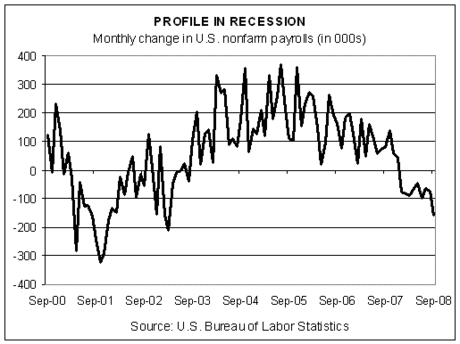
The mounting troubles for the economy have been bubbling for some time, of course, as CS has chronicled throughout this year. Back in March, we laid out the case for why a recession was virtually certain. Unfortunately, the corroborating evidence has continued to pile up since then. Earlier this week, for instance, we learned that car sales and factory orders suffered hefty declines last month, adding more signs that there’s still plenty of trouble ahead.
Monthly Archives: October 2008
SHORT-TERM TROUBLES
The monthly numbers for all the asset classes suffered red ink in September (save for cash), as our table from yesterday details. Fortunately, that’s a rare episode.
For the 10 asset classes listed in that table, the last time the representative indices all posted monthly losses was October 2005. Overall, there have been three times in the last 10 years when losses infected all the major asset classes in one month: 9/08, 10/05, and 4/04. That translates to 2.5% failure rate, if we can call it that. It’s low, but it’s higher than zero, and so we can’t be blind to the possibility.
What’s different this time is that the crisis that came to a head in September 2008 makes the problems of the recent past look shallow by comparison. Indeed, the current troubles are deeper and threaten the economy. The main lesson today is that no asset class is immune from financial and economic crises. Nor is there any reason to think that all the major asset classes can’t suffer losses simultaneously.
The good news is that an across-the-board fall in the 10 major asset classes is abnormal. But it does happen, and a bit more often such events nearly happen.
SEPTEMBER: THE CRUELEST MONTH BY FAR
Thank goodness September’s gone. Although it’s passed into history, the legacy will long linger, in our minds and wallets.
Indeed, September 2008 was ugly. Really ugly. There was no place to hide other than cash. It was just one of those months and it didn’t really matter what you did or what you owned save for T-bills or the closest equivalent. Even our CS Global Market Portfolio Index (GMPI) was crushed last month, dropping a nerve-rattling 9.4% in September. As our table below shows, our index of the global market portfolio is down steeply for year-to-date and 12-month readings too.
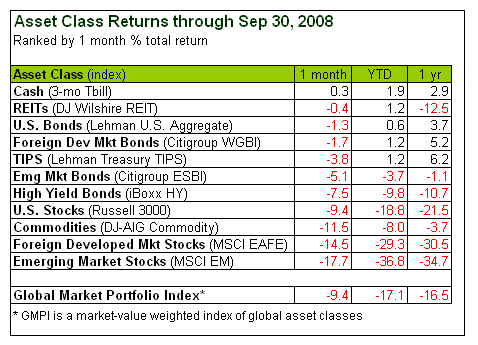
That’s an extraordinary loss for GMPI, all the more so since the previous three months have witnessed hefty losses, although not nearly as deep as September’s tumble. But it’s not entirely surprising. Faith has faded in large swaths of the U.S. economy and investing strategies generally this past month, and GMPI wasn’t immune to the virus.
We’ll be analyzing why GMPI stumbled so horribly last month in the coming days, provide some historical perspective, and what it means for broad asset-class based strategies generally. For now, we’ll let the red ink above speak for itself.
One housekeeping note: the performance numbers for the individual asset classes above are based on indices rather than ETFs and mutual funds, which was the norm previously. That will be the standard going forward, in part because GMPI is based on indices rather than securities products and so the adjustment provides a more apples-to-apples comparison between the components and the global portfolio.