Each new economic update is painful these days, and today’s release of the October employment report is no exception.
The U.S. economy lost 240,000 jobs last month, the Labor Department reports. That’s not as steep as September’s 284,000 tumble, but there’s no mistaking the trend. The economy is in recession and the labor market is now Exhibit A for that view, in no uncertain terms.
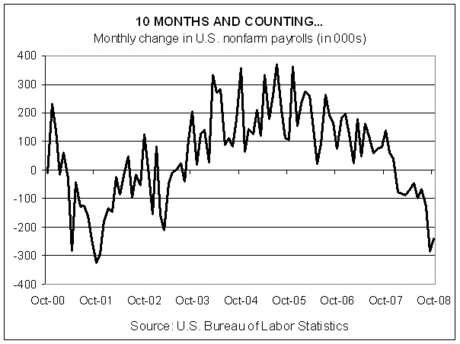
No wonder, then, that the jobless rate jumped to 6.5% in October, up from 6.1% in the previous month. The unemployment rate, as a result, is now at its highest since 1994.
Unfortunately, it looks like the negative momentum has a ways to go. Even the mighty services industry is now routinely stumbling. For the second month running, services employment dropped sharply, falling more than 9% last month, which comes after a 17% decline in September. The significance of this slump can’t be underestimated, given that services jobs represent about 85% of total nonfarm payrolls.
Weighing heavily on services is the retail business, which is now knee-deep in contraction. So-called same-store sales in the retail industry plunged 0.9% last month, reportedly the steepest monthly drop in almost 40 years.
Monthly Archives: November 2008
OUT OF THE ELECTION AND INTO THE FRYING PAN
Barack Obama has won the presidency, and we wish him well—for his sake, the country’s sake and for the world’s. America, in addition to being (still) a crucial factor for global economic growth, remains a beacon of hope and inspiration for liberty. All of that is on the defensive when the U.S. stumbles, as it clearly has in recent years on a number of fronts, including the economy.
The interregnum is traditionally a period of relatively calm political transition, reflection and celebration. But the honeymoon for President-elect Obama is effectively over before it’s even begun. Two wars, a hornet’s nest of other foreign-relations issues and the onset of what promises to be a painful and perhaps lengthy economic contraction insure that yesterday’s history-making election will soon give way to the immense challenges that await. Make no mistake: the challenges are of a breadth and depth that are rarely waiting on the doorstep of new presidents. No doubt he’ll be tested like few before him.
Some have compared Obama’s start with the opening of the Lincoln and FDR presidencies. That’s a bit much. Comparisons to the arrivals of Nixon, Carter and Reagan are closer to the mark. Any way you slice it, Obama will have his hands full, and the odds are high that he’ll have to make tough and unpopular decisions for the next few years.
The stakes are indeed high—higher than at any time in recent memory for a new government. The fact that the incoming president’s resume is a bit light doesn’t inspire. And so we must wait, somewhat anxiously, to see his decisions on a host of subjects. One topic that he can’t afford to fumble is promoting growth, which is really the only solution to what ails America domestically speaking.
DIVIDEND YIELDS, PART II
Last month, we looked at the relationship between dividend yield and the subsequent 5-year return for the U.S. stock market. The motivation: searching for a liaison that binds relatively high yields with relatively high returns. If it holds, then low yields lead to low/negative returns.
In our short sample of history, the relationship held up rather well. For the period January 1995 through February 2003, higher yields were linked with higher returns over the next five years. Indeed, running a regression analysis on the data produced a persuasive 0.95 R-squared. (A quick digression: R-squared ranges from 0 to 100. A reading of 100 means that the variance of one factor fully explains the movement of the other. A reading of 0 tells us that there’s no relationship between two variables. In short, the higher the R-squared, the greater the influence of one factor on the other.)
We also warned in that post that the strong relationship documented in 1995-2003 wasn’t absolute. We cautioned readers to “be careful about thinking the relationship offers easy and sure profits.” It doesn’t. Bottom line, we counseled last month to remain “skeptical” whenever someone shows you a relationship that purports to bring easy profits. No such animal exists, even if the evidence suggests otherwise in the short run.
Our essay inspired others to run a deeper analysis of dividend yield and stock returns. The Aleph Blog, for instance, correctly points out that over a longer sweep of history, the 0.95 R-squared we quoted falls dramatically. Using data from Professor Robert Shiller, Aleph reports that the R-squared for dividend yield and subsequent stock market returns is a mere 0.07 for 1871 to 2003. Crunching Shiller’s numbers on our own, we come up with a similar reading.
Does that mean that looking at the market’s dividend yield is worthless? No, not at all. Although a simple analysis of one holistic view of 100-plus years of stock market history seems to tell us otherwise, there’s a compelling reason to look at dividend yields as one of several metrics for judging prospective return for equities generally. No, we shouldn’t drive blindly down this road, or think we’ve stumbled upon a short-term trading strategy. But with eyes wide open, we should consider the possibilities of using dividend yield as one of several metrics for judging long-term return opportunities.
OCTOBER–THE DEEPEST CUT YET
If October 2008 wasn’t the worst month on record for the capital and commodity markets, we’d hate to find out what is.
Indeed, September was an awful month, but October was a disaster. September’s across-the-board losses for all the major asset classes suffered a repeat performance in October, only more so. The declines last month were in all cases bigger than September’s, in some cases a lot bigger.
REITs suffered the biggest blow in October, falling a shocking 32%. But no other asset class was spared, including U.S. stocks, which tumbled nearly 18%, as per the Russell 3000. It was, to summarize the obvious, the worst month in memory, perhaps the worst in modern times. If you want to see what hell looks like in the investment game, October 2008 looks set to stand as a benchmark of the abyss for generations to come.
No wonder, then, that our measure of the global market portfolio index slumped 15.7% last month–the fifth straight month of losses, and the biggest one yet.

Diversification, to put it simply, did not work in October–the second month running that the global markets repriced risk downward via a broad wave of selling. The lesson is that the pool you’re swimming in will dictate how–or if–you swim. One can’t extract blood from a stone, or positive returns from risk of any kind in a financial calamity. Clearly, the pool has been battered by gale force winds for two months running and the effect has taken a hefty toll on the various components. When risk begins to pay off, the waters will turn calm, but for now investors are knee-deep in the act of wound licking. Perhaps one can be thankful at having any assets left to mourn over.
As for the global markets index, the best we can say is that compared with the defaults, bankruptcies and the complete evaporation of assets in some corners of finance, the red ink afflicting GMPI looks mild. But by any reasonable measure of absolute standards, there’s no way to downplay the fact that risk of any type has inflicted sharp losses on investors. Other than cash, there’s been no place to hide. When a generational storm of unwinding and correction hits, the usual rules take a holiday.
Will this sorry state of affairs continue for a third month running? No one knows, although it’s hard to imagine that everything keeps tumbling. The extraordinary liquidity-injecting efforts of governments around the world–with yet more coming–is starting to show signs of success in at least stabilizing markets. Or so it appears. Outright panic seems to have, temporarily at least, ceased. That’s progress in this environment: stop the massive bleeding. The panic has been replaced with a sober wariness about the future, including the recognition that repairing the financial system and managing the economic contraction will take time and money. Perhaps that keeps asset prices from another month of sharp losses, perhaps not.
Meantime, we’ve all received a lesson in humility, starting with the now-painfully clear lesson that risk can inflict much, much more pain on investors than many thought possible. So it goes after living through a generation of relatively easy and smooth gains.