Today’s report on last year’s fourth-quarter GDP wasn’t good. In fact, it was quite ugly. But it could have been a lot worse.
Even so, the 3.8% contraction in the economy in 2008’s final three months was the steepest decline since 1982. The previous recession in 2001 never came close to what’s unfolding now. The 1990-91 slump was deeper, but even that will look mild by the time the current downturn has run its course.
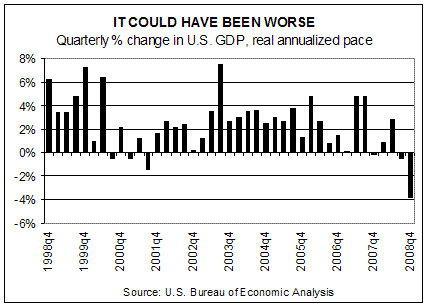
In other words, we’re now in the thick of the worst recession since the early 1980s. That said, the crowd was expecting a far deeper loss. The consensus forecast for Q4 GDP was -5.5%, according to Briefing.com. By that standard, the reported 3.8% retreat was a surprise.
Monthly Archives: January 2009
DREAMING OF BETTER DAYS
Looking for a sign of sunnier days when a storm is raging is human nature. Homo economicus is an optimistic creature at heart, although that optimism is now being put to the test.
REINVENTING FOMC COMMENTARY
The press release that follows the Fed’s FOMC meeting today may offer clues about how the central bank will proceed now that it’s out of conventional monetary policy ammunition. Then again, maybe not. We’re all trapped in gray zone of trial and error about what to do next and the Federal Reserve is also now faced with grasping at straws.
Typically, an afternoon FOMC press release attracts interest for an update on where short-term interest rates are headed. Today, and probably for some time to come, everyone already knows the answer. The Fed controls short rates, starting with the all-powerful Fed funds, but with the effective Fed funds at roughly 0.16%, the mystery about what comes next is, like the price of money, virtually nil.
TALKING ABOUT GINNIE MAE BONDS ON THE INSIDE VIEW
Safety and a higher yield? Typically you can have one or the other. But sometimes you get both. That’s the case with bonds issued by the Government National Mortgage Association, or Ginnie Mae, as it’s commonly known.
In today’s episode of The Inside View, we take a closer look at Ginnie Maes in a conversation with David Ballantine, lead manager of the Payden GNMA Fund (PYGNX). As he explains, Ginnies are mortgage-backed bonds fully secured by the U.S. government. That means Ginnies are effectively of the same credit quality as U.S. Treasuries. Yet Ginnies also tend to offer a yield premium over Treasuries. Currently, Ginnie yields are generally available at 140 basis points over Treasury bonds, Ballantine says.
According to Morningstar, Payden GNMA ranks high for trailing performance in the past five years among intermediate government portfolios. The portfolio’s 7.7% total return in 2008 was not only one of the fund’s better years since it was launched in 1999; last year’s gains also looks attractive generally, given the steep losses almost everywhere else in the capital markets. That’s no guarantee that the fund will continue to excel, of course. Indeed, the strong gains in Treasuries and GNMAs in 2008 offered a bullish tailwind generally last year, and one that’s not likely to be repeated.
Keep in mind, too, that Ginnies bear prepayment risk as mortgage-backed bonds. That risk tends to rise when interest rates fall and homeowners are inclined to pay off old mortgages by refinancing at lower rates. Then again, interest rates have already fallen to levels unseen in decades. That raises questions about the future for bonds generally, although one might wonder if the outlook is different for Ginnies.
With investors looking for a safe haven and a decent yield, it’s a perfect time to take a closer look at these bonds as an asset class and consider the possibilities, and risks. With that in mind, listen in as Dave Ballantine discusses an obscure but intriguing corner of the U.S. government bond market…
Please visit CapitalSpectator.podbean.com for additional options with episodes of The Inside View.
RECESSION UPDATE: SAME OLD, SAME OLD, ALTHOUGH…
This morning’s update of the Conference Board’s leading economic index (LEI) shows a modest gain last month. But let’s be clear: The increase is neither unexpected nor a sign that economic growth is imminent.
As we discussed last week, monetary stimulus these days is in overdrive, and to an extraordinary degree. In turn, that boosts the upside bias of most statistical measures designed to anticipate future economic activity, including the Conference board’s LEI as well as our own gauge of the future. Normally, this boost would offer strong reason to think that a rebound is near in the economy. But given the depth of the economic challenges, even unusually potent levels of monetary stimulus aren’t delivering the usual punch.
The Conference Board’s leading economic index “rose modestly in December, mainly due to the continued and very large positive contribution from real money supply,” the organization’s press release explains. “The yield spread also contributed positively to the index, helping offset the continued declines in building permits, the average workweek, supplier deliveries, and initial unemployment claims.”
FIREFOX PROBLEM RESOLVED…
A quick note to readers: We’ve fixed the glitch with Firefox. The code for the podcast player posted on CS was creating problems for some versions of Firefox. No more. There’s still an issue using Firefox via the links at the top of the page, but that too will soon be set right. Meantime, Explorer continues to work just fine throughout CS.
A NOTE ABOUT INTERNET EXPLORER & FIREFOX BROWSERS
If you’re reading The Capital Spectator using Internet Explorer, this web site should look fine. Reading the site with Firefox, alas, throws the web site askew. We’re looking into making sure that CS reads cleanly in all browsers. Unfortunately, this is a daunting task for your technologically challenged editor. To paraphrase Star Trek’s Dr. McCoy, “I’m a writer, not a web designer.”
In any case, until (and if) we solve this technical glitch, it’s best to vist the Capital Spectator by way of Microsoft’s Internet Explorer. Thanks, and sorry for any inconvenience.
TALKING ABOUT EQUITY INVESTING IN THE LONG RUN ON THE INSIDE VIEW
Stocks for the long run. The idea became popular in the 1990s, although these days it looks a lot less trendy. So it goes after a year of crushing losses in the equity market. Yet there’s a more fundamental reason for taking a fresh look at the conventional wisdom behind the idea of stock investing for the long term.
As the title of a new research paper asks: Are Stocks Really Less Volatile in the Long Run? In today’s episode of The Inside View podcast, we discuss the paper and some of its implications. We also hear from one of the co-authors, Lubos Pastor, professor of finance at the University of Chicago Booth School of Business. He co-wrote the paper with Professor Robert Stambaugh of the Wharton School.
The new research raises a number of questions about some popular notions of equities and the degree of risk they harbor in the long run. In the upcoming February 2009 issue of The Beta Investment Report, we’ll be looking closely at how these questions relate to designing and managing asset allocation. Meantime, here’s a preview…
Please visit CapitalSpectator.podbean.com for more options with this and other Inside View podcasts.
MORE PAIN, NO GAIN
The holiday break in rising jobless claims is over and the lines at the unemployment office are once again growing longer. That’s the message in this morning’s update of new filings for jobless benefits.
Initial claims jumped sharply to 589,000 for the week ended January 17. That matches the level posted for the week through December 20. The bad news is that we’re again at the high point for the cycle so far. Unfortunately, there’s no reason to think that new jobless claims won’t go higher still. Indeed, a reading of other economic statistics far and wide virtually assures that bearish future. Since this data series is considered a “leading” indicator, it also looks like the unemployment rate, which generally lags initial claims, is set to rise further as well.
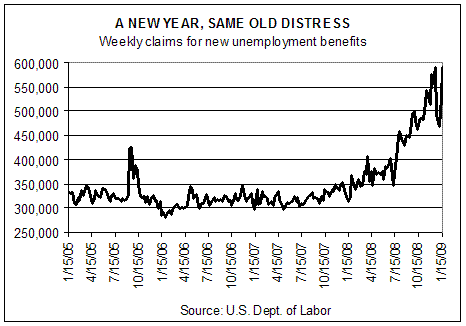
Adding to the evidence that the momentum in the labor market is still negative, and is likely to remain so for some time, is the latest reading for continuing jobless claims. The update today is through January 10 and relates that we’re now at just over 4.6 million, up 97,000 from the previous week. That puts continuing claims at just under the high for this cycle, set in the week through December 27.
FALSE SIGNALS AND REAL HOPE
Today is the first full day of President Barack Obama’s administration and, as everyone knows, the new commander in chief has his work cut out for him. With a fresh start before us in Washington the question on the home front remains: What’s up (or down) with the economy?
In broad terms, the answer is obvious, and the numbers only lend statistical support. Clearly, tough times lie ahead, with the next 6 months or so looking set to be the toughest. But how does that square with our proprietary measure of U.S. economic activity (CS Economic Index), which bounced sharply higher in November, the last month with the full compliment of data pieces for calcuating this benchmark? What’s more, based on preliminary data for December, the November bounce looks set to hold.

Alas, the rise is something of an illusion for the time being since only two factors out of the 17 in our economic index are driving the bounce skyward. Granted, the pair is on steroids trying to bring aid and comfort to the ailing economy. Statistically, the changes in those two factors are enough to push the entire index upward. Even so, those two lone bullish factors alone, unfortunately, aren’t likely to spark a recovery of any substance for the foreseeable future. Looking out later in the year offers some hope, but first let’s talk about the immediate future.