Late last month, we discussed the fact that the strange case of parity had arrived for the yields of the 10-year Treasury and its inflation-indexed counterpart. The conventional 10-year yielded a mere 13 basis points over the 10-year TIPS as of December 26. That was highly unusual, as we pointed out, in part because a conventional Treasury should normally pay a substantial premium over an inflation-indexed bond of the same maturity as compensation for bearing inflation risk.
Of course, the “normal” scenario applies when inflation is generally the path of least resistance. Over the grand course of history, that’s far and away the standard scenario, as fiat currencies have a perfect record of fomenting inflation. But in the shorter term alternative afflictions are possible in the realm of monetary economics, as the last few months remind.
Monthly Archives: January 2009
STRATEGIC DREAMS
Martin Luther King Jr. had a dream and so does Professor Robert Shiller. Civil rights trump financial freedom, of course, in the grand scheme of priorities and so I don’t presume to equate one with the other. That said, it’s a lot tougher to maintain civil rights in the long run without some progress in building and maintaining financial freedom and so on some level we all have a vested interest in advancing both.
Certainly we can all agree that prudent, sound advice on matters financial helps everyone as well as the economy generally. Assisting the masses in the cause of building, growing and preserving wealth won’t solve all the world’s problems, but it helps. With that in mind, Shiller’s piece in the Times yesterday raises the idea that promoting financial literacy is productive as public policy. It’s also timely, given the huge losses suffered recently by so many investors, large and small. “Many errors in personal finance can be prevented,” he writes. “But first, people need to understand what they ought to do.”
Alas, financial literacy seems to be the exception rather than the rule in the world of dispensing investment advice. We can debate how to go about changing that, but there’s no doubt that clear thinking on managing money is in short supply. Given the current economic and financial climate, a solution is needed post haste. Letting the masses fumble what is increasingly a central decision for securing their retirement security is the equivalent of fiddling while Rome burns.
THE CAPITAL SPECTATOR IS NOW AVAILABLE ON THE KINDLE
There are many ways to read The Capital Spectator, and now there’s one more: via Amazon.com’s Kindle. If you’d like to subscribe to CS on your Kindle, please visit here.
For the uninitiated, the Kindle is an e-book reader sold by Amazon. Users purchase content and download it directly into their Kindle. Since its launch in late-2007, the Kindle has become the new new thing for reading books, magazines, newspapers and a sea of other published content. It’s sort of the reader’s equivalent of the iPod. It’s quite a handsome device and offers a number of benefits for staying up to date on your favorite reads. For one thing, it allows you to carry around your personal library in your pocket.
THE DEFLATION BATTLE RAGES ON
For the first time since 1955, the consumer price index fell on a year-over-year basis. Last month’s seasonally adjusted CPI slipped 0.1% for the 12 months through December, the Labor Department reports. On a monthly basis, the decline in CPI is more pronounced, falling by 0.7% last month–the third straight monthly decline.

Deflation, in short, is here. It’s been expected for some time, as we’ve been discussing in recent months, including here and here. The great question, of course: How long will it last?
TALKING ABOUT “HARD CURRENCIES” ON THE INSIDE VIEW PODCAST
The Merk Hard Currency Fund (MERKX) stands out for one simple reason: It’s turned a profit over the past 3 years. That’s no mean feat for the past 36 months, a period when most mutual funds suffered declines.
In today’s Inside View podcast, Axel Merk—the fund’s portfolio manager and president of Merk Investments LLC—explains why his strategy has bucked the generally bearish trend. As a preview, Merk Hard Currency has a strategic preference for cash—non-U.S. cash and related investments, to be precise. That includes gold, foreign currencies and short-term debt instruments denominated in something other than greenbacks. “What we’re offering is diversification in the current environment,” he explains.
To hear more of Axel Merk’s analysis, including his view on what’s next for the U.S. economy and the dollar, tune in to the latest edition of The Inside View…
Please visit CapitalSpectator.podbean.com for more options with this and other Inside View podcasts.
RECESSIONS, BUSINESS CYCLES AND LOOKING FORWARD
Forecasting cyclical turning points in the economy (and inflation) is job one at the Economic Cycle Research Institute (ECRI), a New York consultancy. In fact, it seems to do so rather well, or at least it has in the past. Notably, ECRI has earned some well-deserved praise in recent years for correctly predicting the 2001 recession.
But the current downturn has been a little trickier. True, ECRI was warning of trouble in late-2007. Even so, the firm held out hope that a recession might be sidestepped. As discussed in a November 2007 report, ECRI explained that “the leading indexes are not yet in a recessionary configuration, thus a recession can still be avoided.” Alas, it was not to be. With the clarity of hindsight, we know that the recession began in December 2007, as per NBER’s official (albeit 12-month lagged) dating of the downturn’s start.
THE BETA INVESTMENT REPORT HAS ARRIVED
The Beta Investment Report, a new monthly newsletter edited by yours truly, James Picerno, has hit the streets. For a preview, take a peek at our sister site, BetaInvestment.com, where you’ll find subscription information. In fact, we’re giving away Volume 1, No. 1. Visit BetaInvestment.com to download a PDF file of the inaugural issue.
If you like what you read, please spread the word. Meanwhile, if you’d like to subscribe, here’s a special offer exclusively for Capital Spectator readers: Visit BetaInvestment.com and then email us at the email address listed on that site to ask for the next issue. (Please remember to mention that you read about the offer here, on CapitalSpectator.com). We’ll send the February 2009 issue when it’s published next month, along with an invoice for the next 12 issues. That’s 13 issues for the price of 12. If after reading the February edition you decide not to subscribe after all, no problem: you’re free and clear–no questions asked. Keep the issue as a gift. But don’t delay, as this offer expires at the end of this month, on January 31, 2009.
THE LAST DOMINO
The trade boom is fading. That’s no great surprise, given the weakening state of the global economy. But the slippage in export-related activity comes at an especially challenging moment for the U.S.
Exports remained a bright spot for the U.S. economy last year. As other areas weakened in 2008, the American export machine bucked the trend. It was a timely boost, offering some hope that the approaching recession might be mitigated and perhaps even sidestepped altogether.
The high point came in last year’s second quarter, when real (inflation-adjusted) export activity soared 12.3% on an annualized basis while GDP advanced 2.8%. That took some of the sting out of the drop in durable goods spending and a growing sense of unease otherwise in the GDP trend. In the third quarter, the export boom slowed but remained robust, rising 3.0%, in sharp contrast to the 0.5% decline in GDP.
BIG RISKS, BIG OPPORTUNITIES
The future is always unclear, and therein lies the chief source of risk in the investment challenge. The degree of risk isn’t continuously steady. It ebbs and flows, like market prices and the careers of Hollywood actors.
The fact that risk levels are dynamic suggests a connection. But our ability to model the connection and draw lessons is limited. In fact, at some points the relationship between risk and expected return is especially foggy.
This is one of those times, a state of affairs that creates unusually large opportunities and equally above-average risk. As such, all the usual caveats, and then some apply. Yet recognizing this condition is the first step toward exploiting the opportunity and/or defending oneself against the higher risk.
MORE GRIM NUMBERS FROM THE ECONOMIC FRONTLINES
This is the eye of the economic hurricane. Right now. Today, this minute. The debate necessarily focuses on how long it lasts and what can quickly, efficiently ease the pain and ultimately return the economy to a growth mode. Meantime, we’re knee-deep in the grip of recession—recession with a capital R. This is what a severe downturn looks and feels like.
This morning’s grim employment report for December provides the latest installment of the ugly details. Indeed, the jobless rate popped up to 7.2% last month from 6.8% and is likely to climb further before all is said and done. Meanwhile, nonfarm payrolls shrunk again by more than 500,000 for the second month running, as our chart below shows.
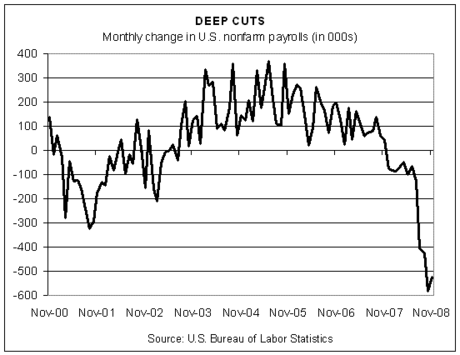
With the December numbers in, that makes for a perfect record in 2008: Every month last year was a losing proposition for jobs, with the trend getting worse as 2008 unfolded. So far in this cycle, nearly 2.6 million nonfarm jobs have been lost to the recession, which NBER says began in December 2007.