Monthly Archives: February 2009

TALKING ABOUT STOCK-MARKET FORECASTING ON THE INSIDE VIEW

In the new episode of The Inside View, your editor begins a series of discussions on the various techniques and methodologies for portfolio management. Today’s show focuses on the Gordon equation, one of the building blocks for estimating prospective equity market returns.
The Gordon equation is one of several applications used for building the model portfolios in The Beta Investment Report. But like any forecasting tool, investors need to be cautious and understand how the Gordon equation is designed. Certainly the Gordon equation isn’t flawless when it comes to divining the future, particularly in the short run. But used prudently, in context with other forecasting tools, it provides a good start for thinking about the investment outlook and designing an asset allocation plan.
What’s the Gordon equation is telling us these days? Tune in for the answer…

Please visit CapitalSpectator.podbean.com for additional options with episodes of The Inside View.

GEITHNER’S “STRESS TEST”

It’s big, it’s bold, but it’s also vague. And that’s the problem.
Treasury Secretary Timothy Geithner yesterday explained the new new plan to solve the financial crisis that ails America. Alas, as articulated yesterday, the plan is short on solution details and long on general notions of what needs to be done.
The challenge is figuring out how the latest effort will work and, more importantly, deciding if it’ll fare any better than its misguided predecessors. At the moment, that’s a challenge with no immediate answer. As the David Byrne and Brian Eno audio montage intones, “America is waiting for a message of some sort or another.”
Certainly the size of the announced plan is a bold stroke. How could $2 trillion be otherwise? We know that some of the money will go to buying up the so-called toxic securities that weigh heavily on the health of banks, and that’s a step in the right direction, as the experience with the Resolution Trust Corp. suggests. Taking some of illiquid assets off banks’ balance sheets should, in theory, help increase lending, which remains tight even at low interest rates. But the details matter, and it’s not yet clear what the fine print will say.

Continue reading

THE BOND GHOULS STRIKE BACK

For a brief, shining moment, there was convergence. Now there’s confusion.
The bond market isn’t taking any chances. Yes, deflation’s a risk, but judging by the sentiment among traders in government IOUs, expectations appear to moving ever so toward the bias that the Fed will be successful in its question to elevate inflation from the grave.
The jury’s still out on that score, at least in terms of timing. And that may make all the difference if you’re a trader. In any case, the 10-year Treasury Note closed above 3% on Friday, an act of defiance to conventional wisdom that we haven’t seen since November, according to numbers from the U.S. Treasury’s web site. Meanwhile, the yield on the 10-year inflation-indexed Treasury has inched lower, staying below 2.0% since early January. The result: inflation expectations are on the rise, moving above 1% this month for the first time since October.

For the moment, the opportunity to buy a 10-year TIPS at virtually no extra cost over its conventional counterpart looks like a train that passed by. As we’ve discussed, hopping on board the train when it was in the station looked like a no-brainer to some degree, in part because such events rarely happens. Indeed, it’s not supposed to happen. Mere mortals are supposed to pay extra for the privilege of hedging future inflation. If you’d rather not, conventional Treasuries will suffice, albeit at the risk of ending up on the losing side of higher future inflation, if any—the bane of unhedged fixed-income securities everywhere.

Continue reading

SPEND, SPEND, SPEND. BUT WHO PAYS?

Paul Krugman in his New York Times column yesterday chastises the Obama administration for not pushing for a sufficiently large enough stimulus package to juice the economy.
“Would the Obama economic plan, if enacted, ensure that America won’t have its own lost decade?” he asks. “Not necessarily: a number of economists, myself included, think the plan falls short and should be substantially bigger.”
Given this morning’s news that the economy shed nearly 600,000 nonfarm jobs last month–the biggest monthly loss since 1974–the case for government stimulus never looked stronger. All the more so if deflation threatens, which it clearly does.

Continue reading

NEGATIVE MOMENTUM STILL HAS THE ECONOMY BY THE THROAT

If the recession now underway was a “normal” contraction, the near-term investment outlook might look quite a bit better. More than a year into the downturn (as we are now) might seem like a good time to start buying in anticipation of the rebound. But this isn’t your garden variety downturn, and so economic and financial metrics remain under a suspicious cloud even when they’re looking bullish.

Continue reading

SEPARATING TRICKS FROM TREATS

Mr. Market is a tricky devil. Or is he a manic depressive, as Ben Graham suggested all those years ago? Whatever the appropriate psychological label, you’ve got to stay alert in the money game when he’s your opponent. You’ve also need to remain willing to act when he drops something more than subtle hints about the future.
That’s not always obvious when your perspective is the past month, or even the trailing 12 months. A short-sighted view of the recent past is the main temptation, though. The world is awash in tactical observation. Reaching for a bit more strategic context, on the other hand, seems perennially unpopular, or at least underestimated.
That’s a mistake, of course, since stepping back and looking at the big picture throws us a strategic bone every now and again. Don’t misunderstand: tactical analysis is helpful, even essential. We do a fair amount of it, in fact. But using it in isolation, without the benefit of strategic review, is like driving with a loose wheel: It’ll work for a time, but it’s going to get you into trouble eventually.

Continue reading

JANUARY’S CHILL

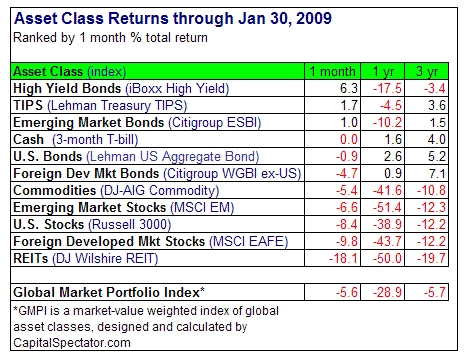
January was another rough month for most asset classes. It was tempting to think there were legs to December’s rebound, which ended the non-stop crushing losses of September-November. Eventually, the genuine rebound will come. In the meantime, there are false starts, as January reminds.
020209.GIF
The good news is that last month wasn’t a complete sea of red ink. That’s an improvement over September’s and October’s across the board losses in the major asset classes. Nonetheless, the gains keeping us out of total red last month rested thinly on high-yield, emerging-market and inflation-indexed bonds.

Continue reading