This morning’s update on new filings for unemployment benefits suggests that the improving trend since the spring for this series remains intact. Initial claims for jobless benefits dropped 33,000 for the week through October 3, the Labor Department reports. That cuts initial claims to the lowest level since this past January, as our chart below shows.

More good news comes in the way of continuing claims, which dropped to 6.04 million, the lowest since April.
Monthly Archives: October 2009
THE ALL-OR-NOTHING TRADE IS HISTORY
In case you were wondering, 2009 is on track to be among the best years in the annals of the stock market. There’s still nearly three months of trading left, of course, and so we shouldn’t write anything into stone just yet. But as we write, it doesn’t get much better than this. In fact, we don’t expect it to get any better and in relative terms, at least, it’s likely to get quite a bit worse. Or perhaps we should say less stellar.
Whatever label is appropriate, there’s just no way that equities can maintain the pace so far this year. As our chart below shows, it’s been nothing less than extraordinarily profitable in the land of equities, here and abroad. The bullish momentum may roll on, of course. In the short term, anything’s possible. But as a strategic matter, there’s reason to wonder.
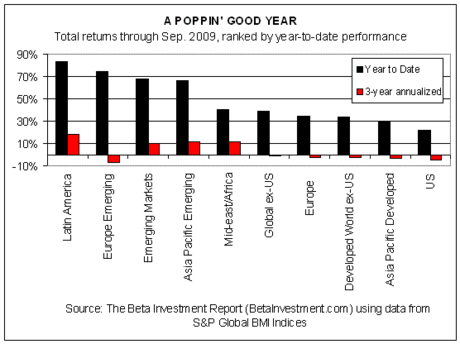
This much is clear: The trailing returns of recent vintage won’t survive for the year or two ahead. No, that doesn’t mean that we’re headed for a new bear market, although no one can dismiss the idea entirely given the still-precarious nature of the economic revival. But equity performance is headed for a period of lesser results, if any, for the foreseeable future.
RAISING INTEREST RATES DOWN UNDER: THE NEW NEW THING?
Someone had to be first. It turns out that it’s Australia. The Reserve Bank of Australia raised its benchmark cash rate by 25 basis points to 3.25%. No longer are rates at a half-century low down under. And so the precedent has been set: the first central bank among the G20 nations has hiked rates.
“Economic conditions in Australia have been stronger than expected and measures of confidence have recovered,” RBA advised in a press release accompanying the rate hike. “Overall, growth [for Australia] through 2010 looks likely to be close to trend.” Nonetheless, the labor market in the country remains weak, the bank acknowledged. But as RBA reasoned, “With growth likely to be close to trend over the year ahead, inflation close to target and the risk of serious economic contraction in Australia now having passed, the Board’s view is that it is now prudent to begin gradually lessening the stimulus provided by monetary policy.”
There will be more reports of rate hikes in the coming months and years. But it starts here. The question now is timing and magnitude. How soon will rates rise and by what degree? And when will the big central banks in the global economy follow suit? And, of course, there’s the $64,000 question: What will be the impact on the global economy and markets?
Questions, questions, always more questions. The only constant: It’s always a different set of questions.
But for now, a milestone has been reached. The Great Decline in rates is over. We’ve known that was coming for some time, of course. Now begins the inevitable sequel.
Risk, in short, is a perennial, albeit in an ever-changing state.
[Note: In the original post, we wrote that the Reserve Bank of Australia was the first central bank to raise interest rates. In fact, as one commenter pointed out, the honor goes to the Bank of Israel. We should have clarified our commentary by noting that the Reserve Bank of Australia was the first central bank of a large economy–i.e., a member of the G20 nations–to hike rates. The oversight has since been corrected in our post above. Sorry ’bout that. –JP]
NONFARM PAYROLLS: STILL SLIPPING AND SLIDING
The news that nonfarm payrolls shrunk again last month by 263,000 is bad news, but a little perspective may help minimize the pain.
But first, let’s recognize that there’s just no way to sugarcoat the fact that the economy has been losing jobs each and every month since January 2008. The question is whether the upward tick in job losses last month vs. August is a turn for the worse or just statistical noise on the way toward zero and, at some point, an expansion in the labor market?

We don’t have a definitive answer, of course, but it’s worth pointing out that the reversal in the recovery trend also occurred in the June jobs update, and on a grander scale. But that was temporary and it soon gave way to more progress, albeit in relative terms by way of fewer losses. It’s also worth reminding that the reversal in June didn’t stop investors from bidding up asset prices in the ensuing months. This time, however, we may not be so lucky.
THE RETURNS OF SEPTEMBER
It’s becoming repetitive, but no one’s complaining. September witnessed across-the-board gains in all the major asset classes. Again.
With some minor exceptions, the world’s capital and commodity markets have been on a non-stop rebound since March. That’s not exactly surprising, given the depth of the previous losses in almost everything. When you stretch returns to extremes in a short period, a reversal in the opposite direction is typical. Deciding how long it will last is the trick.
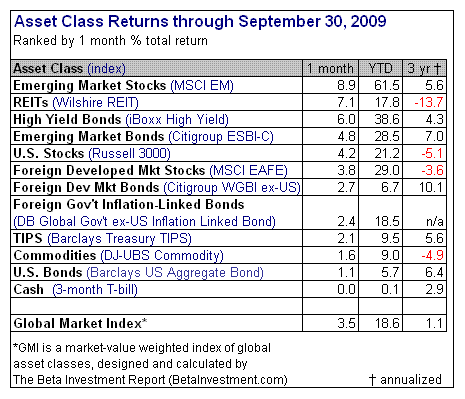
In sum, the good times can’t last, at least not in terms of tidy gains as far as the eye can see. There’s a reason that diversifying across asset classes has merit, even if it’s not obvious these days. But correlations among the various subgroups of stocks, bonds, REITs and commodities are destined for a wider divergence. Designing and managing portfolios, as a result, will become more challenging in the years ahead.
But not today. For the moment, everyone’s a winner regardless of asset allocation. Enjoy it while it lasts.