The U.S. economy expanded at a robust pace in this year’s first quarter, the Bureau of Economic Analysis reported this morning. Real GDP increased by 3.2% on an annualized basis in the first three months of 2010. That’s considerably lower than the 5.6% surge in the previous quarter. But no one expected the powerful momentum in Q4 2009 to continue. The question was (and remains): How much will the economy slow after the initial snapback from the Great Recession? With fiscal and monetary stimulus destined to fade, the economy faces a transition. For now, growth still has the upper hand. The latest numbers, albeit the first of three estimates, suggest that the expansion has a foothold. Encouraging as that is, there’s still some concern about the quarters ahead. The risk that the rebound will stall is lower these days, but not yet low enough to dismiss the idea completely.
Monthly Archives: April 2010
MARKOWITZ ON MPT
Harry Markowitz, who more or less invented modern portfolio theory with his 1952 paper “Portfolio Selection,” talks finance in a new Q&A published by the Journal of Financial Planning. Asked if he thought MPT was fatally wounded from the dramatic market volatility of recent years, he said, No: still alive and kicking. “In fact, it proved itself in the crisis rather than disproved itself,” he asserted.
PONDERING THE POSSIBILITIES OF REBOUND & RETREAT FOR JOBS
Will the Federal Reserve rethink its decision yesterday to keep Fed funds at just above zero after this morning’s news of a fall in new claims for unemployment last week? Not likely. Initial claims slipped by just 11,000. That’s welcome, of course, but if you’ve been following the soap opera with this data series you know that we’ll need to see something more dramatic before the central bank changes its monetary tune of standing pat.
ASSET ALLOCATION FUNDS: POPULAR BUT COMPLICATED
The rising popularity and expanding menu of multi-asset class funds suggests that investors are eager and willing to farm out the asset allocation decision to professionals. Morningstar Principia lists over 1,700 mutual funds and ETFs that engage in some form of multi-asset class investing under one strategic roof. These products are branded under several labels, such as global asset allocation or target date funds. There’s the old standby term balanced fund as well. But no matter what you call them, they all share a common link: managing asset allocation. Some investors think owning these funds relieves them of the chore of making strategic investment decisions, but that’s only partly true.
DISSECTING BUBBLES
Everybody talks about bubbles, but what should we do about it? Before we can answer intelligently, we need to put bubbles in context. In other words, how should we think about bubbles? There’s no simple answer, in part because the hyperbole surrounding the concept is thicker than honey in a beehive.
THE CASE FOR CAUTIOUS OPTIMISM
“The global economy seems to be recovering,” the chairman of the IMF’s Financial Committee meeting said at press conference over the weekend. “The worst is definitely behind us,” advised Youssef Boutros-Ghali, who’s also the Egyptian finance minister in his day job.
IT’S NOT OVER TILL IT’S OVER
Three out of four isn’t too shabby. New orders for durable goods fell last month, the first decline in the last four months. Even if we maintain that success ratio, rebuilding the business of durable goods manufacturing is going to take time. Therein lies the symbolic challenge for the broad economy. Recovery is underway, but it’s still unclear if it’s sustainable at a sufficiently high pace to make a dent in the damage of the past two years. In any case, we’ve still got a long way to go.
JOBLESS CLAIMS FALL, BUT THE THREAT OF GOING NOWHERE FAST STILL LOOMS
Initial jobless claims dropped last week—the first since the drop at the end of March. But the question remains: Is the broader trend stuck in neutral?
NEW MONEY, SAME OLD CHALLENGES
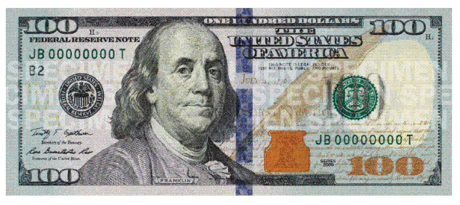
Nothing really changes in the money game, although the face of the currency gets a makeover every so often, as the redesigned $100 bill attests. “In order to protect your money and keep counterfeiting low, the United States government continues to enhance the security of its currency,” the Treasury’s “New Money” web site reports. The latest roll-out is the new C note, which “incorporates the best technology available to ensure we’re staying ahead of counterfeiters,” said Secretary of the Treasury Tim Geithner in the accompanying press release issued today. Colorful, isn’t it? Of course, there’s still no technology that will prevent currencies, freshly designed or not, from losing their purchasing power. That age-old challenge still requires some very old-fashioned ideas.
THE IMF ISSUES A RED INK WARNING
We’ve heard it before, but the IMF is telling us again: there’s a lot of debt sloshing around in the global economy, and more is on the way. The question before the house: At what point will ballooning deficits reach the financial tipping point? Whatever the answer, we seem to be moving closer to that hazardous peak. That doesn’t mean we’re destined to reach it, but the alarm bells are now ringing loud and clear.