Daily Archives: January 14, 2014

Retail Sales Up A Mild 0.2% In December

Retail sales rose again last month–the ninth consecutive month of higher spending. But December’s advance was the slowest since September. The headline figure was pulled down by a sizable slump in auto sales. Excluding motor vehicles, retail spending advanced 0.7% in December over the previous month. Looking past the monthly noise, the broad trend via the year-over-year comparison reveals that moderate growth prevails.

For perspective, let’s start with the monthly numbers. As the first chart shows, December spending turned sluggish vs. October and November. Excluding gasoline sales, retail sales posted the slowest monthly advance since March.

Turning to the annual view, however, suggests that nothing much has changed for retail spending. Consumption through December was higher by 4.1%, a touch lower than November’s 4.2% gain. It’s fair to say that retail spending remains stable at just over the 4% mark. That’s near the lower end of the annual rates of change we’ve seen in recent years and so there’s minimal room for disappointment going forward. But for now, the trend still looks mildly encouraging.

The bottom line: consumer spending isn’t a problem for the economy at this point. By contrast, the income side of personal finances looks a bit wobbly, as I discussed yesterday.

Ultimately, personal spending and income are bound at the hip. In the grand scheme of economic indicators, the tight connection between changes in one vs. the other is second to none in the land of highly correlated variables across, say, rolling one-year periods. With that in mind, today’s retail sales report implies that income-related stress is still minimal. If income suffers in the months ahead, the blowback will show up in various measures of consumer spending, but there’s no major sign of distress in the data du jour.

On that note, we’ll know more when the government publishes the December personal income data on January 31. Meantime, the broad trend for retail spending still looks mildly encouraging.

Asset Allocation & Rebalancing Review | 14 Jan 2014

A new year has started, but the performance view for the major asset classes doesn’t look all that different from the final days of the old year, at least not yet. Let’s consider how the numbers stack up with a set of ETF proxies using a 250-trading-day window. By that standard, US equities are still in the lead, although the performance edge has weakened a bit. Meanwhile, there’s still plenty of red ink at the opposite end of the return spectrum.

Stocks in these United States are up more than 27% through yesterday, January 13, based on the Vanguard Total Stock Market ETF (VTI). At the far end of the losing side of the ledger: a broad measure of commodities, as tracked by the iPath DJ-UBS Commodity ETN (DJP).

gmi.tab.14jan2014.gif

For another perspective, let’s graph the return histories for each of the major asset classes for the past 250 trading days. The next chart shows the performance records through January 13, 2014, with all the ETFs rebased to 100 as of January 15, 2013:

gmi.1.14jan2014.gif

Now let’s review an ETF-based version of a passive, market-value-weighted mix of all the major asset classes–the Global Market Index Fund, or GMI.F, which is comprised of the ETFs in the table above. Here’s how GMI.F stacks up for the past 250 trading days through January 13, 2014. This investable strategy is higher by 11% over that span, or roughly midway between the returns for US stocks (VTI) and US bonds (BND) for the same period.

gmi.x.14jan2014.gif

Comparing the overall dispersion of returns for the major asset classes via ETFs suggests that the rebalancing opportunity is relatively middling for GMI.F vs. recent history. Analyzing the components of GMI.F with the rolling median absolute deviation of one-year returns for all the funds–the GMI.F Rebalancing Opportunity Index, as it’s labeled on these pages–suggests that there’s average potential for adding value by reweighting the portfolio in comparison with the past several weeks.

gmi.3.roi.14jan2014.gif

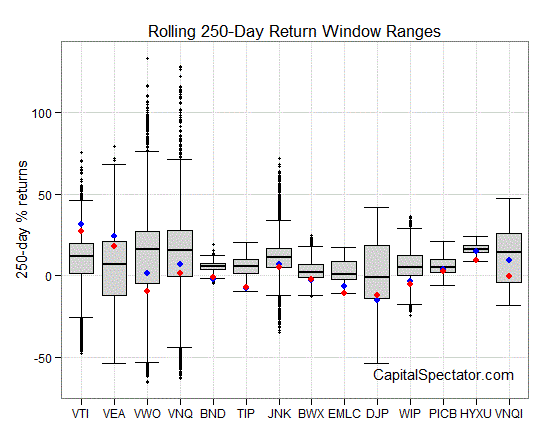
Finally, let’s compare the rolling 1-year returns (defined here as 250-trading-day performance) for the ETFs in GMI.F via boxplots. (Keep in mind that the historical records for these ETFs vary due to different launch dates). The gray boxes in the chart below reflect the middle range of historical returns for each ETF—the 25th to 75th return percentiles. The red dots indicate the current 1-year return (as of Jan. 13) vs. the 1-year return from 30 trading days earlier (blue dots, which may be hiding behind the red dots in some cases). Note that US stocks (VTI) remain in the lead in absolute and relative terms vs. the other asset classes.

gmi.boxplot.14jan2014.gif


If you found the analysis above useful, consider the weekly updates via The ETF Asset Class Performance Review, which offers a deeper look at an ETF-based view of asset classes. For more information and a recent sample, see CapitalSpectator.com/premium.