Monthly Archives: January 2014

Macro-Markets Risk Index: 12.0% | 1.15.2013

The US economic trend has been relatively stable and positive in recent weeks, based on a markets-based profile of macro conditions. The Macro-Markets Risk Index (MMRI) closed at 12.0% on Tuesday, January 14–a level that suggests that business cycle risk remains low. The current 12.0% value is well above the lowest reading in recent history (7.5% in mid-September 2013). More importantly, the current 12.0% value far exceeds the 0% danger zone. If MMRI falls under 0%, that would be a sign that recession risk is elevated. By contrast, readings above 0% imply that the markets are anticipating/forecasting economic growth.

MMRI represents a subset of the Economic Trend & Momentum indices, a pair benchmarks that track the economy’s broad trend for signs of major turning points in the business cycle via a diversified set of indicators. Analyzing the market-price components separately offers a real-time approximation of macro conditions, according to the “wisdom of the crowd.” Why look at market data for insight into economic conditions? Timely signals. Conventional economic reports are published with a time lag. MMRI is intended for use as a supplement for developing perspective on the current month’s economic profile until a complete data set is published.

MMRI measures the daily median change of four indicators based on the following calculations:

• US stocks (S&P 500), 250-trading day % change, plotted daily
• Credit spread (BofA ML US High Yield Master II Option-Adjusted Spread), inverted 250-trading day % change, plotted daily
• Treasury yield curve (10-yr Treasury yield less 3-month T-bill yield), no transformation, plotted daily
• Oil prices (iPath S&P GSCI Crude Oil Total Return Index ETN (OIL)), inverted 250-trading day % change, plotted daily

Here’s how MMRI compares on a daily basis since August 2007:

Here’s a review of how MMRI stacks up over the past 12 months:

Retail Sales Up A Mild 0.2% In December

Retail sales rose again last month–the ninth consecutive month of higher spending. But December’s advance was the slowest since September. The headline figure was pulled down by a sizable slump in auto sales. Excluding motor vehicles, retail spending advanced 0.7% in December over the previous month. Looking past the monthly noise, the broad trend via the year-over-year comparison reveals that moderate growth prevails.

For perspective, let’s start with the monthly numbers. As the first chart shows, December spending turned sluggish vs. October and November. Excluding gasoline sales, retail sales posted the slowest monthly advance since March.

Turning to the annual view, however, suggests that nothing much has changed for retail spending. Consumption through December was higher by 4.1%, a touch lower than November’s 4.2% gain. It’s fair to say that retail spending remains stable at just over the 4% mark. That’s near the lower end of the annual rates of change we’ve seen in recent years and so there’s minimal room for disappointment going forward. But for now, the trend still looks mildly encouraging.

The bottom line: consumer spending isn’t a problem for the economy at this point. By contrast, the income side of personal finances looks a bit wobbly, as I discussed yesterday.

Ultimately, personal spending and income are bound at the hip. In the grand scheme of economic indicators, the tight connection between changes in one vs. the other is second to none in the land of highly correlated variables across, say, rolling one-year periods. With that in mind, today’s retail sales report implies that income-related stress is still minimal. If income suffers in the months ahead, the blowback will show up in various measures of consumer spending, but there’s no major sign of distress in the data du jour.

On that note, we’ll know more when the government publishes the December personal income data on January 31. Meantime, the broad trend for retail spending still looks mildly encouraging.

Asset Allocation & Rebalancing Review | 14 Jan 2014

A new year has started, but the performance view for the major asset classes doesn’t look all that different from the final days of the old year, at least not yet. Let’s consider how the numbers stack up with a set of ETF proxies using a 250-trading-day window. By that standard, US equities are still in the lead, although the performance edge has weakened a bit. Meanwhile, there’s still plenty of red ink at the opposite end of the return spectrum.

Stocks in these United States are up more than 27% through yesterday, January 13, based on the Vanguard Total Stock Market ETF (VTI). At the far end of the losing side of the ledger: a broad measure of commodities, as tracked by the iPath DJ-UBS Commodity ETN (DJP).

gmi.tab.14jan2014.gif

For another perspective, let’s graph the return histories for each of the major asset classes for the past 250 trading days. The next chart shows the performance records through January 13, 2014, with all the ETFs rebased to 100 as of January 15, 2013:

gmi.1.14jan2014.gif

Now let’s review an ETF-based version of a passive, market-value-weighted mix of all the major asset classes–the Global Market Index Fund, or GMI.F, which is comprised of the ETFs in the table above. Here’s how GMI.F stacks up for the past 250 trading days through January 13, 2014. This investable strategy is higher by 11% over that span, or roughly midway between the returns for US stocks (VTI) and US bonds (BND) for the same period.

gmi.x.14jan2014.gif

Comparing the overall dispersion of returns for the major asset classes via ETFs suggests that the rebalancing opportunity is relatively middling for GMI.F vs. recent history. Analyzing the components of GMI.F with the rolling median absolute deviation of one-year returns for all the funds–the GMI.F Rebalancing Opportunity Index, as it’s labeled on these pages–suggests that there’s average potential for adding value by reweighting the portfolio in comparison with the past several weeks.

gmi.3.roi.14jan2014.gif

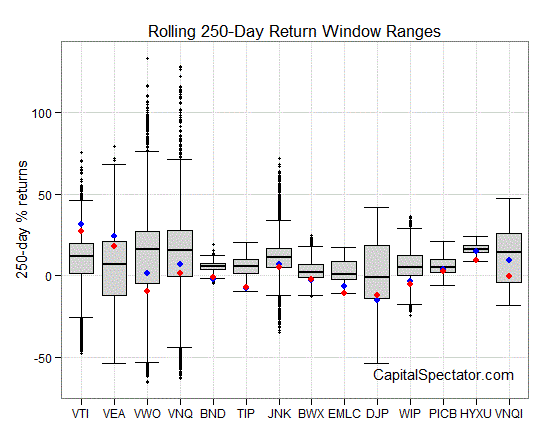
Finally, let’s compare the rolling 1-year returns (defined here as 250-trading-day performance) for the ETFs in GMI.F via boxplots. (Keep in mind that the historical records for these ETFs vary due to different launch dates). The gray boxes in the chart below reflect the middle range of historical returns for each ETF—the 25th to 75th return percentiles. The red dots indicate the current 1-year return (as of Jan. 13) vs. the 1-year return from 30 trading days earlier (blue dots, which may be hiding behind the red dots in some cases). Note that US stocks (VTI) remain in the lead in absolute and relative terms vs. the other asset classes.

gmi.boxplot.14jan2014.gif


If you found the analysis above useful, consider the weekly updates via The ETF Asset Class Performance Review, which offers a deeper look at an ETF-based view of asset classes. For more information and a recent sample, see CapitalSpectator.com/premium.

US Retail Sales: December 2013 Preview

US retail sales are expected to rise 0.2% in tomorrow’s December report vs. the previous month, according to The Capital Spectator’s median econometric forecast. The prediction is substantially below the previously reported 0.7% increase for November. Meanwhile, the Capital Spectator’s median projection for December is above a trio of consensus estimates based on recent surveys of economists.

Here’s a closer look at the numbers, followed by brief definitions of the methodologies behind The Capital Spectator’s projections:

retailpreview.13jan2014.gif

R-2: A linear regression model that analyzes two data series in context with retail sales: an index of weekly hours worked for production/nonsupervisory employees in private industries and the stock market (S&P 500). The historical relationship between the variables is applied to the more recently updated data to project retail sales. The computations are run in R.

ARIMA: An autoregressive integrated moving average model that analyzes the historical record of retail sales in R via the “forecast” package.

ES: An exponential smoothing model that analyzes the historical record of retail sales in R via the “forecast” package.

VAR-6: A vector autoregression model that analyzes six time series in context with retail sales. The six additional series: US private payrolls, industrial production, index of weekly hours worked for production/nonsupervisory employees in private industries, the stock market (S&P 500), disposable personal income, and personal consumption expenditures. The forecasts are calculated in R with the “vars” package.

TRI: A model that’s based on combining forecasts with a technique known as triangular distributions. The forecast combinations include the following projections: Econoday.com’s consensus forecast data and the four predictions generated by the models noted above, i.e., R-2, ARIMA, ES and VAR-6. The forecasts are run in R with the “triangle” package. For more information about TRI, see this post.

Is The Falling Rate Of Personal Income Growth A New Risk Factor?

Friday’s weak jobs report has taken some of the air out of the optimism balloon for the US macro outlook, but in the search for things to worry about I’m more inclined to focus on the discouraging trend of late with personal income. To be precise, the decelerating year-over-year change in personal income less transfer receipts (Social Security checks, for instance) is beginning to look troubling. It may turn out to be noise, as an earlier dip proved to be. But we’re again entering a phase when there’s minimal room for disappointing numbers with the monthly reports on personal income. The data on payrolls, by contrast, still looks relatively strong for the critical year-over-year comparisons.

I don’t want to overplay the potential for trouble with the personal income numbers, at least not yet. As Doug Short reminds, the quirks in the government’s calculation for income may be distorting the trend at the moment. Keep in mind that the statistical twists may get worse before they get better. Taken at face value, however, the 1.2% annual rise in real personal income less transfer receipts is sharply lower vs. previous months and so this indicator is running out of road.

Income growth, of course, is a bedrock for a healthy economy, particularly in the US, where consumer spending is such a big piece of economic activity. Given the soft data on this front lately, the next release of personal income numbers on January 31 deserve close attention. Unfortunately, year-end seasonal issues related to taxes and other complications may leave us no more the wiser about the true trend on this front.

The good news is that the economic data generally still looks encouraging. Moderate growth continues to prevail when we consider a broad spectrum of numbers, as last month’s US Economic Profile shows (I’ll publish an update next week). But the business cycle is constantly evolving. For the moment, the signs of distress remain in the minority. Some choose to point to the surprisingly weak jobs report for December, although it’s too early to let one number cast aspersions across a generally upbeat macro profile. The year-over-year trend in private employment continues to advance at near a 2% rate, or roughly the pace we’ve seen in recent history. For now, the soft December monthly increase appears to be an outlier event for payrolls.

Personal income, by contrast, looks darker via a sharply decelerating rate of year-over-year growth. But it’s going to take some time to decide if this is noise or a legitimate warning sign for the economy.

Meantime, the week ahead brings more context for deciding how the big picture is shaping up, starting with tomorrow’s December report on retail sales, followed by the weekly jobless claims report on Thursday, and a pair of key updates on Friday for December: industrial production and housing starts.

As usual, truth and clarity in matters of the economic trend arrive in a familiar pattern: drip, drip, drip.

Book Bits | 1.11.14

The Investor’s Paradox: The Power of Simplicity in a World of Overwhelming Choice
By Brian Portnoy
Summary via publisher, Palgrave Macmillan
Investors are in a jam. A troubled global economy, unpredictable markets, and a bewildering number of investment choices create a dangerous landscape for individual and institutional investors alike. To meet this challenge, most of us rely on a portfolio of fund managers to take risk on our behalves. Here, investment expert Brian Portnoy delivers a powerful framework for choosing the right ones – and avoiding the losers. Portnoy reveals that the right answers are found by confronting our own subconscious biases and behavioral quirks. A paradox we all face is the natural desire for more choice in our lives, yet the more we have, the less satisfied we become – whether we’re at the grocery store, choosing doctors, or flipping through hundreds of TV channels. So, too, with investing, where there are literally tens of thousands of funds from which to choose. Hence “the investor’s paradox”: We crave abundant investment choices to conquer volatile markets, yet with greater flexibility, the more overwhelmed and less empowered we become.

The Demographic Cliff: How to Survive and Prosper During the Great Deflation of 2014-2019
By Harry S. Dent Jr.
Review via Business Insider
Take one look at Harry Dent’s body of work and you’ll know he likes to make predictions…. What’s ahead now? A “demographic cliff,” according to Dent’s new book: Demographic Cliff: How to Survive and Prosper During the Great Deflation of 2014-2019. “At Dent Research we have a not-so-secret weapon: demographics,” Dent writes. “It is the ultimate indicator that allows you to see around corners, to predict the most fundamental economic trends not just years but decades in advance.” Dent spends the bulk of his book arguing that the demographic story has turned against the U.S. As Boomers retire, it’s not an unfamiliar argument. Dent writes that an aging U.S. will cause deflation that will weaken the economy from 2014-2019.

In Bed with Wall Street: The Conspiracy Crippling Our Global Economy
By Larry Doyle
Review via Kirkus Review
A former Wall Street insider excoriates the current nonsystem of alleged self-regulation and weak government regulation in the finance industry. After being employed as a mortgage-backed securities trader at Bank of America, Bear Stearns and other large financial firms, Doyle became disillusioned and departed. He now runs his own investment practice and serves as something of a whistle-blower. The problems he discusses are mostly familiar to readers conversant in current American politics: the coziness of legislators and lobbyists; campaign contributions meant to sway thinking and, sometimes, votes; government regulatory agencies, such as the Securities and Exchange Commission, that seem more watchful than they are, as well as so-called self-regulatory groups within the Wall Street community that rarely protect investors from inexcusable financial losses. With great intensity, Doyle focuses on a little-known self-regulator called the Financial Industry Regulatory Authority. His deep digging into the operations of that group qualifies as investigative journalism, and the scandalous details he recounts are impressive.

Taxifornia: Liberals’ Laboratory to Bankrupt America
By James V. Lacy
Summary via publisher, Post Hill Press
The biggest and most important state in America was once a land of opportunity in a wonderful climate. But times have surely changed. Things have never been worse for California and its citizens. California’s “one-party” domination of the liberal faction of the California Democratic Party and their union and environmental lobby cronies have wrecked havoc on California, and all Americans are losing as a result. In Taxifornia, James V. Lacy identifies and examines the true causes of California’s decline. Californians are victims of the heaviest taxation in all of America, and those high taxes are now steadily destroying the state’s economy.

Restoring Shared Prosperity: A Policy Agenda from Leading Keynesian Economists
Edited by Thomas I. Palley and Gustav A Horn
Summary via ThomasPalley.com
Edited by Thomas I. Palley and Gustav A. Horn. The economic recovery in the US since the Great Recession has remained sub-par and beset by persistent fear it might weaken again. Even if that is avoided, the most likely outcome is continued weak growth, accompanied by high unemployment and historically high levels of income inequality. In Europe, the recovery from the Great Recession has been even worse, with the euro zone beset by an unresolved euro crisis that has already contributed to a double-dip recession in the region. This book offers an alternative agenda for shared prosperity to that on offer from mainstream economists. The thinking is rooted in the Keynesian analytic tradition, which has been substantially vindicated by events. However, pure Keynesian macroeconomic analysis is supplemented by a focus on the institutions and policy interventions needed for an economy to generate productive full employment with contained income inequality. Such a perspective can be termed “structural Keynesianism”. These are critical times and the public deserves an open debate that does not arbitrarily or ideologically lock out alternative perspectives and policy ideas. The book contains a collection of essays that offer a credible policy program for shared prosperity, rooted in a clear narrative that cuts through the economic confusions that currently bedevil debate.

The Upside of Down: Why the Rise of the Rest is Good for the West
By Charles Kenny
Review via Publishers Weekly
China is poised to overtake the U.S. as the world’s largest economy within the next 15 years, but, according to former World Bank economist Kenny, there is a silver lining for the U.S. economy. Kenny continues in the optimistic vein of his first book, Getting Better, as he explains why America losing its status as the unchallenged global superpower doesn’t have to mean declining living standards for its citizens. “America is a country made great by the founding principles of broad-based democracy, education, civil rights, and openness embodied in [the Constitution]”—qualities that Americans should be glad to see spread throughout the world. As developing countries grow richer and more educated, global values will converge. Kenny decries the simplistic reasoning inherent in judging nations based solely on their GDP or military: “being biggest and among the richest hasn’t helped the United States stake a global lead on measures of the broader quality of life.”

The Watchdog That Didn’t Bark: The Financial Crisis and the Disappearance of Investigative Journalism
By Dean Starkman
Review via The Nation Institute
Nothing defined the financial crisis of 2008 as much as the degree to which it took the public — and the press — by surprise. In a world of twenty-four-hour news coverage and financial reporting, how could so many mainstream journalists, covering something so closely, miss something so big while a few, mostly outside the mainstream, got it? More broadly, what did the business press’s failure say about contemporary journalism’s ability to explain looming systemic problems to the public? In this sweeping, incisive study, Dean Starkman answers those questions, exposing the critical shortcomings that softened coverage during the mortgage era and the years leading up to the collapse. The Watchdog That Didn’t Bark travels back to the early twentieth century to find the roots of the problem in business news’s origin as a market messaging service geared toward investors.

Private Payrolls Increased Far Less Than Expected In December

If you haven’t been skeptical of the noise factor in month-to-month economic numbers, today’s nonfarm payrolls report from the US Labor Department should change your worldview. Private-sector employment grew by far less than expected: +87,000 in December vs. the previous month and well below November’s hefty 226,000 advance. If we stop there the news looks troubling. But there’s no reason to stop there. In fact, economic common sense strongly suggests that we look beyond today’s discouraging monthly comparison.

As usual on these pages, I recommend watching the year-over-year trend for payrolls, along with numerous other indicators. By this standard, nothing much has changed with today’s release. Private-sector employment increased around 2% (1.96% if go to the second decimal point). That’s slightly below November’s annual 2.09% gain and so it’s fair to say that the data du jour is a touch softer. Maybe that’s a sign that economic growth won’t accelerate this year, as many analysts have been predicting. But in the grand scheme of persuasive data trends, it’s premature to say much beyond the simple fact that the labor market continues to grow at a moderate pace—a pace that continues to remain in a tight range via recent history: roughly 2%, give or take.

Meanwhile, let’s recall that looking at monthly comparisons has been wildly misleading all along. That’s nothing new, and it’s a hazard that applies across the board. This is old news, but the danger of focusing on the latest data point is forever lurking in a world where the crowd’s obsessed with each day’s data releases. Looking at the numbers without proper historical context, however, is akin to driving with your eyes closed. You may get lucky for a time, but any success is on borrowed time.

If you look at the monthly net change in payrolls in the chart above (the red line), you’ll see that the numbers have continually delivered a wide array of bullish and bearish results. By contrast, the annual rate of change in private payrolls (the black line) has been relatively steady. That’s been a sign that the labor market has continued to heal, albeit with some bumps along the way.

We’re all susceptible to reinventing our economic outlook whenever a widely followed economic report delivers a surprise. Sometimes an attitude adjustment is warranted, but that’s a rare event. In fact, it’s almost never productive to rethink our macro projections (assuming that they’re reasonable) merely because one number shocks the crowd. And, yes, the rule applies even for the all-important employment report from the government.

The solution, of course, is to routinely review a broad set of indicators in search of reasonably reliable estimates of how the business cycle is evolving. Payrolls are a critical input, but even this essential number shouldn’t be analyzed in a vacuum. A far better approach is to look at a broadly diversified set of numbers that collectively serve as a proxy for the broad macro trend. The US Economic Profile that’s updated regularly on these pages is one example; the Chicago Fed’s National Activity Index is another.

The good news is that the broad trend for the economy continues to look favorable, much as it has in recent history. The economy still has a lot of catching up to do when it comes to matching the numbers in the pre-2008 world. But so far the predictions that the economy is about to slide into a new recession have been wrong–an oversight that can be traced to ignoring the overall trend via the numbers. What’s more, today’s payrolls data doesn’t change that view, based on the year-over-year trend in private employment growth.

Granted, today’s weak report for job creation in December may be a warning sign. But it could just as easily turn out to be noise. On that note, keep in mind that the ADP Employment Report for December offers a considerably brighter narrative for last month’s labor market news.

One of these data sets is misleading us. All will be clear when the revised numbers are published down the road. Meantime, let’s remember that the key lesson over the last several years with matters of estimating the business cycle has been a tendency in some corners to read too much into one or two numbers. That’s a good way to attract a lot of readers when it comes to writing headlines or getting invited to TV shows, but it’s a deeply flawed way to analyze the economy. The track record on this front speaks for itself.

Yes, we’d all like to know how the economy will fare in, say, six months. But such privileged information is beyond the grasp of mortal minds in real time. The next-best thing is looking to a broad set of data on a regular basis for perspective. The economic outlook is constantly in flux, based on the implied future according to the existing data set. Most of the time, however, the shifting projections are minimal, and for the moment that still applies. When there’s a substantial change, for better or worse, you’ll read about it here. Meantime, beware of the usual pitfalls in the game of trying to squeeze blood out of a statistical stone.

The Rebound In Stock Prices & Inflation Expectations

The stock market is up sharply and inflation expectations have been stable in the low-2% range. That’s just what the monetary doctors have been prescribing and the markets have complied. This is the sweet spot that looked unlikely last spring. But a lot can happen when a determined central bank sticks to its plan for quantitative easing. The year ahead, however, will bring a new set of challenges. The first question: How long should the Fed let inflation expectations rise?

Consider how the numbers stack up so far. The S&P 500 has been rising persistently for the past year. Inflation expectations have only recently turned higher, although it’s still early to worry about pricing pressures. For now, higher is still better. Indeed, the Fed’s preferred measure of inflation—core personal consumption expenditures—is rising at a muted 1.1% year-over-year rate through November, or well below the Fed’s 2% target. But the market’s outlook for inflation (the yield spread between nominal 10-year Note and its inflation-indexed counterpart) is increasing again, touching 2.31% in yesterday’s trading. That’s still within the range we’ve seen in recent years and so there’s nothing particularly troubling here. But if the economy is set to accelerate in 2014 (as it seems to be), we may see inflation expectations climb higher in the weeks ahead.

At what point will rising inflation expectations become worrisome? The answer, of course, depends on a number of factors, starting with the state of the economy. Meantime, the recent high for inflation expectations is roughly 2.6%. If and when the market prices the 10-year Treasury market above that level, the calculus for deciding the implications of higher inflation will be ripe for an attitude adjustment.

Jobless Claims At Five-Week Low

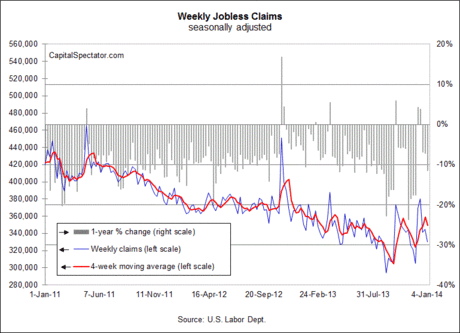
Jobless claims fell last week, settling at the lowest level since late-November. The news follows yesterday’s encouraging employment report from ADP. Taken together, the data suggest that tomorrow’s December payrolls report from the Labor Department will also offer more support for thinking that economic growth is picking up.

Meantime, new filings for unemployment benefits fell 15,000 last week to a seasonally adjusted 330,000. The drop was enough to pull down the four-week moving average for claims—the first decline since the week through November 30.

A stronger signal that the labor market is healing can be seen in the year-over-year decrease in new claims, which fell nearly 12% last week vs. the year-earlier level. Here too we have the biggest retreat since late-November.

“The labor market is continuing to strengthen as we go into 2014,” says UBS economist Kevin Cummins. “We should continue to see the unemployment rate go lower.” Deciding if that’s a reasonable forecast begins by analyzing tomorrow’s payrolls report. For the moment, the outlook is bullish on this front as well.

US Nonfarm Private Payrolls: December 2013 Preview

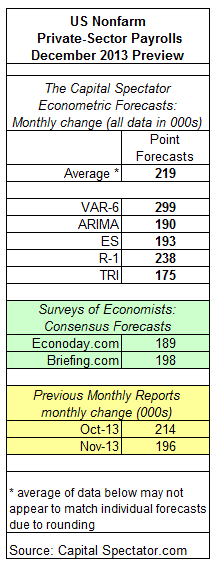
Private nonfarm payrolls in the US are projected to increase by 219,000 (seasonally adjusted) in tomorrow’s December update from the Labor Department, according to The Capital Spectator’s average econometric point forecast. The projected gain is moderately above the previously reported increase of 196,000 for November. Meanwhile, The Capital Spectator’s average December projection exceeds a pair of consensus forecasts based on surveys of economists.

Here’s a closer look at the numbers, followed by brief definitions of the methodologies behind The Capital Spectator’s projections:

uspriv.09jan2014.gif

VAR-6: A vector autoregression model that analyzes six economic time series in context with private payrolls. The six additional series: ISM Manufacturing Index, industrial production, aggregate weekly hours of production and nonsupervisory employees in the private sector, the stock market (S&P 500), spot oil prices, and the Treasury yield spread (10-year less 3-month T-bill). The forecasts are run in R with the “vars” package.

ARIMA: An autoregressive integrated moving average model that analyzes the historical record of private payrolls in R via the “forecast” package.

ES: An exponential smoothing model that analyzes the historical record of private payrolls in R via the “forecast” package.

R-1: A linear regression model that analyzes the historical record of ADP private payrolls in context with the Labor Department’s estimate of US private payrolls. The historical relationship between the variables is applied to the more recently updated ADP data to project the government’s estimate of private payrolls. The computations are run in R.

TRI: A model that’s based on combining forecasts with a technique known as triangular distributions. The forecast combinations include the following projections: Econoday.com’s consensus forecast data and the four predictions generated by the models noted above, i.e., VAR-6, ARIMA, ES, and R-1. The forecasts are run in R with the “triangle” package. For more information about TRI, see this post.