Last week I briefly reviewed the case for casting a wary eye on expecting the standard stock-bond asset allocation to fulfill its historical role as a risk-management tool. Let’s extend this thought experiment by comparing results for possible bond replacements in the classic 60/40 stock/bond portfolio.
Monthly Archives: September 2020
Macro Briefing | 9 September 2020
AstraZeneca Covid-19 vaccine study put on hold due to adverse reaction: STAT
Wildfires burning across three Western states: CNN
Trump to announce further reduction in US troops in Iraq: Reuters
Tensions rise on India-China border as shots are fired: NYT
US companies in China expect bilateral tensions will last for years: Reuters
China’s consumer inflation eased to moderate 2.4% annual pace in Aug: SCMP
Oil prices fall sharply on rising supply and falling demand: CNN
Consumer credit in July rose for a second month: BBG
US small business sentiment edges up in Aug — above 46-year avg: NFIB
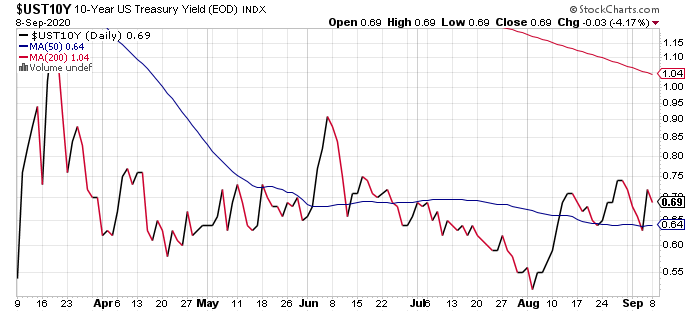
10-year US Treasury yield: Going nowhere fast:
Will Last Week’s Risk-Off Trade Roll On?
The US trading week begins with a fresh dose of red ink hanging over the major asset classes from last week’s sell-off. With the exception of foreign corporate bonds and investment-grade fixed-income in the US, all flavors of global markets lost ground last week (through Sep. 4), based on a set of proxy ETFs.
Macro Briefing | 8 September 2020
Trump says he plans to sharply reduce US-China economic ties: BBG
US states facing deep fiscal crisis: NYT
California wildfires create new electricity blackouts: AP
China’s exports continued to rebound in August: CNBC
Last two Australian reporters in China are flown out of country: BBC
The once-solid Exxon dividend is suddenly in doubt: Reuters
US payrolls continued to recover in Aug but losses still deep for some sectors: FTE

Happy Labor Day!
 “Without labor nothing prospers.”
– Sophocles
Book Bits | 5 September 2020

Cass R. Sunstein
Summary via publisher (MIT Press)
How much information is too much? Do we need to know how many calories are in the giant vat of popcorn that we bought on our way into the movie theater? Do we want to know if we are genetically predisposed to a certain disease? Can we do anything useful with next week’s weather forecast for Paris if we are not in Paris? In Too Much Information, Cass Sunstein examines the effects of information on our lives. Policymakers emphasize “the right to know,” but Sunstein takes a different perspective, arguing that the focus should be on human well-being and what information contributes to it. Government should require companies, employers, hospitals, and others to disclose information not because of a general “right to know” but when the information in question would significantly improve people’s lives.

The ETF Portfolio Strategist: Risk Bites Back
It had to end eventually. Or is this just one more pause in an ongoing bull market? If only we knew.
Will Bonds Continue To Provide Portfolio-Diversification Benefits?
Has the bond market run out of road as portfolio-diversification tool? No one knows for sure, but for some analysts the writing’s on the wall and markets are facing regime shift. The key catalyst: the long-running decline in current yield, which has gone negative in some countries and may soon do so in US.
Macro Briefing | 4 September 2020
Justice Dept. reportedly set to file antitrust charges against Google: Reuters
Trump seeks to cut federal funding to ‘anarchist jurisdictions’: CNBC
US job growth expected to slow in today’s August update: Reuters
Growth in German factory orders continued to decelerate in July: MW
Global Composite PMI, a GDP proxy, rose to 17-month high in August: IHS Markit
US trade deficit in July expanded to biggest gap in 12 years: BC
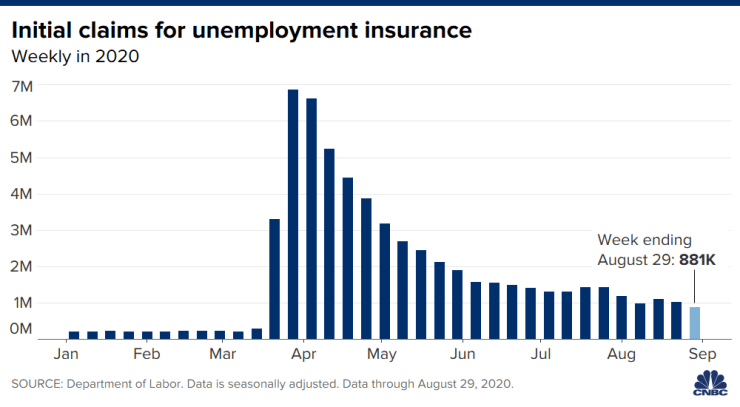
US jobless claims remain high but fell to lowest since pandemic started: CNBC
Growth And Momentum Equity Factors Pull Further Ahead
How has the US stock market performed so far this year? The answer, as always, depends on the definition of “the market.” If we’re slicing and dicing by factor buckets these days, the possibility of radically different answers has rarely been so stark.
Continue reading