Federal Reserve Chairman Jerome Powell may be downplaying inflation risks, but the bond market is signaling skepticism about how quickly price pressures will recede.
Monthly Archives: March 2026
US Q1 GDP May Improve As War Threatens the Outlook
US economic growth in the first quarter is still expected to rebound from the sluggish rise in Q4, but macro storm clouds are gathering for Q2 as the war in Iran continues.
Book Bits: 28 March 2026
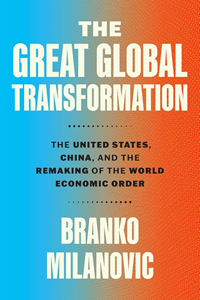 ● The Great Global Transformation: The United States, China, and the Remaking of the World Economic Order
Branko Milanovic
Review via Compact
According to Milanović, our decaying neoliberal order is so globalized and over-extended that it has coiled back in on itself, leaving us to commodify even our own leisure time by becoming increasingly incapable of enjoying it if it is not shared and displayed through social media… he sees little prospect of “re-embedding” market institutions in renewed social democracies and welfare states. While he sees neoliberal globalization coming to an end, he expects this process to crumble back into what he calls “national market liberalism”: neoliberal institutions confined to nations in which the balance between state and market remains tilted in favor of market elites.
Research Review | 27 March 2026 | Crash Risk
After the AI Crash: Bubble Burst or an Economy-Wide Crash?
Asad Ramzanali (Vanderbilt Policy Accelerator/Vanderbilt U.)
March 2026
Public concern about the level of AI investment is everywhere. While some compare today’s scenario to the dot-com bubble, the economy’s overreliance on AI investment, coupled with opaque financial engineering, means that a market correction could look more like the 2008 Great Recession, an economy-wide crash with systemic consequences. After such a crash, Congress will scramble to identify a reform agenda. In a rush, broader reforms that take time to formulate get shelved for quick action. It doesn’t have to be so. Instead of waiting for the crisis and hastily developing insufficient policies, lawmakers should prepare for this anticipated crisis now. Of course, a response depends on exactly how a crash comes to pass. But for meaningful reforms to have a chance, policymakers need to begin debating them. To that end, this paper describes how a crash might occur and outlines policies for Congress to consider in response.
Markets Are Decoupling Again, Based On Return Correlations
The benefits of diversifying across asset classes as a risk‑management tool are widely accepted, but what’s easily overlooked is that the relative benefits wax and wane over time. That doesn’t invalidate global asset allocation, but it does serve as a reminder that your mileage will vary.
Rate Cuts on Ice as Inflation Expectations Surge at the Short End
Inflation worries have convinced markets that the odds are low for a cut in interest rates this year by the Federal Reserve. Rate hikes are still considered unlikely, but the possibility is back on the table, if only on the margins. The change in sentiment, courtesy of the war in Iran, which has sent energy prices soaring, is weighing on the bond market. The hope is that the conflict will soon end, allowing Middle East oil and gas exports to resume, and thereby tame inflation worries.
Trump’s Strike Freeze Lifts Markets, but the Calm Looks Fragile
President Trump’s announcement of a halt in the strikes on Iranian infrastructure sparked a rise in risk assets on Monday (Mar. 23). It’s unclear if this is a temporary lull or a diplomatic opening that leads to a ceasefire, but risk assets found some breathing room yesterday. Commodities are still the strongest year-to-date performer for the major asset classes, but 2026 results are a bit less lopsided through yesterday’s close, based on a set of ETFs.
Stock Market Searches for a Bottom as War Continues
The Iran war is now in its fourth week, with no sign that the conflict is nearing an end. Conditions for a stalemate or ceasefire may be brewing, but for now no one is blinking. Without even a hint of de‑escalation, the stock market will continue searching for a bottom. When a turning point for the market arrives, it will likely coincide with a sense that geopolitical risk has finally peaked.
Book Bits: 21 March 2026
 ● Money Beyond Borders: Global Currencies from Croesus to Crypto
Barry Eichengreen
Review via Financial Times
The US dollar’s recent travails — it has fallen more than 10 per cent against other major currencies since the beginning of 2025 — have led to renewed questioning about its future. How long will it remain the world’s premier currency? What might it take to finally knock it off its perch? And, should it fall, what will replace it — a new dominant reserve currency, a basket of quasi-reserve currencies, perhaps even something from the cryptoverse? …
Eichengreen’s suspicion is that, if and when the US dollar in turn loses its mantle, the wounds will more likely be self-inflicted than exacted by a monetary foe. Among the possible fatal harms, he identifies heightened tariffs, America’s escalating fiscal woes, the undermining of Federal Reserve independence, more aggressive and widespread use of financial sanctions and a retreat from longstanding international alliances. The current US president has leaned — sometimes more than leaned — in all these directions.
Steady Today, Uncertain Tomorrow: Iran War Tests US Resilience
The war in Iran is sending shockwaves across the globe, but the US economy has managed to stay remarkably steady so far. How long the relative calm lasts is unclear, and will likely be determined by the duration of the conflict.