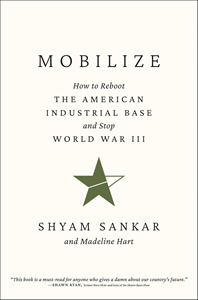
 ● Mobilize: How to Reboot the American Industrial Base and Stop World War III
Shyam Sankar and Madeline Hart
Review via The Wall Street Journal
Shyam Sankar is a Silicon Valley Paul Revere. The chief technology officer of the software company Palantir, Mr. Sankar comes at us with warnings of imminent danger, although not on a galloping steed. Instead, he delivers his hair-raising message—that we’re staring at “a humiliating and bloody defeat” if we go to war with China—in a jaunty, clever and sometimes breathless book.
“Mobilize,” written with the assistance of Madeline Hart, a strategist at Palantir, intends to jolt us out of our national-security slumber. “Complacency in peacetime can lead to war,” Mr. Sankar writes. (The book went to print before the U.S.-Israeli use of force against Iran.)
Monthly Archives: April 2026
Crisis in Transit: War’s Economic Fallout Is Only Beginning
Markets are pricing in higher odds that the war with Iran has ended, but even if that proves true, the economic effects of the conflict will linger for months, if not years.
Whiplash Rally: Stocks Hit New High Just Days After Sharp Drop
In another display of resilience, the stock market rebounded to a record high on Thursday following the recent correction. The drawdown wasn’t particularly unusual, or unexpected, given the geopolitical risk lurking in the background. But the recovery from the low was notable for its speed.
Against the Odds: US Is Relatively Resilient Despite Global Turmoil
How much policy uncertainty and geopolitical risk can the US economy absorb without derailing its expansion? More than many analysts expected.
In 2026’s Wartime Markets, Risky Debt Outshines Treasuries
Bonds are prized for offering stability in an asset‑allocation strategy, providing an offset to the higher risk in stocks, particularly during periods of market stress. But since the Iran war began, fixed‑income securities have had a rough ride as markets struggle to assess whether the conflict’s main threat is higher inflation, slower growth (if not recession), or some mix of both.
Iran War May Widen 10-Year Yield’s Market Premium vs. Fair Value
The inflation-driven spike in the market premium for the US 10-year yield in 2022-2023 has been gradually reversing over the last several years. But in the wake of the turmoil in the Middle East, which has raised energy costs and inflation, the pre-war calculus may be set for an attitude adjustment.
Book Bits: 11 April 2026
 ● Planet Money: A Guide to the Economic Forces That Shape Your Life
Alex Mayyasi
Interview with author via WVPB radio
Q: Give me the 30 second version. What is the economy? Why should I care about it?
A: I mean, first I have to give my favorite joke is that economists say economics is what economists do, because there is this way that it’s a little bit nebulous, and that’s what we’re referring to. But I think one answer is that the economy is humanity’s greatest invention. The economy is all of us pursuing our interests and values, training with each other, interacting with each other, working together. Sometimes when we don’t even know it and we just find it absolutely fascinating to try to better understand and learn how it works and share that with other people.
Momentum Factor Leads as Wall Street Bets on a Fragile Ceasefire
The tentative ceasefire between the US and Iran is holding as both governments prepare to meet for high‑stakes talks in Pakistan. The foundation for a peace deal may be wobbly, but the stock market is cheering: the S&P 500 Index closed on Thursday (Apr. 9) at its highest level in five weeks. Equity factors have also rallied, though results vary widely, with momentum posting the strongest gain based on a set of ETFs.
Q1 GDP Poised for Rebound as Fragile Ceasefire Clouds Outlook
US economic activity is still expected to rebound in the upcoming first-quarter GDP report scheduled for Apr. 30, but recovery from Q4’s stall-speed increase may face stronger headwinds in Q2 as the effects from the war with Iran reverberate in the months ahead.
US–Iran Ceasefire Takes Hold, as Fragile Peace Looms
The two-week ceasefire announced by the US and Iran on Tuesday is welcome news, but deciding if the threat of war has truly passed will take time. The peace may be fragile, but markets are already cheering this morning. The true test will unfold over the coming weeks. Here are some of the indicators I’ll be watching for determining if the worst has passed.