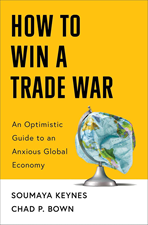
 ● How to Win a Trade War: An Optimistic Guide to an Anxious Global Economy
Soumaya Keynes and Chad P. Bown
Review via Reason
The ancient Chinese military strategist Sun Tzu advised that “he who wishes to fight must first count the cost.” Joshua, the brilliant (for its time) computer in the 1983 film WarGames, did the counting and concluded that “the only winning move is not to play.”
Both lines find their way into How To Win a Trade War. This is no arid academic analysis, and it does not read like one. Instead, Soumaya Keynes, a journalist at the Financial Times, and Chad Bown, a senior fellow at the Peterson Institute for International Economics, have crafted a witty, fast-paced analysis of how the global trading system has unraveled in the aftermath of COVID, Brexit, and (most importantly) President Donald Trump’s electoral successes.
Monthly Archives: June 2026
Research Review | 5 June 2026 | Risk Management
Measuring Bubbles via Put-Call Disparity: A Model-Free Approach
Robert A. Jarrow (Cornell U.) and Simon Kwok (U. of Sydney)
May 2026
This paper introduces simple, model-free lower and upper bounds for measuring the size of asset price bubbles. Assuming only that the market satisfies no-free-lunch-with-vanishing-risk and that all trading strategies are admissible, our framework avoids restrictive parametric models and the no-dominance assumption. We demonstrate that put-call disparity provides an observable lower bound, and is economically justified by short-sale constraints. Additionally, the lowest price of an out-of-the-money (OTM) call option determines the upper bound. To ensure empirical reliability, we modify these bounds using data-driven regularization and bootstrap methods to disentangle genuine bubble signals from market microstructure noise and to reduce reliance on thinly traded deep OTM options. Using S&P 500 index option prices from 1996 to 2025, we document a sustained bubble during the COVID-19 era and capture market exuberance preceding the 2000 dot-com and 2008 financial crashes. In addition, the empirical study suggests that the market violates no-dominance and is incomplete.
Trailing Yields: Major Asset Classes | 4 June 2026
US junk bonds continue to post the highest trailing one‑year yields for the major asset classes, based on a set of ETFs through June 3. Roughly half of the funds are reporting payout rates above the current pace of annual consumer inflation.
Energy Shock Looms, but Q2 GDP Still Looks Surprisingly Strong
The US economy isn’t immune to the energy shock continuing to reverberate from the Middle East, but the fallout may be hard to spot in the upcoming second‑quarter GDP report. That, at least, is the message in current nowcasts.
Continue readingTotal Return Forecasts: Major Asset Classes | 2 June 2026
The expected long-term total return for the Global Market Index (GMI) continued to tick higher in May, rising to the highest level in recent history. Although the annualized performance outlook has edged up to a mid-7% forecast, the current outlook remains well below GMI’s realized return over the trailing ten-year window.
Major Asset Classes | May 2026 | Performance Review
Most markets continued to rise in May, extending April’s bounce-back after March’s broad and deep selloff, based on a set of ETFs. The main exception among the major asset classes: commodities, which fell sharply, posting the first monthly decline this year.