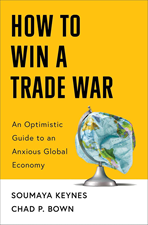
 ● How to Win a Trade War: An Optimistic Guide to an Anxious Global Economy
Soumaya Keynes and Chad P. Bown
Review via Reason
The ancient Chinese military strategist Sun Tzu advised that “he who wishes to fight must first count the cost.” Joshua, the brilliant (for its time) computer in the 1983 film WarGames, did the counting and concluded that “the only winning move is not to play.”
Both lines find their way into How To Win a Trade War. This is no arid academic analysis, and it does not read like one. Instead, Soumaya Keynes, a journalist at the Financial Times, and Chad Bown, a senior fellow at the Peterson Institute for International Economics, have crafted a witty, fast-paced analysis of how the global trading system has unraveled in the aftermath of COVID, Brexit, and (most importantly) President Donald Trump’s electoral successes.
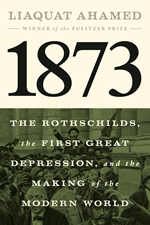 ● 1873: The Rothschilds, the First Great Depression, and the Making of the Modern World
Liaquat Ahamed
Review via The Wall Street Journal
In one single unforgettable day—Friday, May 9, 1873—prices on the Vienna Stock Exchange plunged by 45%. All at once the world was changed.
“1873,” by Liaquat Ahamed, author of “Lords of Finance: The Bankers Who Broke the World” (2009), is the story of the trans-Atlantic depression that followed the crash. It is the story, too, of a generation-long, befuddling decline in the prices of all kinds of things. In 1878, confronting the lowest prices for pig iron since colonial times, American ironmasters wondered if the smokestacks on their idled blast furnaces might serve a higher use as astronomical observatories.
 ● Lightning Beneath the Sea: The Race to Wire the World and the Dawn of the Information Age
James M. Tabor
Review via The Wall Street Journal
You’ll rarely know for certain, but when you send an email, check your social-media feed or read this newspaper online, you may be sending pulses of light through a conduit the size of a garden hose resting on the floor of the sea. Around 500 fiber-optic cables, not counting those owned by governments, stretch for more than a million total miles beneath the oceans. They provide the physical backbone for the weightless world of the internet. Life without them would be hard to imagine.
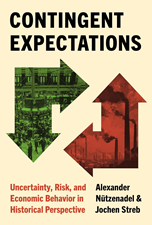 ● Contingent Expectations: Uncertainty, Risk, and Economic Behavior in Historical Perspective
Alexander Nützenadel and Jochen Streb
Summary via publisher (Princeton U. Press)
Expectations play a crucial role in shaping economic behavior. But how are expectations actually formed, and how has this changed over time? The financial crisis of 2007–08 cast doubt on traditional theories of expectation formation, particularly the rational expectations framework. In Contingent Expectations, Alexander Nützenadel and Jochen Streb examine the ways that past experiences influence the economic expectations and decision-making of households, investors, and policymakers through history, and offer an alternative perspective. Combining a comprehensive empirical analysis of expectation formation from the eighteenth century to the present day with an assessment of the relevant economic theory, Nützenadel and Streb present a new theoretical framework, contingent expectations, for understanding economic expectation.
Please note that the links to books above are affiliate links with Amazon.com and James Picerno (a.k.a. The Capital Spectator) earns money if you buy one of the titles listed. Also note that you will not pay extra for a book even though it generates revenue for The Capital Spectator. By purchasing books through this site, you provide support for The Capital Spectator’s free content. Thank you!