The momentum risk factor has been leading the field in recent history, but there are signs that a rotation may be underway, based on a set of ETFs through yesterday’s close (July 20).
As a new phase of the Iran conflict heats up—reigniting concerns about macro effects—there are hints that the leadership profile in the factor space is shifting. The analysis is speculative at this point, but the differences in how various segments of the current stock‑market pullback are performing suggest that capital flows in equity allocations may be shifting.
Let’s start with an update of factor performances since the conflict with Iran began on Feb. 28. Results highlight the momentum factor’s ongoing leadership via the iShares MTUM Momentum ETF (MTUM), which is up nearly 20% over that span—a clear outlier that’s well ahead of the rest of the field, including the stock market benchmark (SPY).
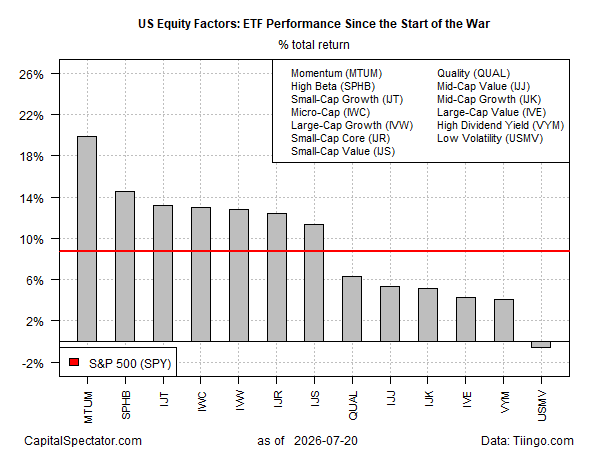
Month‑to‑date results, however, highlight a reversal of fortunes for several of the leading factor funds. Notably, the leading factors in the chart above—momentum (MTUM) and high beta (SPHB), the second‑best performer since Feb. 28—have fallen the hardest this month. Meanwhile, small‑cap (IJR) and micro‑cap (IWC) shares have posted relatively modest losses.
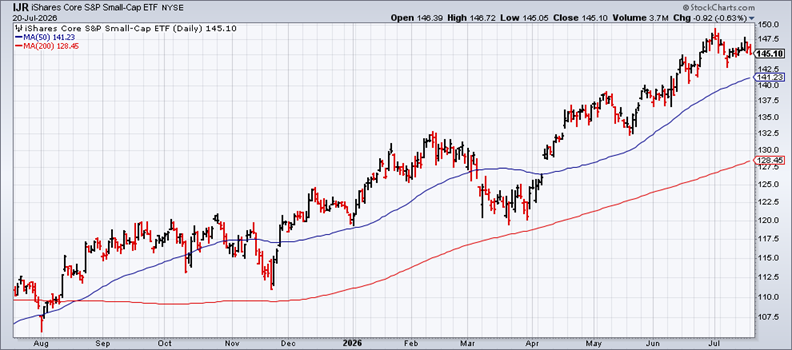
Reviewing the price charts also highlights a divergence in the recent correction and the trend profiles. Consider the recent price action for small‑cap stocks (IJR), which have posted only mild downturns.
Compare that with the considerably deeper slide for momentum stocks (MTUM).
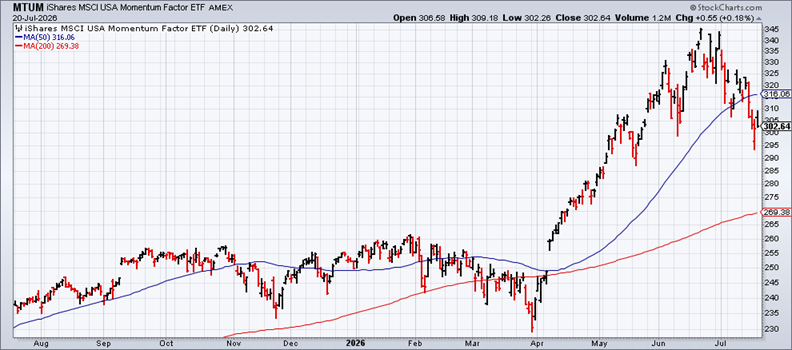
These differences could be noise, of course, and so it remains unclear whether the long dominance of momentum via large caps, as reflected in the MTUM portfolio, has run out of road or is simply on the back foot temporarily. But after a long run of relatively weak small‑cap results, the recent strength for these shares raises the possibility that a leadership rotation may be developing.
For some analysts, the writing is already on the wall. Vanguard is currently forecasting that small caps will outperform large caps over the decade ahead.
Royce Investments’ co‑CIO, Francis Gannon, told CNBC on Monday that an earnings rebound for small caps is a key factor shaping expectations. The negative earnings run for small caps “just turned positive at the end of last year. The [earnings] outlook [for small caps] is pretty positive, and we think it’s actually going to continue to be in line—perhaps even potentially better than large‑cap earnings—by the end of this year into 2027. If earnings lead the market, as I believe they do, I think you’re going to be in a sweet spot here for small caps for a period of time.”
Forecasts should be viewed cautiously, especially in the small‑cap space, which has suffered numerous false dawns in recent years. But monitoring price trends is a way to trust but verify. If the relative‑strength profile holds up, the bullish earnings outlook will continue to resonate—a combination that could keep the small‑cap engine humming.
