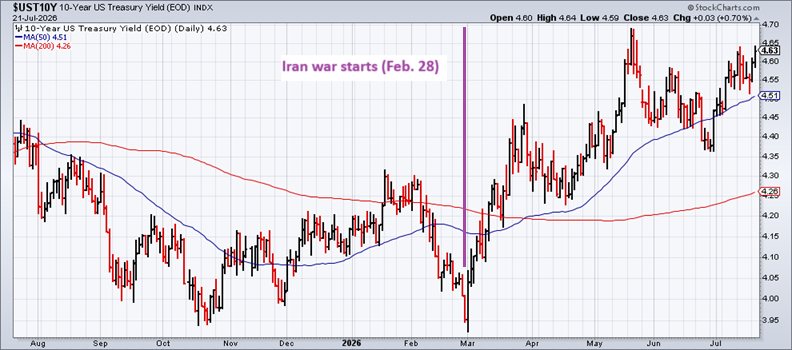
In late February, the US 10-year Treasury yield was trending lower, dipping below 4.0% on the final trading day of the month. The macro outlook at the time suggested the benchmark yield would dip even lower in the coming weeks, a view supported by the downside trending behavior that month. But on Feb. 28, the bombs started falling on Iran, an event that reversed the 10-year yield’s slide—a turnaround that has strengthened in July.
The collapse of the US-Iran peace agreement and renewed military strikes in the Gulf region have revived the bond market’s focus on inflation risk. The US military on Tuesday conducted an 11th straight day of attacks on Iran. Secretary of State Marco Rubio on Wednesday said the US was open to diplomacy, but that the attacks would continue if Iran continued its efforts to control shipping through the Strait of Hormuz, the critical chokepoint for Middle East energy exports. Meanwhile, President Trump this week said he is willing to escalate US military action by again bombing Iran’s nuclear facilities, or what’s left of them after previous attacks.
Earlier this week, the risk of a wider war that further restricts oil shipments came into focus after the Houthis in Yemen threatened to blockade ships moving from Saudi Arabia through the Bab al-Mandab Strait at the southern end of the Red Sea. At stake is roughly 4% of the world’s oil shipments, according to Kpler, a consultancy.
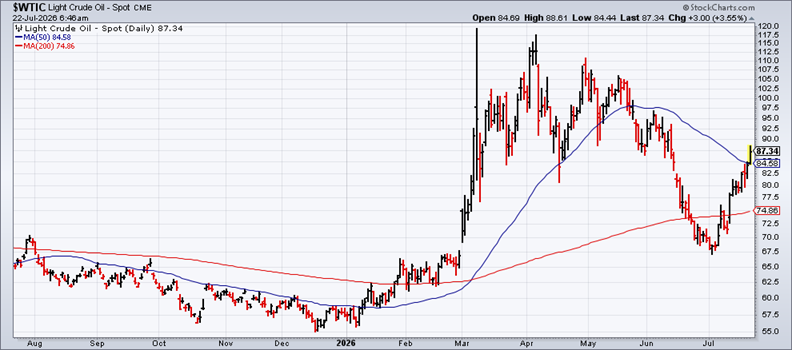
The oil market is taking the hint and repricing crude higher again. The US benchmark rose above $87 a barrel in trading yesterday, the highest in more than a month.
The bond market is processing the news and testing the upper level of the trading range for yields since the war started. The 10-year yield rose to 4.63% yesterday, just below the war’s peak set in May.
The revival of energy costs is again pointing to higher inflation risks at the headline level. Although the Federal Reserve may be inclined to look through a new spike in a general increase in pricing pressure to the extent it’s driven by energy costs, there’s a growing concern that core inflation, which ignores food and energy costs, will stay elevated or rise further. Core inflation tends to be more influential for monetary policy decisions because this measure generally offers a steadier read on the underlying price pressures that matter most for setting interest rates.
Expectations for higher core prices cooled after the June update on prices reported softer inflation pressure, but the optimism has faded as the latest phase of the war has continued. The Fed funds futures market is still expecting no change to rates at next week’s policy meeting (July 29), but at least one rate hike is now priced in for the rest of the year.
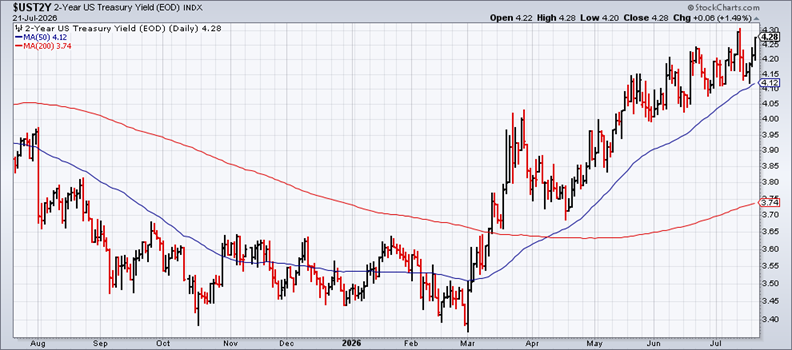
The policy-sensitive 2-year yield’s hawkish pivot is especially pronounced these days. In yesterday’s trading, this yield rose to 4.28%, just a few basis points below the peak since the war began—set a few days earlier at roughly 4.30%. Notably, this yield is well above the Fed funds 3.50%-3.75% target range—a clear sign that the market expects rate hikes.
Inflation and Treasury yields remain closely tied to Middle East instability. Finding an off-ramp presents a strategic dilemma for the US. A de-escalation is vital to ease energy-driven inflation and calm nervous financial markets, yet accepting anything less than explicit capitulation from Iran risks looking weak on the international stage. With missile exchanges continuing alongside mixed diplomatic signals, any proposed “deal” risks being framed as a retreat—leaving the administration trapped between market-damaging inflation and political face-saving.
Is Recession Risk Rising? Monitor the outlook with a subscription to:
The US Business Cycle Risk Report
That’s a really interesting read – it’s wild to think how quickly things can shift with those treasury yields.