The war with Iran is bad news for the global economy, but it’s lifting the fortunes of most energy stocks, led by oil refiners, according to a set of ETFs. The world has had a painful reminder that fossil fuels from the Middle East can’t be ignored. At the same time, some corners of energy have taken a hit — the nuclear power industry is the major downside outlier since the conflict began on Feb. 28.
The benchmark for energy stocks is the Big Oil sector, proxied by the State Street Energy Select Sector SPDR ETF (XLE), dominated by ExxonMobil, Chevron, and ConocoPhillips, which together make up more than 40% of the portfolio. Since the conflict began, XLE is up more than 7% through Wednesday’s close. It’s a solid gain, though it trails the broader stock market: the SPDR S&P 500 ETF (SPY) has risen about 9.5% over the same period. Competing with AI and tech — SPY’s largest weights — is difficult these days, even with a Middle East war providing a tailwind for energy.
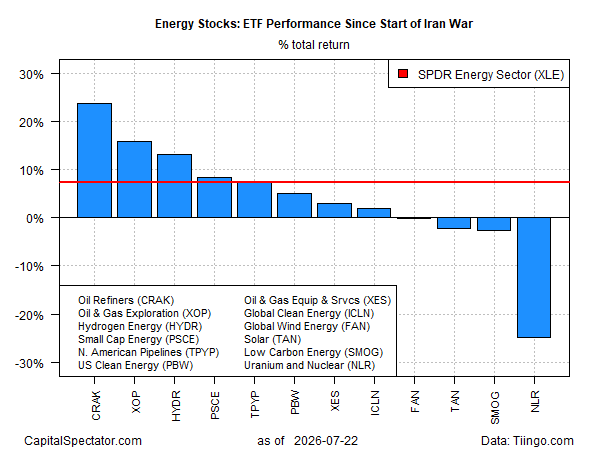
Looking beyond Big Oil reveals an even wider spread of outcomes. Oil refiners have dramatically outperformed XLE. The VanEck Oil Refiners ETF (CRAK) has surged nearly 24% during the war, marking the strongest rally in the group. The Iran conflict has created a perfect storm for refiners: years of lagging refinery-capacity growth, geopolitical disruption, and strong consumer and industrial fuel demand have combined to boost profitability.
The big energy loser during the war has been uranium and nuclear stocks. The VanEck Uranium and Nuclear ETF (NLR) has fallen nearly 25% since Feb. 28. Some of this weakness reflects the unwinding of a large 2024–2025 rally. Recent news — including the Trump administration’s approval of a U.S.–Saudi civilian nuclear pact and a White House-backed AI-driven nuclear acceleration initiative — has helped revive sentiment this week. There are early signs that fortunes in the industry may be stabilizing.
In the near term, however, if the Iran conflict continues to simmer, traditional oil and gas stocks are likely to remain the primary beneficiaries. Geopolitical risk tends to support crude prices, bolster refining margins, and strengthen cash flows for fossil‑fuel producers — giving them a clearer upside path than more volatile, sentiment‑driven segments like nuclear.
Is Recession Risk Rising? Monitor the outlook with a subscription to:
The US Business Cycle Risk Report