Treasury Secretary Scott Bessent is escalating the government’s campaign to cap, if not lower, long‑term yields. After last week’s expanded buyback plan failed to sway the bond market, the government raised the stakes again on Monday, floating the prospect of a dramatically larger pool of funds to step up purchases of government debt.
This is a high‑risk game of chicken. If it works, and long yields stabilize or fall, the strategy could go into the history books as a grand success. On the flip side is the possibility that the market calls the government’s bluff and yields keep rising. In that latter case, the Treasury Department’s credibility will take a blow, which could trigger even higher yields.
For now, it’s just talk, starting with last week’s announcement by Treasury to double the size of buybacks of 10‑ to 30‑year maturities to $4 billion—a drop in a $30 trillion‑plus bucket of the U.S. government bond market, of which nearly $6 trillion is estimated in long‑dated securities.
When that plan fell flat and long yields continued to rise, Bessent hinted on Friday that the buyback program could exceed $4 billion. On Monday, the government escalated the rhetoric, noting that Treasury could spend as much as $1 trillion to finance buybacks, according to two senior Treasury officials, CNBC reports. The Treasury General Account is the U.S. government’s central checking account at the Federal Reserve Bank of New York, used for receiving federal revenues and making all official government payments.
News that the government could dramatically increase buybacks seemed to have a calming effect on the bond market yesterday. The 30‑year Treasury yield, for example, fell to 5.23%, near the lower range of trading in recent days. But the outcome of the government’s efforts to talk down yields—perhaps backed up with real money—remains a work in progress with an unclear result.
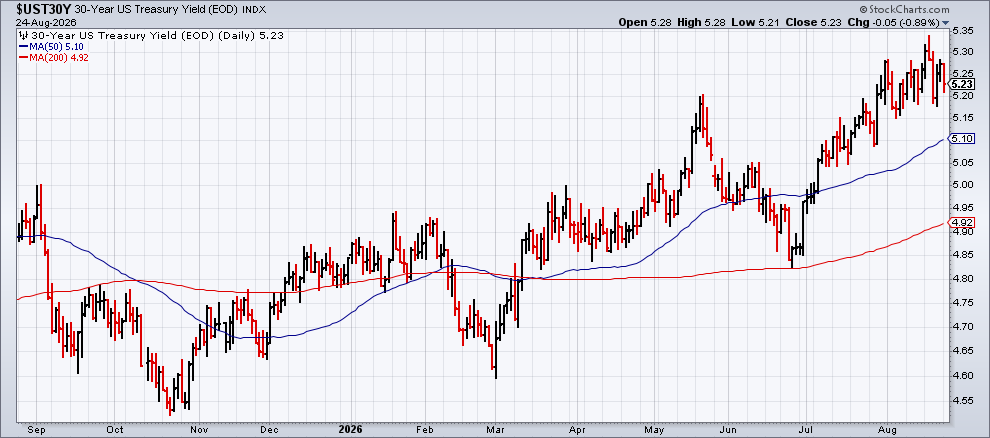
A government attempt to cap yields faces strong headwinds from several fundamental factors. Long‑term rates are climbing as energy‑driven inflation from the Iran war, a post‑election government debt surge, and massive AI‑related corporate bond issuance squeeze the fixed‑income market. Together, these forces support inflation expectations, flood the market with Treasury debt, and heighten competition for capital.
Fueling the bond market’s selloff, which has been lifting yields, is last week’s news that the U.S. national debt reached $40 trillion and the annual deficit is expected to hit $2 trillion this year. The truly big guns needed to wage a war to lower yields require fiscal reform in the form of legislation. Congress or the White House, alas, appears unlikely to even discuss the issue, much less forge a path to craft a credible package to start a national conversation and lay the groundwork for tackling a growing threat.
Bond investors know all this, of course, and so the question is whether Treasury can convince the market that it has the firepower—and, crucially, the will—to spend enormous amounts of public money to suppress yields.
Treasury has another lever to pull to raise the ante further: directing the Federal Reserve to increase its purchases of Treasury bonds and revive the controversial quantitative easing (Q.E.) program. But that would put Fed Chairman Kevin Warsh in an uncomfortable position, given his sharp criticism of Q.E. in the past.
The danger here is that the bond market continues to raise yields, effectively telling the government that fundamental reform of spending and debt management is the only game in town.
For now, it’s unclear whether the bond market bears can be tamed. If investors remain skeptical and continue to raise yields by selling fixed‑income securities, the potential for a much deeper bond‑market rout could be lurking.
Cue up this Friday’s speech by Fed Chairman Warsh at the central bank’s Jackson Hole meeting. His speech won’t just be a policy update—it may be a pivot point when the bond market decides who’s really in charge, and perhaps the defining moment, for good or ill, of Warsh’s tenure at the Fed.
