One of the more persuasive explanations for the recent increase in U.S. Treasury yields is that the economy remains resilient, prompting the bond market to push interest rates higher in response to a stronger growth outlook. Recent third-quarter GDP nowcasts support that narrative. The catch is that higher interest rates may be a double-edged sword: while they can signal economic strength, they can also undermine it by creating headwinds for future growth. The growth narrative may be convincing, but it is unlikely to be the whole story. Some of the other factors driving yields higher paint a less reassuring picture.
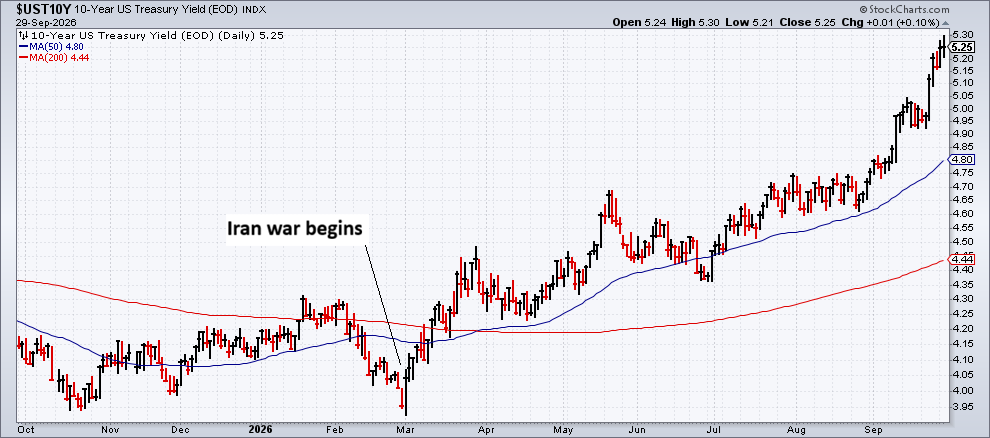
Much depends on whether rates keep rising. For the moment, the trend is pointing in that direction. The U.S. 10-year Treasury yield climbed to 5.25% on Tuesday, the highest level in nearly two decades.
The case that the runup in yields is largely a function of stronger economic activity looks reasonable, perhaps even persuasive, based on the latest nowcasts for third-quarter GDP. The projected growth rate has risen to a 3.2% annualized pace, based on the median estimate from a set of forecasts compiled by The Capital Spectator. If accurate, growth will more than double from Q2’s modest 1.5% increase.
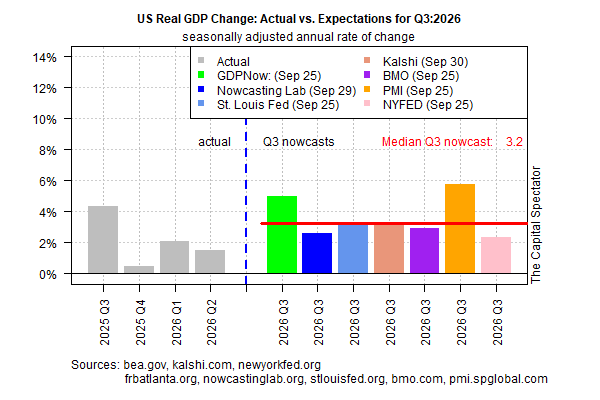
The median Q3 nowcast reported by The Capital Spectator has been rising in recent weeks. Two of the inputs are running especially hot, with forecasts of 5% growth and higher.
The survey-based US Composite PMI Index, a widely followed GDP proxy, surged in last week’s preliminary September estimate, rising to 58.4, a 62-month high. Based on The Capital Spectator’s estimate, that reading is consistent with a 5.8% annualized increase in GDP.
The Atlanta Fed’s GDPNow model isn’t far behind. Its September 25 nowcast indicates 5.0% growth for Q3.
The debate in the bond market is how much of the rise in yields is being driven by accelerating economic activity versus less favorable factors, including inflation concerns. Although price pressures appear relatively stable in the latest data, that stability reflects inflation running well above the Federal Reserve’s target, which recently prompted the central bank to raise interest rates for the first time in more than three years.
Elevated energy costs are a key component for the inflation concern, driven by the ongoing conflict with Iran. Near-term relief in the form of lower oil, gasoline, and diesel prices does not appear imminent after President Trump rejected Iran’s peace proposal on Saturday.
By some accounts, a meaningful decline in energy costs may require a significant slowdown in economic activity if the Iran conflict continues in its current form. If Treasury yields continue to rise, it is reasonable to assume that higher borrowing costs will eventually slow economic activity, if only at the margins.
Another factor that appears to be contributing to higher yields has no obvious short-term solution. Treasury yields may be reflecting a growing fiscal risk premium as investors grapple with the prospect of persistently large deficits and a national debt burden that appears unlikely to be meaningfully addressed anytime soon.
New York Fed President John Williams yesterday gave bond investors a modest reason to dial back expectations for additional monetary tightening, at least in the immediate future. He downplayed the inevitability of another rate hike at next month’s FOMC meeting, saying there was “no need for urgency” and that “we have time to gather more information” before making the next policy decision.
The policy-sensitive 2-year Treasury yield took the hint and edged lower yesterday, but longer-term bonds largely ignored the comments. Notably, the 30-year Treasury yield, the most sensitive maturity to long-run inflation and fiscal concerns, continued to climb, ending Tuesday’s session at 5.57%, the highest level since 2002.
For now, the bond market appears unconvinced that slower growth, lower inflation, or fiscal restraint are close at hand. Until one of those narratives gains traction, Treasury yields may continue marching higher, testing not only the economy’s resilience but also investors’ willingness to keep pricing in a best-case scenario centered on improving economic activity.
