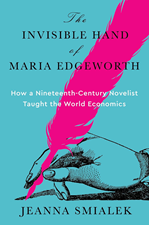
 ● The Invisible Hand of Maria Edgeworth: How a Nineteenth-Century Novelist Taught the World Economics
Jeanna Smialek
Interview with author via Marketplace
You may have learned in grade school that Adam Smith originated many of the ideas behind modern economics in his book “The Wealth of Nations.” Maybe you’ve also heard about Thomas Robert Malthus or John Maynard Keynes, economists who are also remembered for their contributions to the field. But chances are, you probably haven’t heard of Maria Edgeworth — at least not for her contribution to economics.
Edgeworth was a Regency-era novelist who, at one point, was England’s most popular writer.
“Jane Austen was a Maria Edgeworth fangirl,” said Jeanna Smialek, Brussels bureau chief at The New York Times. “She’s obsessed with Maria Edgeworth and is sending her letters and being like, ‘please review my books.’’’
But Smialek also found that Edgeworth was deeply engaged in economics, corresponding with peers like David Ricardo and Thomas Malthus, and working the ideas from Adam Smith into her novels.
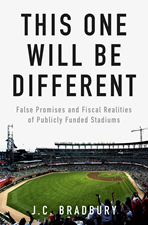 ● This One Will Be Different: False Promises and Fiscal Realities of Publicly Funded Stadiums
J.C. Bradbury
Review via CleveScene.com
When Atlanta’s Truist Park opened up in 2017, there were mixed feelings about the Braves’ new ballpark as the team moved out of downtown. Truist Park was now surrounded by a village of shops, restaurants, bars and luxury move theaters, all buoyed by some $300 million of public money with promises of grand returns.
That’s not what has happened, according to sports economist J.C. Bradbury. A professor at Kennesaw State University, Bradbury is one of the nation’s leading researchers on publicly financed stadium and arena projects. And he’s just released his latest book, This One Will Be Different: False Promises and Fiscal Realities of Publicly Funded Stadiums, a 440-page dive into how sports teams time and again attract taxpayers dollars to pay for new stadiums that, decades later, never turn a profit or deliver on economic impact pledges.
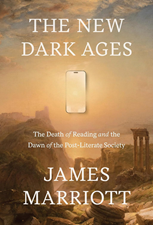 ● The New Dark Ages: The Death of Reading and the Dawn of the Post-Literate Society
James Marriott
Review via Los Angeles Review of Books
The broad thrust of Marriott’s argument — there is a decline in reading that is antithetical to the progress of the Enlightenment — strikes me as persuasive and deeply troubling. The one area where the reading crisis, an associated mistrust of science, superficial public policy, and a dire future do unquestionably converge is a crucible I have not seen discussed in The New Dark Ages or elsewhere in the literacy debate. It is, of course, climate change. Whether we stop vaccinating against the measles long enough for cases to rise, and for fools to realize their mistake, is bad enough. But a refusal to acknowledge demonstrated scientific facts that will irreversibly spell doom for the planet raises the stakes considerably. I would tell you to find a climate skeptic you know, hand them a book like Spencer R. Weart’s The Discovery of Global Warming (2003), and urge them to educate themselves. But they probably wouldn’t read it.
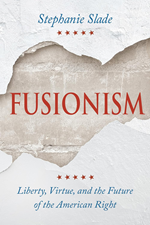 ● Fusionism: Liberty, Virtue, and the Future of the American Right
Stephanie Slade
Review via The Wall Street Journal
The name of Frank Meyer is rarely heard on the political right today. Younger conservatives in the 2020s won’t know much about fusionism, the political outlook Meyer formulated — briefly, the idea that free markets, virtue and tradition can cohere with one another. Since his death in 1972, fusionism’s heyday, it has gone out of fashion, replaced by a form of right-wing bellicosity with little patience for compromise.
Stephanie Slade’s “Fusionism: Liberty, Virtue, and the Future of the American Right” explores the intellectual roots of fusionism and, by extension, American conservatism. The starting point is the great debate between traditionalists as defenders of order, morality, religion and virtue, and libertarians and classical liberals as advocates of the free market and individual rights. Over time, neither side achieved dominance within American conservatism; what emerged instead was a “fusion” of the two. Ms. Slade, an editor at Reason magazine, has given us an excellent account of a once-influential political outlook that deserves renewed attention.
Please note that the links to books above are affiliate links with Amazon.com and James Picerno (a.k.a. The Capital Spectator) earns money if you buy one of the titles listed. Also note that you will not pay extra for a book even though it generates revenue for The Capital Spectator. Thank you!