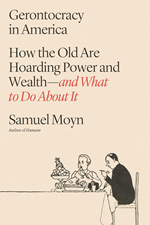
 ● Gerontocracy in America: How the Old Are Hoarding Power and Wealth―and What to Do About It
Samuel Moyn
Review via The Economist
America is ruled by the old, argues Samuel Moyn, a Yale professor, in “Gerontocracy in America”. It is not just that Donald Trump is 80 or that his predecessor left office at 82 and was palpably impaired. Mr Moyn sees a society that privileges the elderly, blocks the young and “is more set on preservation than on renovation”.
When it comes to politics, he has a point. American lawmakers grow mightier with seniority, and there is no good mechanism for getting rid of them when they can no longer do their jobs. Kay Granger, a member of Congress from Texas, served despite living in a retirement home and suffering from dementia. Dianne Feinstein, a senator from California who died in office at 90, often failed to understand what was going on around her.
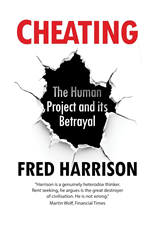 ● Cheating: The Human Project and its Betrayal
Fred Harrison
Summary via publisher (Shepheard-Walwyn)
Five thousand years ago, humanity made a huge mistake. The income generated from shared land, known as economic rent, was taken by chiefs and priests instead of being used for everyone’s benefit. Every unfair tax, every preventable death from poverty, and every financial crash since can be traced back to this original betrayal. Drawing on evolutionary science and years of accurate economic predictions, including the 2008 financial crisis, Fred Harrison reveals the “culture of cheating” built into the foundations of modern society. He explains how mainstream economics deliberately removed the idea of rent and how governments choose to tax wages instead of land, harming prosperity and shortening lives. With five major crises: political gridlock, environmental collapse, mass migration, authoritarianism, and uncontrolled artificial intelligence, set to clash around 2028, Harrison makes an evidence-based case for tax reform: replacing taxes on labour with Annual Ground Rents and sharing rents between nations to resolve conflicts from Gaza to the global climate crisis.
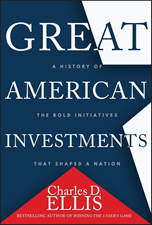 ● Great American Investments: A History of the Bold Initiatives that Shaped a Nation
Charles D. Ellis
Summary via publisher (Wiley)
In Great American Investments, legendary investor Charles D. Ellis reveals the fascinating stories behind the decisions that shaped America. From the Louisiana Purchase that doubled the nation’s size to Land Grant Colleges that democratized education, Ellis explores how bold investments in people, land, and infrastructure transformed a young country into a land of unprecedented opportunity.
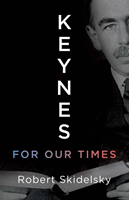 ● Keynes for Our Times
Robert Skidelsky
Adaptation via IMF.org
Artificial intelligence has a penchant for pronouncements that are clear, confident…and often wrong. More than a passing technical flaw, this speaks to the difficulty we all—including AI’s human architects—face in dealing with uncertainty. John Maynard Keynes, in contrast, understood that the future is essentially unknowable, and it is “better to be vaguely right than precisely wrong.” This insight remade economics in the 20th century, and it is but one of his ideas that are even more relevant in our own extremely uncertain times.
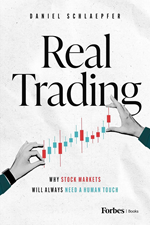 ● Real Trading: Why Stock Markets Will Always Need a Human Touch
Daniel Schlaepfer
Press release via PR Newsire
Real Trading explores the evolution of global markets, the rise of high-frequency trading, the retail trading boom, the risks of dark pools and payment for order flow, and the growing confusion between trading, gambling and entertainment. Schlaepfer also takes aim at the rise of so-called “funded trader” programs, arguing that many of them are designed less to develop professional talent than to profit from repeated failure.
“Too many funded trader businesses are not really funding traders,” Schlaepfer said. “They are funding a funnel. Their economics depend on people failing challenges, paying again and believing the next attempt will be different. That is not professional development. It is extraction dressed up as opportunity.”
Please note that the links to books above are affiliate links with Amazon.com and James Picerno (a.k.a. The Capital Spectator) earns money if you buy one of the titles listed. Also note that you will not pay extra for a book even though it generates revenue for The Capital Spectator. By purchasing books through this site, you provide support for The Capital Spectator’s free content. Thank you!