Category Archives: Uncategorized

Macro Briefing: 15 November 2024

US jobless claims fell to a six-month low last week. “While many employment-related indicators point to a significant softening in labor market conditions this year, that change has not carried over to the unemployment insurance data thus far,” says Lou Crandall, chief economist at Wrightson ICAP. An economist at RSM, Tuan Nguyen, writes: “The continued drop in new filings for unemployment benefits, a proxy for layoffs, should suggest a strong rebound in payroll gains this month, which would reaffirm that the disappointing October jobs report was a one-time shock.”

Continue reading

Macro Briefing: 14 November 2024

US consumer inflation edges up to 2.6%, marking first pickup in pricing pressure since March. The core reading of inflation (excluding energy and food) held steady at a 3.3% pace. “Progress on inflation has started to stall,” says Michael Pugliese, a senior economist at Wells Fargo. “The time is fast approaching when the Fed will signal that the pace of rate cuts will slow further, perhaps to an every-other-meeting pace starting in 2025.”

Continue reading

Macro Briefing: 13 November 2024

The US dollar index rose to a six-month high on Tuesday, fueled by expectations for rising inflation risk during a second Donald Trump presidency. The reasoning is related to the possibility that the Federal Reserve may curtail or perhaps reverse rate-cutting plans if inflation rebounds due to potentially reflationary policies driven by higher tariffs and other policy plans outlined by the president-elect. Higher interest rates tend to support a higher dollar relative to other currencies. The Fed would “continue to take a cautious tone going forward, especially in light of what we view as heightened inflation risks in a second Trump term,” predicts Win Thin, global head of markets strategy at Brown Brothers Harriman.

Continue reading

Macro Briefing: 12 November 2024

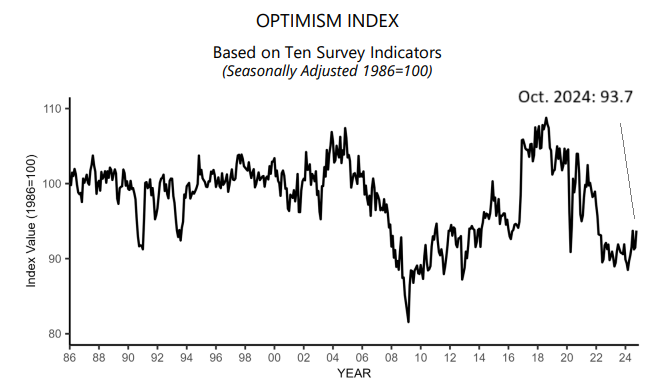
US small business optimism edges up to three-month high in October, but remains far below pre-pandemic levels. “With the election over, small business owners will begin to feel less uncertain about future business conditions,” predicts NFIB Chief Economist Bill Dunkelberg. “Although optimism is on the rise on Main Street, small business owners are still facing unprecedented economic adversity.”

Continue reading

Will Reflation End The US Bond Market’s Recovery?

In mid-September, the bond market looked set to coast to a second year of recovery after a bruising run of back-to-back losses in 2021 and 2023. Since then, the market has lost altitude. Although a modest year-to-date gain is holding for the moment, the headwinds may be strengthening for fixed-income securities as the market grapples with a changing outlook for inflation.

Continue reading

Macro Briefing: 11 November 2024

US consumer sentiment continued to improve in early November, rising for a fourth straight month to a six-month high. “While current conditions were little changed, the expectations index surged across all dimensions, reaching its highest reading since July 2021,” says Joanne Hsu, surveys of consumers director at University of Michigan, which publishes the data. The results reflect sentiment before the Nov. 5 election.

Continue reading

Book Bits: 9 November 2024

Is the Chinese Economy a Miracle or a Bubble?
Lawrence J. Lau
Summary via publisher (The Chinese University of Hong Kong Press)
Since China undertook economic reform and opened its economy to the world in the late 1970s, its economy has been growing at an average annual rate of over 9 percent for more than four decades. No other economy in recorded history has grown at such a high rate and for such a long period as China has done. The questions that naturally arise are: Was the Chinese economy a miracle? Or was it a mere bubble? Will the Chinese economy begin to stagnate like the Japanese economy did in the 1990s, and perhaps decline? Will it be able to escape the “middle-income trap”? If it is not a miracle, can the Chinese development experience be replicated elsewhere?

Continue reading