Maybe he said it to counter expectations that he would be dovish and follow President Trump’s demands for lower interest rates. Or maybe it was simply a clear‑eyed recognition that inflation has been heating up. Whatever the motivation or strategy, Fed Chair Kevin Warsh, in his public debut on Wednesday, said that “This Committee will deliver price stability,” signaling that a hawkish tilt was possible—perhaps even likely—in the near term.
Warsh hedged a bit later in his prepared remarks, though only slightly. Following the widely expected news that the Fed left its target interest rate unchanged, he announced that one of several task forces he has appointed “will examine the drivers of inflation, first principles, and weigh the full range of ideas for delivering price stability in a changing economy.”
The statement on the inflation task force leaves room for debate about the policy implications, given that the new chair has advocated for using “trimmed mean” inflation metrics over traditional measures like Core Personal Consumption Expenditures (PCE). But for now, at least, Warsh leaned hawkish by emphasizing that price stability would remain a priority at the Fed.
Warsh also noted that “inflation has been running well ahead of the Fed’s long‑stated inflation goal of 2%—that’s been going on for more than five years. Persistently high prices are a burden for the American people.”
The Fed chair, in other words, seemed to be laying the groundwork for downplaying expectations for rate cuts in the near term. The Treasury market, however, delivered a mixed verdict.
The policy‑sensitive 2‑year yield rose to 4.20% on Wednesday, the highest level in more than two years.
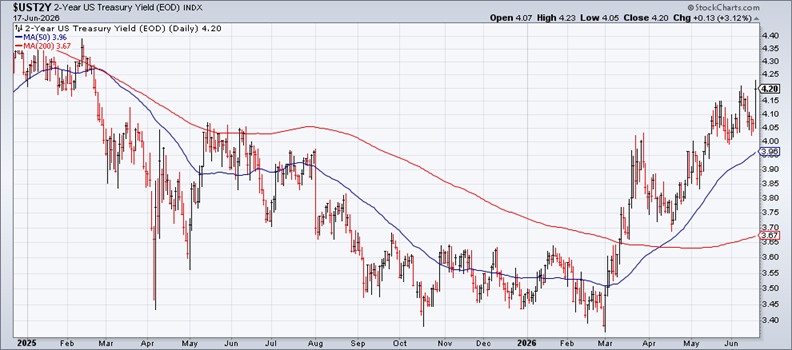
The benchmark 10‑year yield also rose, but at 4.50% remains at a middling level compared with the last several months. Perhaps more crucially, the 30‑year yield—the most inflation‑sensitive maturity—fell, easing to 4.93%, the lowest in over a month.
Fed funds futures are still pricing in odds that favor no change in the Fed’s target rate at the next FOMC meeting on July 29, but they also signal a non‑trivial chance of a 25‑basis‑point rate hike and zero odds of a cut. For the September meeting, the odds skew toward a rate hike.
Regardless of Warsh’s worldview on monetary policy, interest rates are still set by committee. Judging by the new quarterly Summary of Economic Projections (SEP), a hawkish tilt is visible in the updated estimates relative to the March meeting. The committee’s median projection for the Fed funds rate is now 3.8%, up from 3.4% three months ago, and half of FOMC members expect rate hikes at some point this year.
Warsh was careful to avoid outlining where he thought inflation was headed or how the Fed should act. But whatever his leadership style and preferences turn out to be, the FOMC still runs the show.
Yesterday was a triumph for Warsh in that the vote to keep rates steady was unanimous. But the mixed reaction in the Treasury market suggests that navigating the path ahead won’t be easy.
Relief on the inflation front may be coming following the U.S.–Iran peace deal. The question is whether the energy‑fueled surge in headline inflation will continue to spill over into core measures of price indexes.
Warsh may have set a new tone, but the real constraints on policy will come from the incoming inflation data and the bond market’s verdict. No committee, however unified, can force markets to see the world differently. As each data release hits and yields adjust, the Fed will be pushed toward or pulled away from action. In the end, the numbers—not the rhetoric—will decide the path forward.
Is Recession Risk Rising? Monitor the outlook with a subscription to:
The US Business Cycle Risk Report