China says it may detain Americans in retaliation for US prosecutions: WSJ
Fate of additional US stimulus legislation to be decided by Tuesday: BBG
Arms embargo on Iran expired on Sunday: Politico
Pfizer begins manufacturing vaccine ahead of its expected approval: TOI
Growing reluctance of Americans to get vaccine early once it’s available: STAT
Foreign inflows into Asian bonds accelerated in September: Reuters
China reports 4.9% year-over-year growth in GDP for Q3: CNBC
US consumer sentiment edges up but still far below pre-pandemic levels: MW
Industrial output in US fell in September–first decline since April: CNBC
US retail spending growth accelerated in September: MW
Book Bits: 17 October 2020
● The Price of Panic: How the Tyranny of Experts Turned a Pandemic into a Catastrophe
Jay W. Richards, et al.
Summary via publisher (Regnery)
For the first time in history, the world shut itself down—by choice—all for fear of a virus, COVID-19, that wasn’t well understood. The government, with the support of most Americans, ordered the closure of tens of thousands of small businesses—many never to return. Almost every school and college in the country sent its students home to finish the school year in front of a computer. Churches cancelled worship services. “Social distancing” went from a non-word to a moral obligation overnight. Moral preening on social media achieved ever new heights. The world will reopen and life will go on, but what kind of world will it be when it does? It can’t be what it was, because of what’s just happened.
The ETF Portfolio Strategist: 16 Oct 2020
No Way But Up? The US stock market continued to confound the bears as shares rose for a third week. Vanguard Total US Stock Market (VTI) posted a thin gain—a slim 0.1% advance for the trading week through today’s close (Oct. 16), but that was enough to lift the fund to a record close based on week-end numbers. (On a daily basis, VTI is 1.6% below its record Sep. 2 close).
Research Review | 16 October 2020 | Index Investing
Does Joining the S&P 500 Index Hurt Firms?
Benjamin Bennett (Tulane University), et al.
July 20, 2020
We investigate the impact on firms of joining the S&P 500 index from 1997 to 2017. We find that the positive announcement effect on the stock price of index inclusion has disappeared and the long-run impact of index inclusion has become negative. Inclusion worsens stock price informativeness and some aspects of governance. Compensation, investment, and financial policies change with index inclusion. For instance, payout policies of firms joining the index become more similar to the policies of their index peers. ROA falls following inclusion. There is no evidence of an impact of inclusion on competition.
Macro Briefing: 16 October 2020
World Bank chief economist: pandemic is turning into major economic crisis: BBG
Global study of remdesivir finds drug doesn’t prevent Covid-19 deaths: CNN
Harris cancels trips after positive Covid-19 for 2 people linked to campaign: USAT
Fatigue, colder weather, lax restrictions are factors in US Covid-19 rebound: WSJ
Record 17 million Americans have cast early votes to date: AP
Veteran investor Mark Mobius sees big risk for markets in US election: CNBC
Philly Fed Mfg Index: growth accelerates in October: PF
NY Fed Mfg Index: expansion slows in October: NYF
US jobless claims rose last week, highest since mid-Aug: CNBC
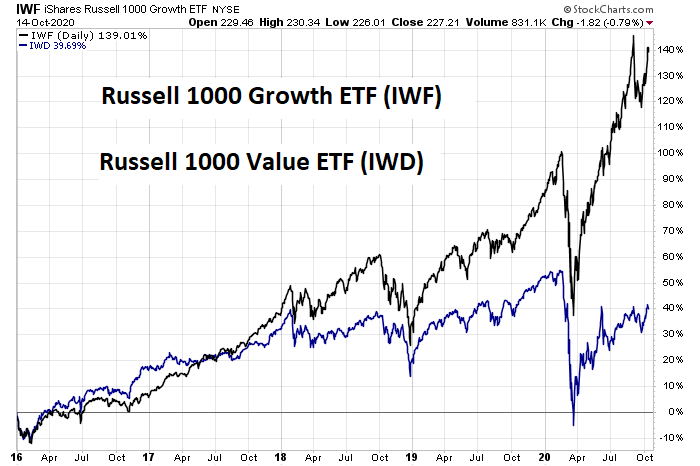
Will Value Stocks Overtake Growth Shares After The Election?
Citigroup analysts say the probability is rising for a recovery in the value risk factor, which has trailed the equivalent for growth stocks in recent years. It’s anyone’s guess if they’re right. The market gods are consistently shy about revealing such insights in advance. Perhaps, then, it’s no surprise that many forecasts in recent years have argued that value is on the cusp of a rebound only to see the relentless dominance in growth persist. But maybe it’s different this time.
Macro Briefing: 15 October 2020
Half of Americans say they would be reluctant to take new Covid-19 vaccine: WSJ
Europe battling resurgent coronavirus infections: CNBC
Thailand bans large gatherings amid pro-democracy protests: CNN
China’s consumer inflation eases to slowest in 19 months: Reuters
Record demand for China’s first direct bond offering to US investors: FT
Global oil demand expected to peak in 2030, Int’l Energy Agency predicts: MW
Mexican farmers attack soliders, seize dam in battle over US-directed water: NYT
Wall St trading boosts bank earnings as Main St operations stumble: NYT
Will long-suffering value stocks shine after election? Yes, predicts Citigroup: BBG

The ETF Portfolio Strategist: 14 Oct 2020
Calm Before The Storm? The markets continue to churn but most of the major asset classes continue to go nowhere fast. Surprising? Not really. With the US election less than a month away the markets seem to be holding their collective breath and ponder what may lie in wait on the other side. That starts with the obvious: Who will be president? A worthy question, but that’s just the opening bid.
The Wide(r) World Of Energy ETFs
The energy sector is a critical part of the US and global economy and this slice of global markets deserves a spot at the asset allocation table. But as an investment it’s been a disappointment in recent years… or has it?
Macro Briefing: 14 October 2020
Eli Lilly’s Covid-19 antibody trial on hold due to safety concerns: SN
Supreme Court rules census counting can end before Oct. 31: CNBC
IMF cuts outlook for global growth in 2021: CNN
JPMorgan, Citigroup: US economic rebound continues to face risks: WSJ
Debate over the relevance of the equity size factor is heating up: II
China’s stock market value rises to record high of $10 trillion: FT
US’s weakest local economies face dire outlook in pandemic: Reuters
Eurozone industrial output continued to rise in Aug but at much slower pace: MW
US small business optimism continued to rebound in Sep: NFIB
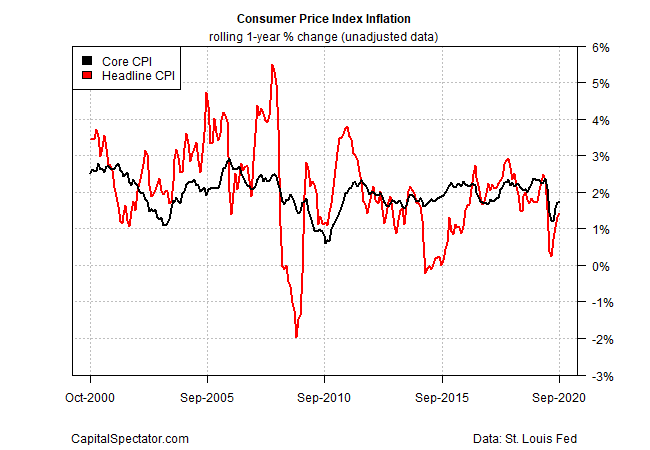
US core consumer inflation’s 1-year change holds at moderate 1.7% for Sep: LD