As Congress haggles over stimulus bill, economic outlook darkens: Politico
Will Trump reopen the economy, against the advice of medical experts? BBC
Fed rolls out major expansion of lending operations for corporates, munis: WSJ
Should Fed emergency lending go beyond banks? Bloomberg
Eurozone economic activity collapses in March, via PMI survey data: IHS Markit
Coronavirus woes offer business upside to technology companies: NY Times
Chicago Fed National Activity rebounded in Feb, but March data will be ugly: CF
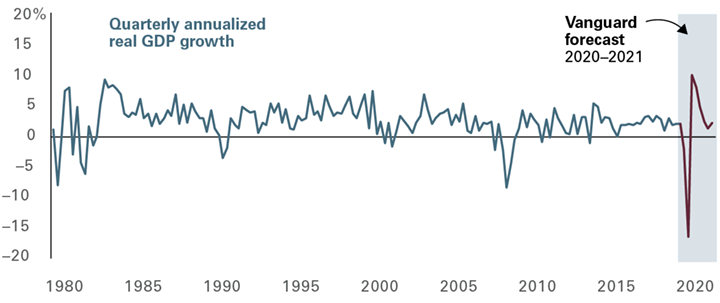
Vanguard expects a “sharp but short contraction” for US economy: Vanguard
The Last Defense: 1-Year Trends Go Red, Except For US Bonds
As risk-off sentiment deepens around the world due to the coronavirus pandemic, red ink has spread to nearly every corner of the major asset classes. For the one-year trend, however, there are still two slices of global markets holding on to modest gains, US bonds, based on a set of exchange-traded funds.
Macro Briefing | 23 March 2020
Senate fails to advance latest version of economic stimulus bill: CBS
Fed officials: more policy moves are available to fight economic slide: BBG
Central banks offer record sums to keep financial system afloat: Reuters
China reports drop in new coronavirus cases on Monday: Reuters
S. Korea reports lowest number of new cases since peak of 4 wks ago: BBC
69 drugs on the short list that offer hope for treating covid-19: NY Times
How the gov’t can promote a “V” shaped economic recovery: NY Times
Will coronavirus become a seasonal problem? WSJ
S&P 500 drawdown fell to -32% on Friday:
Book Bits | 21 March 2020
● Radical Uncertainty: Decision-Making Beyond the Numbers
By John Kay and Mervyn King
Review via The Telegraph
That ripping sound you may have heard lately is the noise of economists around the world tearing up carefully-honed forecasts, thanks to the rapidly spreading coronavirus.
For former Bank of England Governor Mervyn King and the senior economist John Kay, the all-too-rapid redundancy of the investment banks’ glossy brochures merely underline the folly of such prognostications in the first place.
In their new book, Radical Uncertainty, the pair turn a critical gaze on their own economics profession and find it badly wanting. They paint an unsparing picture of a discipline enslaved by its models, pretending to knowledge it cannot possibly have, and losing public trust as a consequence.
Surveying This Year’s Stock Market Damage Through A Sector Lens
It’s been a brutal year to date for US stocks, but the pain varies substantially from sector to sector, based on a set of exchange traded funds as of Thursday’s close (Mar. 19). Consumer staples, tech and health care are suffering the least among the main sectors that comprise the US market. Energy, by comparison, is deep in the hole, posting the biggest loss by far in the sector space.
Macro Briefing | 20 March 2020
California is first state to issue statewide stay-at-home order: CNN
Will the federal govt’s $1 trillion stimulus be enough? Politico
Search for coronavirus vaccine has become a global competition: NY Times
The stock market could bottom before the coronavirus epidemic peaks: MW
Some safe-haven assets aren’t as safe as assumed in this crisis: Mstar
Will small businesses survive the coronavirus crisis? NY Times
Trump administration attempting to suppress surging jobless claims data: WSJ
Fed expected to significantly ramp up bond purchases: WSJ
Is the Fed considering a tool known as yield curve control? Reuters
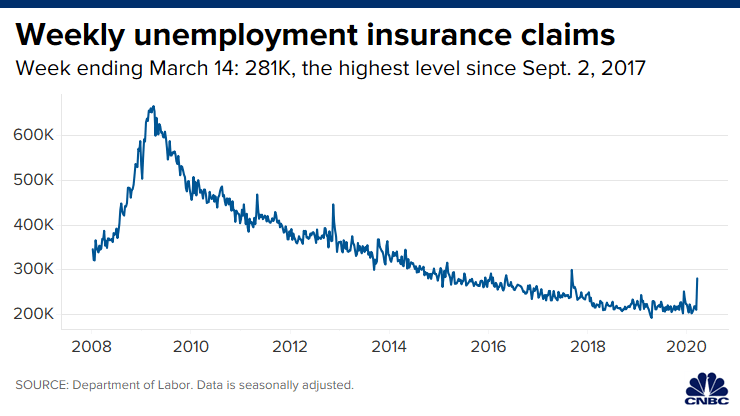
US jobless claims surged last week as coronavirus layoffs spread: CNBC
US Business Cycle Risk Report | 19 March 2020
The global coronavirus pandemic is creating havoc in economies around the world and the US is no exception. In the wake of this crisis, the standard modeling techniques have become worthless for estimating current conditions and estimating the near-term. The only thing that’s certain is that a significant shock is unfolding in real time—a shock that’s not being picked up, yet, in the economic data that’s been published to date. But there will be blood. The key questions for the recession: how deep and how long? Unclear. Since we’re heading into an unprecedented period in modern times, uncertainty is extraordinarily high. Nonetheless, let’s run through the numbers, if only as an academic exercise to profile the US economy as it was on the eve of the deluge.
Macro Briefing | 19 March 2020
US gov’t working on large economic stimulus bill: Bloomberg
A virus recession will create an unprecedented shock for the global economy: BBG
Coronavirus pandemic will test limits of how much debt US gov’t can bear: WSJ
Layoffs rising at US businesses as coronavirus spreads: WSJ
China reports no new local infections–a positive milestone: NY Times
Credit crisis looms as investors dump lesser grades of corporate credit: Reuters
Fed offers emergency lending to support money market mutual funds: WSJ
New US housing construction fell in Feb–ahead of coronavirus disruption: MW
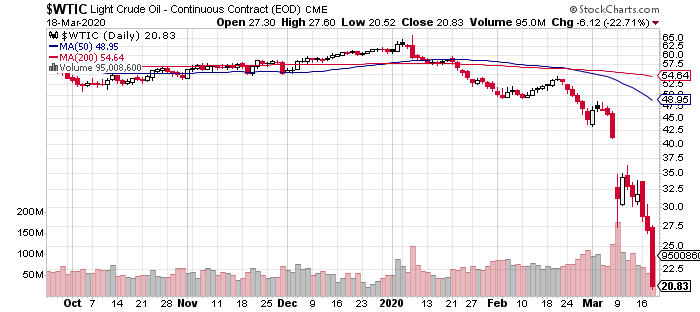
US crude oil benchmark collapses to just over $20 a barrel on Wednesday:
US Bond Returns Vary Dramatically So Far In 2020
The upheaval in global financial markets this year is unleashing profound effects on US fixed-income assets—negative and positive. Depending on the slice of the bond market, year-to-date results vary from strong gains to deep losses, based on a set of exchange-traded funds.
Macro Briefing | 18 March 2020
Trump seeks $1 trillion economic stimulus for ailing US economy: Reuters
Treasury Sec. Mnuchin: policy mistakes could result in 20% jobless rate: CNN
Fed to reopen short-term lending resource to large financial institutions: WSJ
Biden wins Tues primaries, effectively becoming Democratic nominee: WSJ
Worst rout in credit mkts since global financial crisis is spreading: BBG
Surging US dollar is new risk factor for emerging market economies: BBG
Crude oil falls to 17-year low: Reuters
Is Boeing (largest US manufacturer) at risk of going under? NY Times
US industrial production rebounds in Feb, ahead of coronavirus blowback: MW
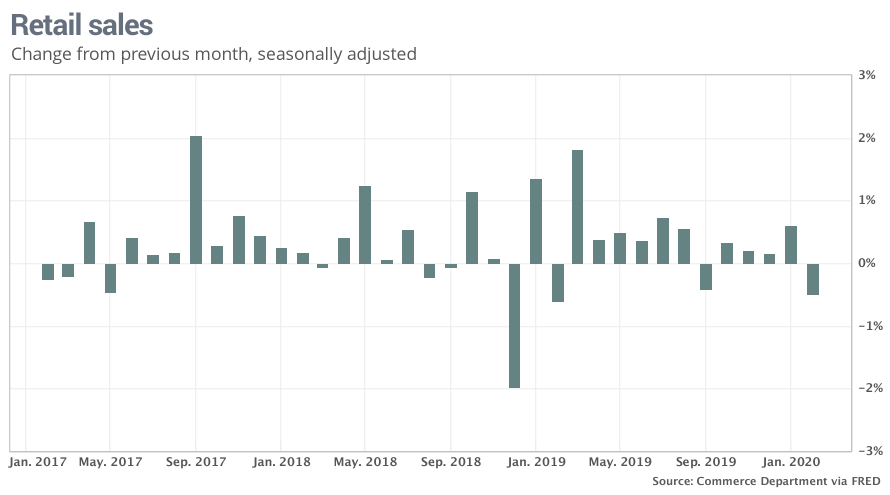
US retail spending unexpectedly dropped in Feb–first decline in 5 months: MW