Macro Briefing | 29 November 2019

Trump restarts talks with Taliban during visit to Afghanistan: The Hill
North Korea fires two short-range missiles in latest provocation: AP
Will US law on Hong Kong derail trade talks with China? Maybe not: NY Times
Is a tight US job market Trump’s ticket to re-election? WSJ
Signs of financial stress are rising in China: Bloomberg
Poll sees UK’s Conservatives set for big win in December election: Reuters
German retail spending tumbled in October: Reuters
Industrial output in Japan fell sharply in October: Nikkei Asian Review
Japan’s retail sales tumble after tax hike: Japan Times
US stock market begins November’s last trading day at record high:

Happy Thanksgiving!

“As we express our gratitude, we must never forget that the highest appreciation is not to utter words, but to live by them.”

– John F. Kennedy

Is The Recent Rebound In Interest Rates Fading?

For much of this year through early September a downside bias in interest rates was conspicuous. The driving force: economic pessimism. The 10-year/3-month yield curve inverted in the spring and for the most part remained below-zero, offering what is widely seen as a recession forecast. But over the last three months the yield curve turned positive and key interest rates rebounded. But economic data doesn’t look any better today vs. the macro profile of three months ago—in fact, the economic trend has weakened slightly. Is that a clue for thinking that interest rates will resume a downward bias in the final month of 2019?

Continue reading

Macro Briefing | 27 November 2019

US opens criminal probe into role of drug companies in opioid crisis: WSJ
China’s economy continues to slow in November: Bloomberg
Pondering the economic iron curtain that’s dividing the world: NY Times
US trade gap narrowed sharply in October: Reuters
Sales of new US homes unexpectedly fell in October: CNBC
Home prices in the US picked up in September: CNBC
Richmond Fed Manufacturing Index turned slighty negative in Nov: RF
US Consumer Confidence Index ticked lower again in November: MW

Macro Briefing | 26 November 2019

Yet another hint of progress in US-China trade-deal talks: Bloomberg
Fed Chairman Powell: strong labor market still has room to run: NY Times
2% inflation remains Fed’s target, says Powell: CNBC
Americans expect to raise their Christmas spending at a strong pace: Gallup
Financial advisers worry they’ll get squeezed in Schwab-TD Ameritrade deal: WSJ
Dallas Fed Mfg Index reflect modest contraction in November: DFed
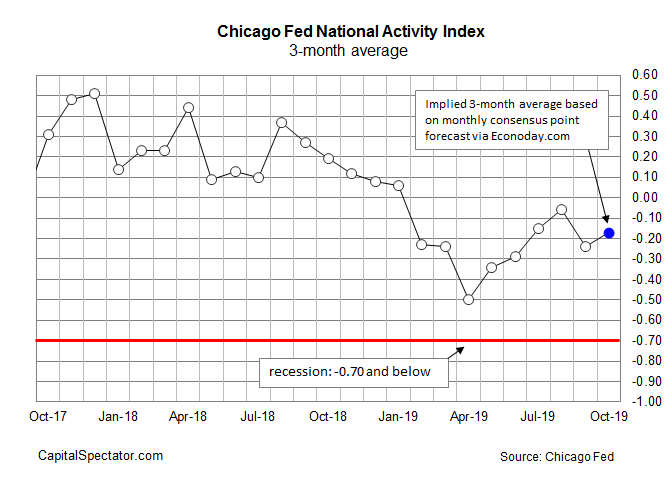
US economic activity continued to slow in October: Chicago Fed

Macro Briefing | 25 November 2019

US Navy Secretary forced to resign over controversial SEAL case: Reuters
Pro-democracy candidates win big in Hong Kong election: Reuters
German business sentiment improved slightly in November: Bloomberg
Capital spending by S&P 500 companies slows, creating economic headwind: WSJ
Security forum focuses on rising stress weighing on West’s democracies: Politico
US consumers remain upbeat in November: CNBC
KC Fed Manufacturing Index falls again in November: Mstar
US economic growth picked up in November but remains slow: IHS Markit
Slightly firmer slow-growth sign expected in today’s CFNAI (3mo avg) data for Oct:

Book Bits | 23 November 2019

The Deals of Warren Buffett Volume 2: The Making of a Billionaire
By Glen Arnold
Summary via publisher (Harriman House)
In this second volume of The Deals of Warren Buffett, the story continues as we trace Warren Buffett’s journey to his first $1bn. When we left Buffett at the end of Volume 1, he had reached a fortune of $100m. In this enthralling next instalment, we follow Buffett’s investment deals over two more decades as he became a billionaire. This is the most exhilarating period of Buffett’s career, where he found gem after gem in both the stock market and among tightly-run family firms with excellent economic franchises. In this period, Berkshire Hathaway shares jumped 29-fold from $89 to $2,600.
Continue reading

Research Review | 22 November 2019 | Factor Investing Strategies

ETF Momentum
Frank Weikai Li (Singapore Management University), et al.
October 12, 2019
We document economically large momentum profits when sorting ETFs on returns over the past two to four years. A value-weighted, long-short strategy based on ETF momentum delivers Carhart (1997) four-factor alphas of up to 1.20% per month. Neither cross-sectional stock momentum nor co-variation with macroeconomic and liquidity risks can explain ETF momentum. Instead, the post-holding period returns are most consonant with the behavioral story of delayed overreaction. While ETF momentum survives multiple adjustments for transaction costs, it may be difficult to arbitrage as the profits are volatile and concentrated in ETFs with high idiosyncratic volatility or that hold low-analyst-coverage stocks.
Continue reading