US preparing new tariffs on remaining Chinese imports if talks fail: Bloomberg
Trump expects a ‘great deal’ with China on trade: Reuters
US to send 5,200 US troops to border to stop migrant caravan: Fox
If Dems take the House, expect a lot of new investigations: NY Times
Germany’s Angela Merkel will step down as chancellor in 2021: BBC
What will follow the Merkel era in Germany? Slate
Consumer spending in US was solid in Sep; income growth was sluggish: Reuters
US PCE inflation remained tame in September: WSJ
The earth’s topical zone is expanding 30 miles per decade: Yale Environment 360
S&P 500 fell to lowest close in nearly six months on Monday: USA Today
US Bonds Edged Up Last Week As Stocks Tumbled Worldwide
A rush into safe-haven US Treasuries dominated last week’s trading action for winners amid a rout in equity markets around the world, based on profiling the major asset classes via a set of exchange-traded products.
Continue reading
Macro Briefing: 29 October 2018
Pittsburgh synagogue shooting suspect due in court today: CNN
US Homeland Security Secretary: ‘This caravan is not getting in’: Politco
2nd migrant group headed for US tries to force entry into Mexico: Fox
Brazil elects right-wing former military officer as president: BBC
Another setback for Germany’s governing after state election: BBC
Germany’s Merkel to quit as head of her Christian Democratic party: Bloomberg
IBM to acquire Redhat as Big Blue focuses on cloud computing: CNBC
US economic output slowed in Q3, but still posted solid 3.5% gain: MW
Gender gap has opened up for views on American economy: NY Times
Is bear market for stocks lurking if Democrats take House? Bloomberg
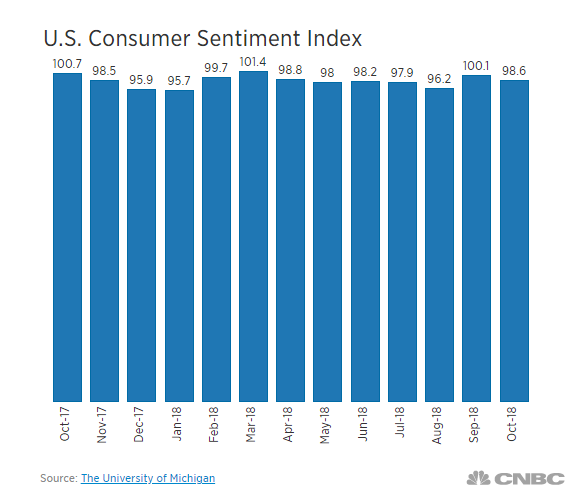
US consumer sentiment eases in Oct but remains at historically high levels: CNBC
Book Bits | 27 October 2018
● Money: 5,000 Years of Debt and Power
By Michel Aglietta
Summary via publisher (Verso)
As the financial crisis reached its climax in September 2008, the most important figure on the planet was Federal Reserve chairman Ben Bernanke. The whole financial system was collapsing, with little to stop it. When a senator asked Bernanke what would happen if the central bank did not carry out its rescue package, he replied, “If we don’t do this, we may not have an economy on Monday.” What saved finance, and the Western economy, was fiscal and monetary stimulus – an influx of money, created ad hoc. It was a strategy that raised questions about the unexamined nature of money itself, an object suddenly revealed as something other than a neutral signifier of value. Through its grip on finance and the debt system, money confers sovereign power on the economy. If confidence in money is not maintained, crises follow. Looking over the last 5,000 years, Michel Aglietta explores the development of money and its close connection to sovereign power.
Continue reading
US Growth Slowed In Q3, But Annual Pace Continued To Improve
US GDP growth beat expectations in today’s “advance” estimate of third-quarter data. Output increased by an annual 3.5% (seasonally adjusted real rate), the Bureau of Economic Analysis reported earlier today. The gain is slightly above The Capital Spectator’s 3.3% nowcast (based on several sources) from earlier this week. Although the Q3 advance marks a solid rise, today’s results reaffirm expectations that growth has decelerated following Q2’s sizzling 4.2% surge.
Continue reading
Explaining The “Robot” ETF’s Bull Run With Factor Analysis
Bloomberg last week published an intriguing story about a new exchange traded fund (ETF) that uses artificial intelligence (AI) to outperform market indexes and active managers alike. The implication: a new era of AI-driven investing has dawned, putting the standard applications of indexing at a disadvantage. Yet a closer look at the so-called Robot ETF’s results via a factor-analysis lens tells a different story and one that can be explained with a mix of large-cap, small-cap and micro-cap equity betas. In turn, replicating the Robot ETF’s performance, which Bloomberg claims “leaves pros in the dust,” is a simple matter of holding a trio of plain-vanilla index funds.
Continue reading
Macro Briefing: 26 October 2018
Mail bomb threat widens, including package sent to former VP Joe Biden: BBC
Florida mail facility in focus for bombmaker investigation: CNN
Trump may close southern border as migrant caravan nears: USA Today
China and Japan pledge to forge closer ties: Reuters
ECB chief says recession risk is low for Eurozone economy: NY Times
Global stocks on track for worst week in five years: Reuters
US pending home sales in September posted first gain since June: NAR
Wholesale inventories in August up more than initially estimated: Reuters
US jobless claims rose slightly last week but remain near 45yr low: MW
Trade deficit in US widened for fourth straight month in Sep: CNBC
US durable goods orders rebounded in September: CNBC
Putting The Recent Market Decline Into Historical Perspective
The stock market has been tumbling lately, which means that dramatic media headlines are roiling investor sentiment far and wide. As a result, recency bias threatens to overwhelm otherwise rational minds. To be fair, October looks pretty grim and the latest market rout could roll on… or not. But before you let your emotional demons take over all your decisions, take a moment to consider the historical perspective, which tends to be overlooked in times like these.
Continue reading
Macro Briefing: 25 October 2018
Suspected package bombs sent to Obama, Clinton and CNN: Reuters
Is Trump’s diplomacy pushing China and Japan closer together? CNN
Worries over a trade war and tariffs are key factors in market selloff: CNBC
Is the Fed making a mistake on inflation outlook and raising rates? Yardeni.com
US Composite PMI for Oct: economic growth ticked up to 3-mo high: IHS Markit
Home Price Index for US up 0.3% in Aug as mid-Atlantic slumped 0.7%: HW
Fed’s Beige Book: wages, prices rising at “modest to moderate” pace: MW
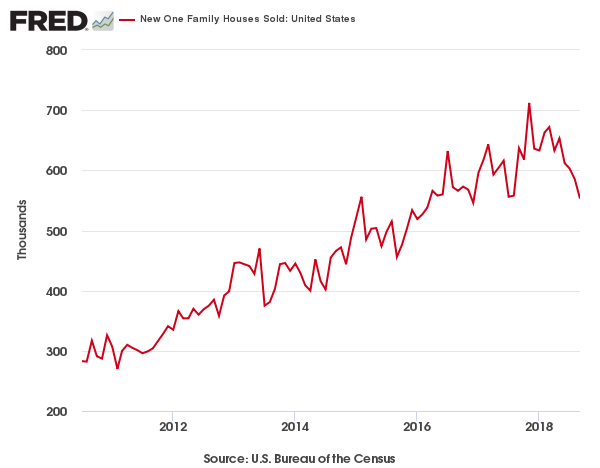
New home sales in US fell to lowest level in nearly 2 years in Sep: Reuters
Mideast Stocks Steady As Rest Of World’s Equities Fall
Equity markets in the Mideast remain the performance leader this year as selling takes a toll on the world’s other major stock market regions, based on a set of exchange-traded funds as of yesterday’s close (Oct. 23).
Continue reading