The US stock market is still posting strong gains for the year, but rising Treasury yields, if they continue to move higher, pose a threat to the bull run. A review of the major equity risk factors already shows what could be an early shift in leadership, a shift that could accelerate if interest rates continue rising in the weeks and months ahead.
On a year-to-date basis, the recemt winners continue to dominate, but there are signs of rotation unfolding over the summer, based on ETF proxies for the major risk factors.
Let’s start with 2026 performance, led by high beta (SPHB), which is up nearly 22%. This segment of stocks tends to outperform during broad bull-market periods, which is exactly what SPHB has done this year by outperforming the standard market benchmark (SPY) with roughly twice the gain.
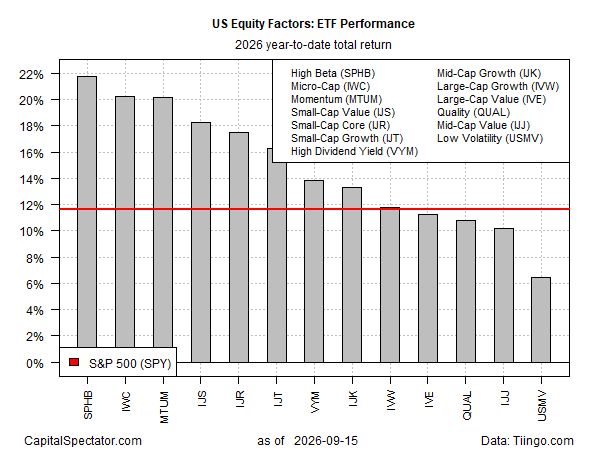
The weakest performer this year is a basket of low-volatility stocks (USMV), which is up just 6.4%. The low-volatility factor tends to deliver a smoother ride than higher-risk portfolios and generally lags during strong bull markets. That has been the case this year, as AI-fueled animal spirits have ruled.
More recently, however, the tables have turned, and low-volatility (USMV) is outperforming high beta (SPHB) by a wide margin over the trailing three-month window: a gain of 3.3% versus a decline of 7.8%.
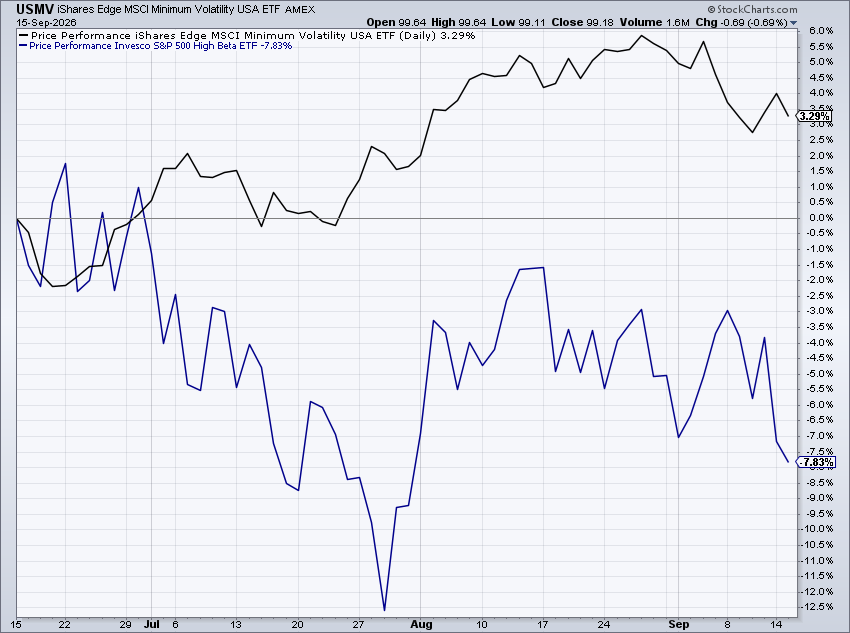
It’s too soon to view the shift as a high-confidence signal that a persistent leadership change is underway, but in the current environment it is a development worth monitoring. One question is whether low-volatility can retain its performance edge in the weeks ahead, which could deliver a stress test for stocks generally if interest rates continue to rise.
The recent rise in the 10-year Treasury yield is already flashing a warning for stocks. One example of how this dynamic is evolving is shown in the chart below, which tracks the 10-year rate’s relative level versus its maximum over a rolling 200-day window. When the current yield is running at 100% of its highest level over the past 200 days, as is the case now, that can be a headwind for stocks in the near term.
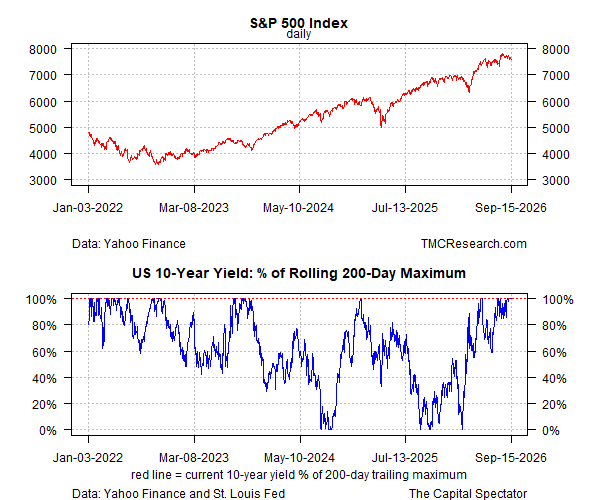
This relationship is only suggestive of the direction in which probabilities appear to be tipping. Perhaps a more decisive variable is how the 10-year yield evolves in the near term. A key input: today’s Federal Reserve policy decision on interest rates.
There are several possibilities, depending on your macro outlook. The Capital Spectator expects that if the Fed surprises markets and leaves its target rate unchanged, the bond market will push Treasury yields higher and stocks will come under additional pressure. The S&P 500 has declined modestly in recent weeks after setting a new high in early August.
By contrast, a rate hike, which is considered highly probable based on Fed funds futures, would signal to the bond market that the central bank is intent on taming inflation, which has been running above the Fed’s 2% target for more than five years.
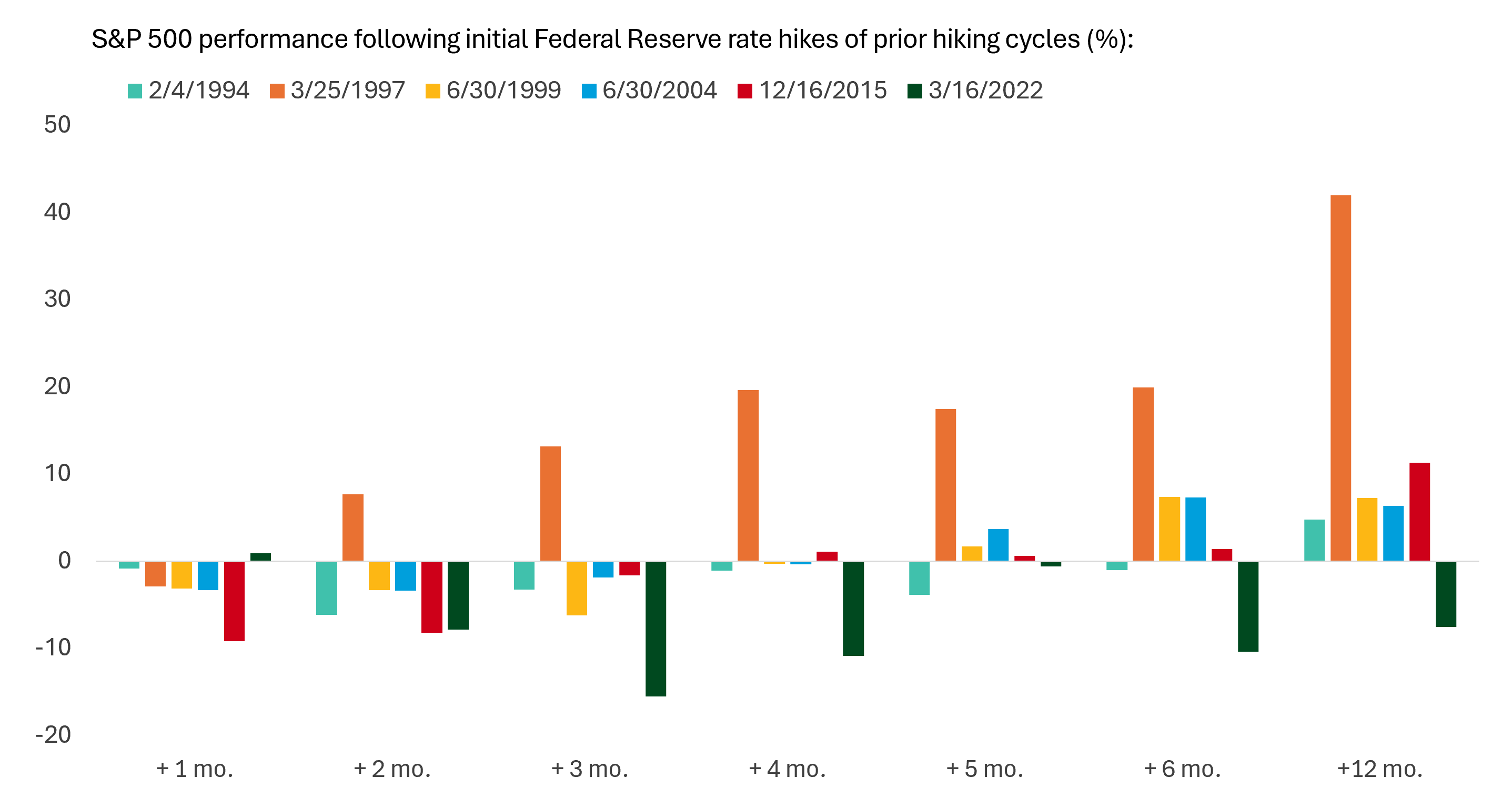
History shows that initial rate hikes tend to trigger stock market losses in the short term, but equities generally rebound after six months, according to analysis by Jeff Buchbinder, chief equity strategist at LPL Research.
Another variable that will likely be critical is how corporate earnings fare. Analysts remain bullish on the outlook for the S&P 500, drawing support from strong earnings growth lately. As John Butters of FactSet reports: “The third quarter marks the second-straight quarter that the bottom-up [earnings per share] estimate has increased during the first two months of a quarter.”
A potential vulnerability is that earnings are highly reliant on AI investment, with roughly half of S&P 500 earnings growth driven by this technology spending, according to Goldman Sachs chief US equity strategist Ben Snider. If capital spending begins the falter, it could have an outsized impact on market expectations. A crucial question now is whether higher Treasury yields will change the calculus. In a recent report, Snider advised: “The medium-term impact of Fed tightening on equities will depend on how tightening affects earnings growth, which is the most important driver of stocks.”
It is not just the level of interest rates that matters, but also how fast they move, Snider writes. In recent decades, stocks have usually generated positive returns alongside rising interest rates unless the pace of the increase was more than two standard deviations above normal. Today, that threshold would equate to an increase in 10-year Treasury yields of roughly 50 basis points over a month or 30 basis points over two weeks. “The speed of the rate moves during the last few weeks helps explain why stocks struggled to digest those changes,” Snider writes.
The bottom line is that the recent rise in Treasury yields is shifting investor attention back to the variable that may matter most right now: Federal Reserve policy. Today’s decision is important, but it is only the opening chapter. Whether stocks can extend the bull market, whether interest rates continue to climb, and whether recent factor rotation gathers momentum may depend on how the Fed navigates inflation and growth in the months ahead. For investors, the key risk is no longer what the Fed does today, but what it signals about the path forward.
