Consumers elevated spending last month, the Bureau of Economic Analysis reported this morning. But a closer look at the numbers suggests that there’s still reason to fear for 2007’s economic performance.
Let’s start with October’s rise in personal consumption expenditures (PCE). Yes, it inched up by 0.2% over September, but the performance was at the low end for monthly reports this year. In fact, revised data show that the initial report of September’s PCE 0.1% advance has evaporated, turning into a 0.2% decline. The month before, August, offered the slimmest of increases at just 0.1%. Perhaps the most distressing news in the revised data is that nondurable goods spending dropped for the second month in a row in October. Nor does it boost one’s optimism to learn that initial claims for unemployment benefits jumped to a 14-month high of 357,000 last week, the Labor Department advised today.
Stepping back and looking at the trend, as per our chart below, it’s clear that Joe Sixpack is rethinking his former appetite for spending. Yes, the pause may be temporary. In fact, we’re sure it’s temporary. Alas, we just don’t know when Joe will return to form. And neither does anybody else. At this stage in the economic cycle, when worries over continued real estate fallout and other items lurks, a slowdown in consumer spending in the months ahead could take a toll on investor sentiment.
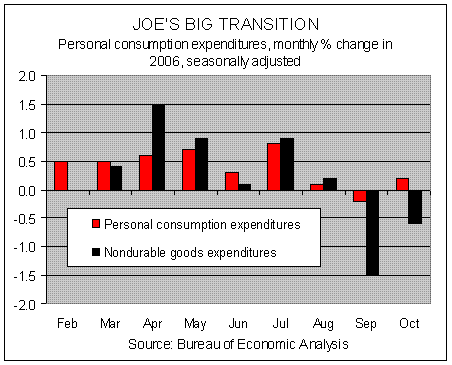
What’s clear now, today, this minute is that there’s reason to wonder about the near term. This, ladies and gentlemen, is what’s known as a transition. To wit: if an economic transition arrives, does it make an impact?
Apparently not, at least from the stock market’s perspective. Measured by the S&P 500, the theme is onward and upward. Yes, there was a distracting correction last Friday that spilled over to Monday. But since Tuesday, the bulls have returned and are intent on pushing on to new highs. Momentum may not always be enlightened, but it’s a force that isn’t easily dismissed either.
The bond market, meanwhile, is quietly placing bets that the pause has legs. Momentum, in other words, is alive and kicking in fixed-income trading. Bulls are keeping the yield on the benchmark 10-year Treasury at just above 4.5%, the lowest since February.
Sooner or later, either stocks or bonds will blink, and we think we know which one. But we’re not sure. Diversification has never looked more comforting.
Monthly Archives: November 2006
FASTER GROWTH, LESS FILLING
The economy grew faster in the third quarter than initially estimated, the Bureau of Economic Analysis reported today. Higher is better, although yesterday’s anxieties about the economic outlook continue to plague.
Arguably, those anxieties should have marginally lessened on the news that GDP rose by 2.2% during July through September, higher than the 1.6% initially estimated. The source of the upward revision was a combination of a downward estimate of imports and a hike in calculations of private inventory management and personal consumption expenditures.
That’s all well and good, but it doesn’t change the strategic issue of: what’s up for 2007? Indeed, the economy grew faster in the third quarter, but the 2.2% pace was still slower than the second quarter’s 2.6%, which in turn was much slower than the first quarter’s 5.6%.
The trend, to cut to the chase, remains intact: the economy’s slowing. To reiterate the obvious: how much it slows, for how long, and if it leads to an outright contraction are the great questions. Next year is likely to dispense an answer, and by this time in 2007 (if not sooner) we’ll all have something meatier to chew on in terms of a definitive answer. Getting from here to there, of course, is the challenge and the peril.
That issue, in fact, was front and center this morning at a press conference in New York, hosted by Deutsche Bank’s private wealth management division. Your editor was in attendance, and among the comments that caught our attention was the intention in the near term for “taking risk out of portfolios rather than putting it in.”
THIS OR THAT, UP OR DOWN, & ALL AROUND
Optimists say that yesterday’s sharp selloff in the stock market was merely a healthy bout of profit taking. Perhaps, although this morning’s durable goods report for October offers a fresh dose of caution about the economy.
New orders for durable goods fell 8.3% last month from September, according to the Census Bureau. One has to go back to 2000 to see monthly declines of that magnitude. The year-over-year comparison isn’t that encouraging either. October’s new orders rose just 2.3% over the previous 12 months–the slowest annual pace this year.
But the news wasn’t all bad in the latest batch of number updates. The National Association of Realtors reports that existing home sales last month rose from the previous month for the first time February. Yes, even a dead cat has to bounce, as the saying goes. But can this kitty also start walking again? Never say never. Indeed, total existing-home sales – including single-family, townhomes, condominiums and co-ops – rose 0.5% last month over September, NAR’s press release advised.
A rise of any degree comes as a welcome change from the relentless declines in recent months. Before anyone gets too excited, it’s important to note that October’s new home sales were still down a hefty 11.5% from a year earlier. Nonetheless, those who think the worst is past in the real estate correction can point to today’s existing home sales for support. NAR’s chief economist, David Lereah did just that, offering a ray of cautious optimism by opining:
The present level of home sales demonstrates some confidence in the market, but sales are lower than sustainable due to psychological factors. The demographics of our growing population, historically low and declining mortgage interest rates, and healthy job creation mean the wherewithal is there to buy homes in most of the country, but many buyers remain on the sidelines. After a period of price adjustment, we’ll see more confidence in the market and a lift to home sales should be apparent in the first quarter of 2007.
Then again, a stabilizing housing market doesn’t necessarily translate into a booming economy. Risk is still very much in the air at the moment, as suggested by the latest OECD forecast, which calls for a “mild and short-lived weakening” in the world economy in 2007. Adding to the odds of a slowdown for the United States, the OECD noted, is the task of bringing core inflation down to 2.0% from the current 2.8%, which “may require maintaining the current restrictive stance for some time.”
Translated: don’t hold your breath for an interest rate cut at the Fed’s next FOMC meeting next month. Fed funds futures traders certainly aren’t: the January ’07 contract is priced in anticipation of holding Fed funds steady at the current 5.25%.
The outlook may suggest that it’s too close to call for what happens to economic growth or interest rates, but sitting on the fence just won’t do for the bond market. Indeed, the fixed-income set continues to exude confidence that slower growth, or worse is coming and that inflation won’t be a problem. A tall order, but one that the bond market is inclined to predict.
Indeed, the yield on the benchmark 10-year Treasury has slipped below it’s previous, intraday low of 4.53% set back on September 25. As we write, the 10 year trades at 4.52%–the lowest in more than a year.
Alas, growth isn’t slow or strong enough to skew the odds heavily in one direction or the next. Diversification across asset classes, as a result, has never looked so good in concept, and felt so vulnerable based on valuation and trailing performance. Cash may still be your only friend if you’re planning on picking up bargains in 2007. But for the bond bulls, there’s no time like the present.
LET THE GOOD TIMES ROLL
Stocks are up, bonds are up. Hey, it doesn’t take a brain surgeon to see that 2006 is shaping up to be a pretty good year for investors. But how good is good? And what does it mean for the future?
In pursuit of an answer, or at least some perspective, we crunched the numbers and found that the past three years aren’t all that extraordinary when compared with equity performance history over the past generation. Compare the results for yourself:
The S&P 500’s total return this year is 14.1% through November 24, and the index’s three-year annualized performance is 12.0%. In both cases, that’s above the long-run average of about 10%. Does the recent run therefore offer a reason to worry? Has the market overextended itself?
Not necessarily, at least not based solely on the historical context. Looking at rolling three-year total returns for the S&P 500 through the end of October 2006 (courtesy of Morningstar’s Principia software), the latest 36-month stretch looks middling. For the three years through October 31, the S&P 500 advanced by 11.4% a year. Not bad, although it pales by the best trailing 36-month run through July 1987, which posted an astounding 33.3% annualized gain.
Looking at the opposite extreme, the three years through March 2003 rank as the greatest bloodletting since 1979, with the S&P 500 shedding an annualized 16.1%.
Based on those extremes, the S&P’s performance of late looks fairly unspectacular. Of course, statistics will tell you anything you want. With that in mind, the question is whether the recent gain looks encouraging based on the future rather than the past? By that standard, the analysis becomes more complicated.
Consider earnings and valuation. First, the rate of earnings growth for the S&P 500: it’s been stellar of late, rising 10%-15% in each of the past six quarters through this past June, according to an article in yesterday’s New York Times that cites Thomson Financial data. Even better: the S&P in this year’s third quarter is expected to post a nearly 20% rise–which would be the highest in nearly two year. But the party downshifts considerably thereafter: the outlook calls for a sharp slowdown in earnings growth as 2007 unfolds.
As for valuation, the S&P 500’s p/e is around 17, which is the lowest in years, according BullandBearWise.com. A bargain? Yes, based on recent history.
But it’s the future that counts. History is a guide, and as we see it a poor one at the moment. Looking to the recent past has rarely offered less insight about what comes next, in our view. Economic, financial and political upheaval is everywhere these days, although you wouldn’t know it by looking to Mr. Market, who appears relatively calm and comforted. That will change, perhaps soon. Meanwhile, our over weighted cash allocation continues to burn a hole in our pocket. No matter: we can stand to blaze a bit longer.
TAKING A LITTLE TURKEY TIME
Your editor has flown the coop for an extended gobbler’s holiday. After a brief respite, laden with turkey-related gastronomic recreation, we’ll return to the scene of the rhetorical crime on Monday, November 27. In the meantime, Happy Thanksgiving!

A NEW DAY, A NEW DEAL
There are several theories about what keeps REITs flying. There’s also a growing chorus of bears who warn that we’re near a top for the asset class. But whatever your view, the news of a private-equity fund’s unsolicited buyout offer on Sunday for Equity Office Properties (NYSE: EOP) offers one more reason to think that the game’s not quite up in the long-running bull market for publicly traded real estate securities.
EOP, the largest REIT and one that’s in the S&P 500, accepted a $36 billion buyout offer from an affiliate of the Blackstone Group, a New York private equity firm. Blackstone will acquire all the outstanding common stock of EOP at $48.50, or an 8.5% premium over last Friday’s close.
The deal for the nation’s largest office landlord raises eyebrows on a number of levels. For starters, it’s reportedly the largest buyout package in history. The Wall Street Journal (subscription required) reported that the price tag “implies a ‘cap rate’, or rental yield, of about 6% — well below the 10% at which real-estate investment trusts, or REITS, have historically traded.” The article adds that the terms suggest that Blackstone is valuing EOP at a 17% premium to net asset value, according to analysis by Citigroup. “That’s unusual — even for Blackstone,” the story advised. “It paid no more than 4% premiums to NAV when it acquired Trizec Properties and CarrAmerica. And even those were seen as pricy at the time.”
Rich or not, the EOP deal is a sign of the times. Indeed, this year has witnessed a surge in mergers and acquisitions of REITs. Keven Lindemann, director of real estate for SNL Financial, told the New York Times today that 21 REITs in 2006 have announced that they’re being bought by another REIT or private firm, and that more were probably coming.
STILL FLYING
The search for fallen angels continues to be a fruitless exercise in 2006. As our table below reminds, all the major asset classes continue to stay afloat.

Yes, there’s a touch of red ink on the ledger, with commodities bleeding a bit this year. But the tumble isn’t quite what it seems, at least not yet.
For starters, we’re using the Goldman Sachs Commodity Index as a proxy, by way of the Oppenheimer Real Assets mutual fund. Alas, this benchmark is heavily concentrated in energy, which comprises more than 69% of the weighting. We prefer the DJ-AIG Commodity Index, which caps energy at a 33% weighting and in the process makes for a more diversified mix of raw materials. There are mutual funds and a recently launched exchange-traded note that track DJ-AIG, but none go back three years, and so for the moment we’re still using Oppenheimer to fill out that slot in our table. In any case, DJ-AIG is up slightly this year, with the Credit Suisse Commodity Return Strategy climbing 1.4% this year through last Friday.
For investors who are widely diversified, the above table offers great news, namely: your portfolio has done well. Diversification is a risk-management system that often means holding asset classes that have retreated. Not this year. But while that makes looking at trailing returns a happy occasion, it complicates the task of rebalancing, i.e., selling winners and redeploying capital to losers (or winners that haven’t won quite as much as others).
Deciding where to redeploy begins with looking at trailing performance, although it hardly ends there. Putting a valuation on the various asset classes and coming up with a reasonable outlook for returns completes the task.
In the here and now, we present only the first step of the thousand-mile journey. Sometime in the near future we plan on launching a premium service that goes the extra miles–an event that will be duly noted on these pages. In the meantime, we’re watching the trends, crunching the numbers and wondering where new opportunities will emerge. Mr. Market will eventually offer a new deal, but for now his lips are sealed and allure is limited.
ANOTHER HOUSING STUMBLE
Earlier this month, former Fed Chairman Alan Greenspan dispensed some widely reported optimism by opining that “the worst is behind us” in the housing correction of late. The forecast may yet prove accurate, but the skeptics are snickering a little louder today after reading this morning’s update on housing starts for October.
New construction of privately owned housing units fell sharply last month, the Census Bureau reported. So-called housing starts dropped 14.6% in October from the previous month, measured on an annualized, seasonally adjusted basis. That’s the biggest single-monthly percentage loss since May 2005.
On an absolute basis, the trend doesn’t look any better, as the chart below illustrates. The annualized rate of 1.486 million new starts last month is the lowest in more than six years. If there’s a bottom coming in housing starts, it’s not obvious at the moment. Free fall might be a more accurate term.

FAREWELL, MILTON
The great economist Milton Friedman died yesterday. But like all great thinkers, he left an intellectual legacy that will endure.
Friedman’s métier was documenting and espousing the libertarian cause in economics and, by extension politics. Free markets and democracy are inextricably linked, he taught. One can’t long survive without the other, an empirical observation that’s still far from universally accepted in the 21st century.
Unlike some in the dismal science, Friedman was no ideologue, even if he was easily caricatured as such by those who don’t understand the academic foundation sustaining his views. Indeed, Milton didn’t preach utopian visions in the hope that the empirical record would lend support. Rather, Friedman looked at the evidence and drew conclusions about how the world worked. As a result, his analysis is both practical and scientifically sound, at least to the extent that any economic theory can be. Reality, in sum, is a mighty potent tool in the pursuit of the truth.
Of particular relevance to CS is Friedman’s pioneering work on money supply theory. His lucid analysis on that front has been widely celebrated and so we’ll simply close by referencing his final essay on the subject, which appears in today’s Wall Street Journal (subscription required): “Why Money Matters.” To summarize the piece, keep your eye on the quantity of money, Milton asserts last time.
INFLATION TAKES A HOLIDAY
Inflation’s still a threat, but for the moment it’s in remission.
This morning’s update on consumer prices for October echoed yesterday’s report on producer prices by taking a sharp turn south. Consumer prices fell 0.5% last month, the second consecutive descent of that magnitude and the first back-to-back monthly declines since 2005’s November/December. The bottom line: top-line inflation for the past year through October was running at just 1.3%, the slowest annual pace since early 2002.
But wait, there’s more. The encouraging inflation report looks even better with news of cooling core CPI, which ignores food and energy prices. Although core CPI was worrisome in September’s report, it’s less so for October. Core CPI advanced 0.1% last month, the lowest since February and down from September’s 0.2% rate. For the past year through October, core CPI was chugging ahead by 2.8%.
Before we become too giddy, it’s worth pointing out that a 2.8% core inflation rate is still too high. As the chart below reminds, core CPI has climbed sharply over the past two years, reaching a recent peak in September. It’s too soon to tell if October’s downshift is temporary or the start of a secular decline in core pricing pressures. For our money, we’re hopeful, but still wary.

Meanwhile, there’s a bit less pressure on the Fed, although not enough to warrant a rate cut. That appears to be the market’s conclusion as well for the Fed’s next FOMC meeting on December 12. The January ’07 Fed funds futures contract this morning is priced in anticipation of keeping Fed funds at the current 5.25%. And prudently so, as one month a trend does not make. Indeed, it’s important to point out that top-line consumer prices eased for the same reason that wholesale prices did last month: energy prices fell. Seasonally adjusted, CPI’s energy index dropped a hefty 7% last month, following September’s 7.2% tumble. That’s one gift, rest assured, that won’t keep giving.
As for core inflation, there’s reason to remain hopeful. Apparel and transportation prices fell substantially last month, while housing costs were flat, as per CPI’s methodology. Alas, the only thing to do is wait and see if this trend has legs.