For the remainder of 2006, CS will be on holiday. We’ll return on January 2, 2007. Meanwhile, to all our readers, your editor sends best wishes for a prosperous New Year! Out with the old, in with the new, and let’s hope it’s a good one. Cheers!
Monthly Archives: December 2006
THE BOUNCE THAT REFRESHES
Yes, you’ve got to hand it to our hero Joe Sixpack. He always comes through in a pinch.
The pessimists thought he’d materially slow his spending and throw the economy into a tailspin. But Joe confounds the experts time and time again, and last month was no exception.
Personal income increased by 0.3% last month, the Bureau of Economic Analysis reported today. But Joe and his counterparts across the nation, true to form, saw fit to raise spending by 0.5% in November. Even more impressive is the fact that consumer purchases accelerated for durable goods, the most volatile and, for reasons we discussed yesterday, the most cyclically sensitive slice of the public’s spending habits.
The volatility of late seems to favor higher spending for durable goods. As the chart below illustrates, personal consumption expenditures (PCEs) have rebounded handsomely from August’s steep decline.
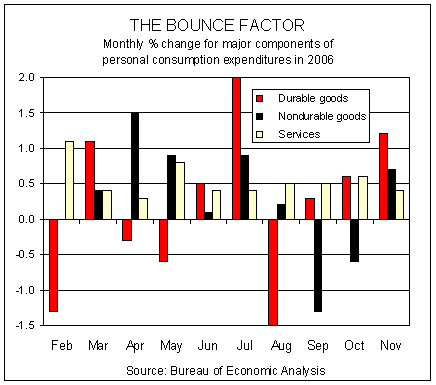
August’s 1.5% drop in durable-goods spending appeared to foreshadow trouble ahead for the economy, all the more so as worries mounted over the unfolding correction in the housing market. Several months later, however, fears that a correction in the real estate market would convince Joe to hoard his income look unfounded. Or was the summer fear just premature?
ANOTHER KREMLIN VICTORY IN ENERGY
If you’re looking for one more reason to worry about the future of global oil production, take a gander at the news on Royal Dutch Shell’s coerced sale of a majority stake in its Sakhalin-2 oil and gas project in Russia to the state-controlled Gazprom.
REASON TO BE WARY, PART III
The government dispensed the third and final update on third-quarter GDP this morning, and no one who routinely reads such things will be shocked by the numbers. The annualized quarterly real 2% pace of economic growth for July through September was a bit slower than previously estimated, although it’s in line with the latest consensus guess from the dismal scientists.
The government’s former estimate for GDP was a tad higher at 2.2%. More importantly, the final 2.0% rate in the third quarter is below the 2.6% rise logged in the second quarter. The economy, in sum, is still slowing. Everyone knew that, of course. So, now what?
FOLLOW THE MONEY
With bull markets blooming around the world in recent years, the news of yesterday’s self-inflicted financial wounds in Thailand has delivered an unscheduled reminder that prices also go down.
The calamity started when the Thai Finance Ministry yesterday announced a “lock-up” program to restrict capital flows into the economy. Investors reacted by selling…and selling and selling some more. The Thai stock market crumbled by 15% by Tuesday’s close, although as we write this morning (New York time) prices have retraced the lion’s share of the decline.
AND NOW FOR SOMETHING COMPLETELY DIFFERENT
The folks at TrendMacrolytics have been advising for some time now that the economy will “reaccelerate” and inflation isn’t as tame as some think. This morning’s updates on housing starts and producer prices lend support to this contrarian view of things to come. Does that mean it’s no longer a contrarian view?
In any case, housing starts climbed 6.7% last month, the Census Bureau reported today, reversing some of the pain from October’s 13.7% collapse. Even so, November’s housing starts are still off more than 25% from a year ago. And there’s no getting around the fact that last month’s annualized 1.588 million starts, along with October’s 1.488 million, are the lowest in one-two punch in several years. If nothing else, today’s report proves once again that dead cats do indeed bounce. The question is whether the kitty has any more jumps up his paw?
While you’re chewing on the implications, add this to today’s menu of economic consumables: producer prices in November rose 2.0%–the highest monthly gain since 1974. The core rate of change in PPI last month wasn’t quite the record that top line PPI was, but it was close. Indeed, the 1.3% surge in core producer prices in November is a height that’s rarely attained.
NEW ERAS & OLD WORRIES
In search of reasons for why all the major asset classes have been on an extended bull run, Justin Lahart in today’s Wall Street Journal (subscription required) raises the possibility that smoother, kinder and increasingly gentler economic cycles are the source of the good times.
“The economy doesn’t rock ‘n’ roll the way it used to,” he wrote. And indeed it doesn’t. Recessions are less frequent intrusions, and when they do arrive they tend to be less severe compared with the contractions of generations past.
A forthcoming paper in The Review of Financial Studies explains that declining macroeconomic risk, or the volatility of the economy, may account for a lower equity risk premium. In other words, stock prices are higher than they otherwise would be if recessions were more common and took a bigger bite out of the economy.
The idea that things have fundamentally changed is hardly new, especially when it comes to finding cause for predicting that bull markets will run longer. Unfortunately, the advice is often tainted with failure. One of the more infamous examples came on the eve of the 1929 stock market crash, when Professor Irving Fisher of Yale counseled that equities had reached a “permanently high plateau.”
HOLIDAY GIFT
Today’s inflation report is a gift, and it arrives just in time for the holidays. But after we’ve unwrapped it, ogled its components and dispensed a few “oohs” and “aahs,” it’ll be time to ask: Is it a gift that keeps on giving?
There’s reason to think that the gift may in fact be around a while, as suggested by reading today’s update on November’s consumer prices, which were unchanged last month. Ditto for core inflation, which excludes food and energy. In fact, one could say with more than a little pleasure that a whole lot of ‘nuttin was going on with inflation last month.
RETAILING’S BIG SURPRISE
In theory, one economic release has marginal relevance. But as yesterday’s news on retail sales for November reminds, sometimes theory gets trampled under the rush to embrace the number du jour, particularly when there’s a big upside surprise making the rounds.
The consensus outlook for retail sales last month was a meager rise of 0.1%. The actual number was a startling 1.0% surge, the Census Bureau reported. Such a hefty surprise comes at just the right time for anxious investors who are told by some that the economy will slow considerably next year. But after yesterday’s news, is the notion of a slowing economy now officially dead?
DISSECTING CYCLES
The Federal Reserve yesterday kept Fed funds at 5.25%. Treading water, in other words, continues to remain the bias of choice for monetary policy. But while the central bank must pronounce a decision whenever the FOMC meets, the matter of what constitutes an enlightened and accurate price for money given the context du jour and an informed outlook is far from settled in the capital markets. The great questions of the moment center on whether or not a recession looms, and if the future will bring higher or lower core inflation. The answers are coming, but just not today. While waiting for the financial gods to speak, investors may want to review the primary forces that shape trends in the capital markets. On that score, a recent paper considers the interactions of monetary policy, economic cycles and stock market booms and busts. Your editor interviewed one of the authors, David Wheelock, an economist at the St. Louis Fed, for the December issue of Wealth Manager. For the associated observations, read on….