It was old news that the economy slowed by more than a little in the first quarter. In fact, it slowed by quite a bit more than initially thought.
The second of three updates on 1Q GDP was released this morning, revealing that growth was only 0.6%. That’s down from the earlier estimate of 1.3%, based on annualized, real rates of expansion. The notion that the economy expanded at a pace that was less than half as fast as the government previously said puts the idea of an interest rate cut back on the table. Or does it?
Nothing’s quite so simple these days with monetary policy in connection with trying to second guess the path of least resistance in the dismal science. Recent economic data has suggested that maybe the economy’s not as weak as some said. For example, last week’s report on April’s new home sales showed a rise of nearly 11% over March, suggesting that the worst of the real estate fallout may be past. Meanwhile, April’s durable goods
update offered mild encouragement after stripping out the volatile aircraft orders. Another bright spot was industrial production for April, which was unambiguously buoyant last month.
Monthly Archives: May 2007
LIQUIDITY’S LEGACY?
There may be a relationship between M2 money supply and the benchmark 10-year Treasury yield. Then again, maybe not. But interest rates are rising once again, and it’s time to round up the usual suspects.
On that note, may we suggest that money in circulation influences the price of said money? Yes, it’s true that such thinking has gone the way of formal dress at baseball games and putting tailfins on cars. But nostalgia beckons here at the world headquarters of CS, and so we provide a retro notion of what may be gnawing at traders in the bond pits these days…


We’re the first to admit that there are more variables in heaven and earth that move the price of money, Horatio, than we could ever hope to quantify within a single post within these digital pages. Nonetheless, perhaps ours is a case that’s not completely lacking in merit. Consider that the real yield on the 10-year TIPS, which closed last Friday at 2.51%, is now the highest since last October.
We can debate the causes and the consequences, and whether the trend has legs, but there’s no doubt that interest rates are taking flight once more. Let the deliberation begin, with your host, Mr. Market….
A NEW LOOK AT AN OLD IDEA
Few investment books make it to a ninth edition. One that’s beat the odds is Burton Malkiel’s A Random Walk Down Wall Street. Released anew earlier this year, Random Walk is the original treatise on indexing and its allure as an investment strategy. The first edition was released more than 30 years ago, but the message has withstood the test of time for the simple reason that it works. In short, it’s hard to beat the market over time, and if you can’t beat ’em, join ’em. The argument is now in middle age, but the inherent wisdom is as relevant as ever. With that in mind, we recently interviewed Malkiel for the May issue of WM and asked him what’s new in the 9th edition and how the update compares with the original.
THE ETF TRAIN
There may be no one left on the planet who hasn’t already heard that ETFs are reordering the business of investing. What’s less obvious is where this train is headed and what it means for investors. Yes, innovation in the ETF space is alive and well. That’s the good news, based on the theory that a wider menu of betas enhances opportunity for building portfolios.
Yet not every new arrival represents genuine progress. In fact, some ETF launches look more like tools for cashing in on the frenzy of demand for exchange-listed products (gasp, gasp). That, of course, is par for the course in finance, which has a less-than-perfect history of giving investors what they need at a fair price. All of which reminds that rule number one when kicking the tires of new securities is caveat emptor! Yes, that applies to ETFs. As we reported in the May issue of WM, the ETF revolution is in high gear, but investors should be increasingly selective when it comes to the launch du jour.
HARD FACTS & NET RESULTS
Investment performance is often less than it appears. The top-line number may impress, but after adjusting for real-world frictions, the net result may disappoint.
Everyone knows this and, for the most part, everyone ignores it. Maintaining a sunny disposition is essential when it comes to deploying capital, and so who wants to let reality muck up the fun?
Meanwhile, even for those who demand nothing less than the unadulterated truth, it’s unclear how to adjust top-line returns to calculate something closer to reality. Although it’s easy to generalize for everyone, the final numbers may be applicable to no one. So it goes with investing when you move from paper to reality.
That said, in those rare instances when someone takes the time to estimate the damage, the reality burst can be shocking, even if it’s not precisely accurate. One example was dispensed yesterday, deep within the walls of New York’s celebrated 21 Club, where Garrett Thornburg, CEO of Thornburg Investment Management, spoke to a room of journalists (including yours truly) on the hard facts of net results.
Consider the S&P 500, for instance. According to Thornburg, the 11.7% annualized total return for the index over past 20 years through 2006’s close fades considerably after deducting for a variety of monetary abrasions that cut into investors’ take.
Indeed, the annualized 11.7% for the S&P 500 falls to 6.5% after investment management fees, dividend and capital gains taxes and inflation, according to Thornburg. The dynamic is at work in other asset classes too. Again using Thornburg’s numbers, we’re told that annualized total returns over 20 years are smaller than they appear. In particular,
* small cap stocks (as per the Russell 2000) fade to 5.9% from 10.9%
* foreign stocks (MSCI EAFE) drop to 3.5% from 8.4%
* long term government bonds (20 year Treasuries) slip to 2.1% from 8.3%
* commodities end up with a negative 0.9% from a nominal 3.1%.
CHINA DISCOVERS PRIVATE EQUITY
Minds will differ on the implications, but the fact that the Chinese government has jumped on the private equity/alternative assets bandwagon is a sign of the times.
It remains to be seen if China’s $3 billion investment in the Blackstone Group signals a top, or the next bull phase in liquidity’s big adventure. While the world ponders the issue, we can at least state the obvious: the global economy has more cash than it knows what to do with. Beijing in particular is swimming in it, so why not put a bit into private equity?
“With all the money that has flowed to China and the cash they’ve built up, they’re looking for ways to put it to work,” Colin Blaydon, director of the Center for Private Equity and Entrepreneurship at Dartmouth College, told Bloomberg News.
Strategic-minded investors can only sit back and wonder what the effect of all the liquidity will be down the road. Perhaps there really is a pot of gold at the end of this rainbow. For the time being, notions of anything less are out of favor.
OPTIMISM TODAY, TOMORROW…FOREVER?
The stock market reflects a variety of emotions over time, but no one can say that it suffers from excess pessimism at the moment.
In the face of what might be labeled as conflicting trends, Mr. Market chooses to err on the side of optimism, and by more than a little. The S&P 500 was up 4.4% in April, and has climbed more than 15% over the past year through last month. We’ve all heard that the stock market’s a forward-looking animal. But is the confidence warranted, based on the latest economic numbers?
No one really can say for sure, but we can at least revisit what’s already set in stone. By that measure, one could argue that the jury’s still out on the economic outlook, as per the numbers released for April. As our table below reminds, red ink still plagues the statistical tally, albeit only marginally. Last month, weekly hours of production workers slipped by 0.3% while retail sales contracted by 0.2%. For the past year through April, the big loser was housing starts, which plunged by more than 16%.
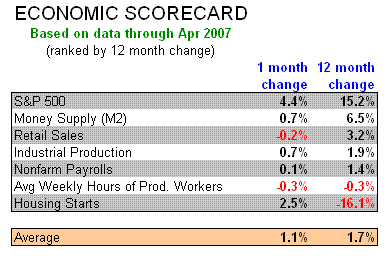
If any of this demands caution in one’s view of the future, there’s not much sign of it in the equity market, as defined by the S&P 500. To be sure, gloom and doom hardly dominate the economic reports. Notably, housing starts turned up last month, and growth still dominates overall. Perhaps that’s why the S&P continues to favor optimism this month, with the index up another 2% so far in May, through last night’s close.
For all we know, the stock market’s correct in predicting that the economy will keep bubbling. Of course, it’s possible that equity traders are dead wrong.
A WHIFF OF STABILITY, OR A PAUSE IN THE CORRECTION?
No one disputes that the housing market has been suffering a sharp correction, but the jury’s out on when the recovery will commence.
For those who lean toward the idea that it’ll arrive sooner rather than later, today’s report on April housing starts offers a statistical club to beat back the pessimists. Privately-owned housing starts rose by 2.5% last month over the March tally, based on seasonally adjusted annual rates. As our chart below shows, that puts April’s annualized total at 1.528 million units–the highest since December.

No one will confuse the rebound (if we can call it that) with a new bull market in housing. At least not yet. The wounds still smart from the fallout of the former decline, which cut starts by nearly 40% in 12 months from January 2006’s peak to the trough a year later. But by 2007’s reduced standards, this year’s looking up…so far.
IS THE REPRIEVE REAL?
There was no mention of “inflation” or “consumer prices” in Fed Chairman Ben Bernanke’s speech this morning. Of course, his prepared remarks were focused elsewhere: regulation and financial innovation, to be precise. No matter, as inflation was probably on the chairman’s mind just the same, especially after 8:30 this morning, Washington time, when the April update on consumer prices was released.
For a refreshing bit of change, the latest numbers offer reason for cautious optimism, along with some fresh hope for optimism on the future course of Bernanke’s authority on matters of price trends. The core CPI through April rose by 2.4% on a 12-month basis, down from 2.5% previously. In fact, April’s 2.4% annual pace is the lowest annual rate in nearly a year, as our chart below shows.
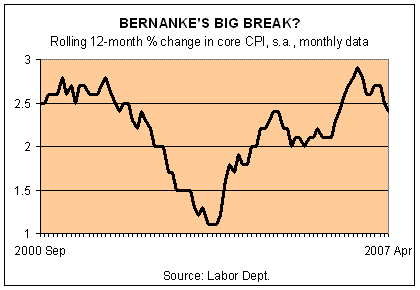
But if inflation is moderating, as Bernanke has been predicting, what will we worry about now? Slowing growth, of course. In fact, some argue that inflation’s downshift is a byproduct of the economy’s slowdown. “It is now becoming more apparent that core inflation has peaked and is moving lower in response to anemic economic activity,” Joseph LaVorgna, chief U.S. economist at Deutsche Bank Securities, told Bloomberg News before the CPI report’s release.
At the very least, the recent fall in core CPI gives the Fed some breathing room for considering the potential for lowering interest rates if the economy needs a jolt of liquidity to offset any further slowdown. For the moment, though, traders aren’t rushing to that conclusion. Fed funds futures didn’t move much after the CPI report. The November contract, for instance, is still priced in anticipation for 5.25% Fed funds.
Does that mean the market remains skeptical about moderating inflation? Or, perhaps the crowd thinks the economy’s not about to fade, despite some predictions to the contrary?
Of course, one could make the case that inflation’s still a problem by way of the headline number. If you add energy and food back into the equation, CPI advanced by 0.4% in April, mirroring the pace in March. David Resler, chief economist at Nomura Securities in New York, labels headline inflation’s pace “uncomfortably large,” in a note to clients this morning.
The jury’s never really out when it comes to inflation. But for the moment, at least, Bernanke and company have a reprieve, assuming you’re looking at the world through core-filtered glasses.
A SHORT TREATISE FOR A TWO-FACTOR WORLD
Investing is subject to the emotions of the moment, the analysis du jour and the exogenous event that unexpectedly and instantly delivers yesterday’s pearls of wisdom to the trash heap of history. What then can the strategic investor rely on for true perspective?
In search of an answer, we suggest reviewing the basic forces that propel markets, which your editor believes to be momentum and value factors.
A number of studies over the years have boiled the primary engine of market forces down to these two drivers. And to a degree, common sense suggests no less. Momentum is simply the tendency of price trends to continue, up or down–autocorrelation, as it’s called. Value, by contrast, is a condition of excess asset valuation, either or high or low, which leads to a correction in price.
Momentum and value have a long history of generating returns, albeit in sharply different ways, with sharply different types of risks and under varying time periods. Momentum of the bull market variety can stretch out for long periods and render investors complacent with the view that what’s past will roll on indefinitely.
By contrast, bear-market momentum has a nasty habit of arriving suddenly and, save for those with a contrarian mindset, without clear warning. In addition, bear-market momentum tends to be relatively short, albeit decisive. In turn, the rapidity of its emergence delivers a fair share of what we’ll label the deer-in-the-headlight syndrome, which poses a challenge for fully exploiting the trend.
Meanwhile, the value factor exists in varying degrees over time, wedged in between the fading of bull market momentum and the soon-to-be emergence of bear-market momentum. Value’s power and influence, in short, are at a peak during periods of extreme excess in the market. At that point, and for some time after, value decisively overwhelms momentum, slowly giving way to momentum’s charms anew.