The economy’s slowing. That’s old news. What’s fresh is the revelation that the pace of downshifting is quite a bit steeper than some have been expecting.
The government this morning advised that first quarter GDP grew by a meager 1.3%, based on an annualized real pace. That’s sobering for a number of reasons, starting with the fact that it’s materially below the fourth quarter’s 2.5% rate. In fact, 1.3% is below every quarterly GDP change since the first quarter of 2003. Meanwhile, the consensus forecast called for something much higher today, at roughly 2.0%, according to TheStreet.com.
Judging by recent history, when GDP’s pace falls this low, it’s not a good sign about the future. Akin to a plane with a stalled engine, there’s a risk that the momentum may stall. It’s not fate, but only a fool would ignore the danger.
Yes, today’s GDP report is the first of three estimates on the nation’s economy, offering the possibility that subsequent updates may revise the growth rate upward. But let’s not gloss over the fact that consumer spending–the single-large factor in the economy–is showing signs of age in the latest quarterly profile. Although personal consumption expenditures (PCE) rose by 3.8% in the first quarter, that’s down from 4.2% previously. That’s hardly a problem, but the question is whether Joe Sixpack is now inclined to slow his pace of spending? For the moment, erring on the side of caution seems reasonable, at least from an investing perspective.
Monthly Archives: April 2007
WHO’S WORRIED?
Every data point is studied with increasing scrutiny. We’re all looking for a sign, a clue, a crumb, anything that could impart insight about the future. At the same time, we all know that the economic cycle is no spring chicken, having been running for several years now. Yet to judge by the stock market lately, the bulls have it all figured out: more of the same will prevail.
Amid that backdrop comes the latest weekly number for initial jobless claims. On first glance, the trend looks good. The Labor Department reported this morning that the number of workers filing for jobless benefits fell by 20,000 for the seven days through April 14 from the previous week. That’s the largest decline in more than two months. In fact, the size of the fall surprised economists, who had generally been expecting something on the order of a 10,000 decrease.
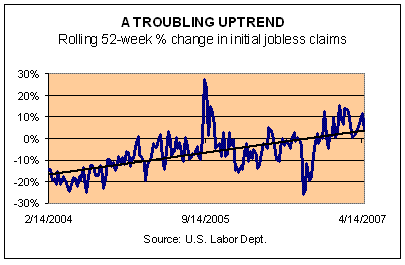
All told, a total of 321,000 people asked to be put on the unemployment rolls for the week through April 14. The total’s fairly middling, as the range of initial claims has generally bumped around within the 300,000-350,000 range for more than a year. But if you’re inclined to worry, you’ll take note of the larger trend, namely: the year-over-year percentage change in jobless claims has been trending higher for some time now.
As our chart below illustrates, the rolling 52-week change in new filings of jobless is pushing higher. By itself, the figure is just one of countless economic measures that go into the mix of deciphering the big picture. But for those who ask if the economy looks any better than a year ago, here’s one metric that fosters doubt about what’s coming.
KEEPING HOPE ALIVE
This morning’s update on durable goods orders is just what the optimists need. As a leading indicator of future economic activity, a positive reading in this space provides one more reason to think that a recession is that much further off.
Or so one could reason after digesting the numbers. New orders for manufactured durable goods rose 3.4% last month, the U.S. Census Bureau announced. That’s up from a 2.4% jump in February. In fact, advance durable goods orders rose in four of the past five months, as the chart below shows.
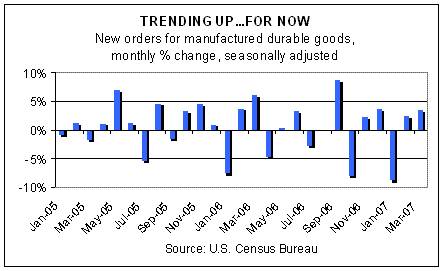
Encouraging as the recent record is, there’s still reason to reserve judgment about what it all means for the economy down the road. Although durable goods orders have been pushing higher lately, the gains tend to pale compared to the losses, which have been less frequent but much bigger in relative terms.
BLAME IT ON THE WEATHER
The initial estimate of GDP for the first quarter is schedule to arrive on Friday. The consensus forecast calls for a 2.0% annualized rise, according to TheStreet.com. That would mark a slowdown from 2.5% in last year’s fourth quarter.
Still, 2.0% wouldn’t be the end of the world. But after reading this morning’s 8.4% slump in existing home sales for March, might there be a rationale for thinking that the economy’s growth will be slower than the crowd thinks?
TOO EARLY TO TELL
The current economic expansion is now well over five years of age. To judge by the comments of Fed Governor Frederic Mishkin on Friday, one could reasonably assume that celebrating a sixth anniversary is a distinct possibility.
Yes, the expansion during the last year “appears to have been undergoing a transition to a more moderate and sustainable pace,” he advised at a conference at The Levy Economics Institute of Bard College in Annandale-on-Hudson, New York. But the jig is not yet up, he suggested. “Looking ahead,” Mishkin said, “the most likely outcome for the coming quarters is, in my judgment, a continued moderate rate of economic expansion….”
How then does one square Mishkin’s modestly upbeat forecast with the fact that the yield curve remains inverted by more than a trivial amount? As of Friday’s close, the benchmark 10-year Treasury yield was 4.67%, or nearly 60 basis points below the Fed funds rate of 5.25%.
THE MOMENTUM GAME
Perhaps the world’s stock markets will merely slow down rather than suffer a glaring correction. That may be overly optimistic, but looking at the total returns for regions across the globe raises the prospect that a soft landing for equities is a possibility. One reason to think that a kinder, gentler correction may be in the offing is that liquidity is still high and there’s an abundance of committed investing shops looking for bargains.
The combined assets in mutual funds, ETFs and hedge funds have never been greater. Such capital may be flighty when it comes to any particular corner of the securities markets or countries. But portfolios jammed with cash looking for a home aren’t going anywhere, at least not any time soon. The explosion in professional investment management in all its various guises means that there’s always of hungry investors. That may prove ill-advised in time, but the trend has been decades in the making and it won’t evaporate over the next week, month or even year.
WET & TIRED
The Capital Spectator will be on holiday this week. A forced holiday, that is. In fact, the time off will be nothing close to a holiday. The storm that hit the Northeast on Sunday left your editor with about six inches of water in the basement. The cleanup, as any victim of flooding knows, is time consuming, among other things. In short, Mother Nature trumps Mr. Market this week for yours truly. Hopefully, next week we’ll return to what passes for normal on these digital pages. Meanwhile, stay dry.
FRESH NUMBERS & OLD QUESTIONS
Like so many economic reports these days, this morning’s update on producer prices for March is open to interpretation.
Depending on one’s capacity for optimism, or the lack thereof, the latest gauge of inflation represents either a reprieve from anxiety, or another reason to worry.
The good news is that wholesale prices rose 1% last month. Although that’s uncomfortably high, it’s down a bit from February’s 1.3% pace. Meanwhile, core PPI (excluding energy and food) was unchanged in March and below the 0.2% rise that the consensus outlook was projecting.
The bad news is that the PPI has climbed by 3.1% for the year through March. That’s far below the 12-month rolling peak in recent years, but it’s still too high to allow the Federal Reserve to focus exclusively on promoting economic growth in its monetary policy. “This certainly doesn’t let the Fed off the hook by any means,” Gina Martin, an economist at Wachovia Corp., told Bloomberg News. Inflation doesn’t seem to be rising, but neither is it falling, she explained. That’s a concern because inflation is “stubbornly staying high.”
MEANDERING MINUTES
The Federal Reserve yesterday released the minutes of its March 20-21 FOMC meeting and confirmed the worst-kept secret in finance and economics: inflation’s still a problem. Or a concern. Or something.
Anyone who’s taken the time to look at the numbers dutifully released by the government each month already knows that there’s reason to wonder if the price of money might rise again to fight any resurgence of the dark enemies of price stability. Notably, the core CPI (which excludes food and energy) shows no sign of moderating.
For good or ill, the Fed pays close attention to core CPI, and so the future path of interest rates may very well be determined by this inflation gauge. With that in mind, over the 12 months through February, core CPI rose by 2.7%. Not only is that near the highest level in years, it’s also well above the Fed’s comfort zone. “On a twelve-month-change basis,” the Fed minutes advised, “core CPI inflation in February was considerably above its pace a year earlier, largely because of a sharp acceleration in shelter rents over the past year.”
Q1 QUESTIONS
The S&P 500 may be rocked with corrections from time to time, but they never endure, or so recent history shows. The S&P closed yesterday at less than 1% under its post-2000 high. So far this year, the S&P 500 is up 2.6%. For the past 12 months, the index has climbed 13.9%. If price is taken at face value, optimism continues to dominate the world of equities trading.
How does one square that with the news that earnings growth is decelerating? As The New York Times reported over the weekend, S&P 500 earnings are no longer rising at a double-digit rate, as they were previously in recent years. Earnings for the index “are expected to grow by only 3.3 percent in the first quarter of 2007, according to Thomson Financial,” the Times advised. “This represents a huge drop in expectations, as Wall Street analysts at the start of this year were expecting a first-quarter growth rate of 8.7 percent.”
Perhaps it’ll be a sign of some relevance if the index makes a new high for the post-2000 era, although there’s reason to wonder if that’s imminent. “I think we’re all anticipating the earnings season,” Tim Hartzell, chief investment officer at Kanaly Trust Co., told AP. “I think everyone is going to wait on their heels and see how the numbers are going to come through.”
Of course, if the numbers don’t astonish like they used to, Mr. Market may be inclined to grade on a curve. “Investors have kind of lowered the bar” for first-quarter earnings, “making it easier for stocks to outperform,” Christopher Johnson, chief investment strategist at Johnson Research Group, told Bloomberg News. “The numbers that we see coming in aren’t much worse than what we saw last quarter. We could see some bright spots.”